


Newsletter Subscribe
Enter your email address below and subscribe to our newsletter


Why We Live Longer. A century ago, more Canadian families lost children before their fifth birthday. Statistics Canada estimates that falling infant and child mortality accounted for more than half of the rise in life expectancy at birth between 1921 and 1951. Early advances included childhood immunization and treatments such as penicillin. In the decades that followed, fewer deaths from heart disease and other circulatory conditions made the largest contribution to further gains. Life expectancy describes how long people survive under a given set of conditions. Biological ageing describes the changes that take place in our bodies over time. That distinction matters when we ask whether medicine can slow ageing itself. Continued below
THIS WEEK’s PODCAST – JOIN US
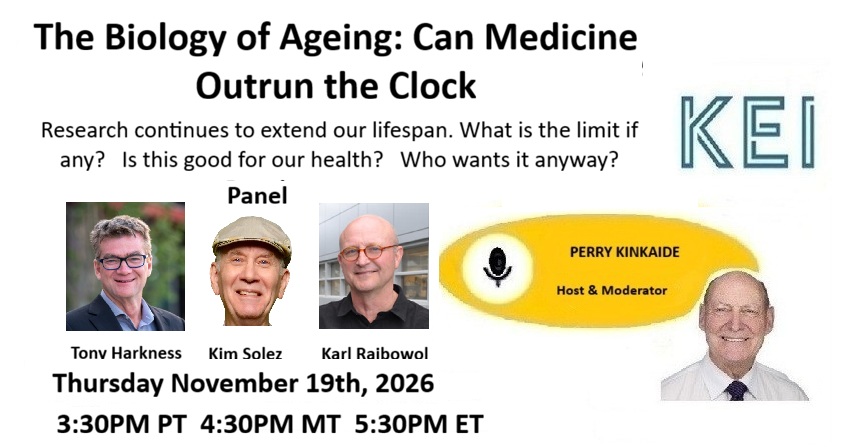
No need to register. Just Zoom in https://us02web.zoom.us/j/84258596166?pw
Continued from above
LAST WEEK’S PODCAST RECORDING: The Ageing Reckoning: When the Numbers No Longer Add Up
What Happens When We Age. The body repairs itself throughout life. Over time, damage can accumulate in DNA, some proteins lose their shape, and cells can become less efficient at producing energy. Some damaged or stressed cells stop dividing and release signals that can promote inflammation. This is one form of cellular senescence. These changes interact, and tissues can become slower to recover from injury or illness.
The changes can unfold at different rates within one person. Someone may stay mentally sharp as their mobility declines. Another person may remain physically active while having more trouble remembering or finding their way. An account of ageing has to leave room for how different parts of the body change and how those changes affect daily life.
What a Biological Clock Can Tell Us. Researchers build biological-age clocks using patterns in blood, proteins or chemical marks on DNA. A 2026 Nature Medicine review by Tony Wyss-Coray and Eric Topol examined how these measures might help assess risk and test interventions. A clock score can be a useful research signal. What would make it meaningful to a patient is evidence that a change in the score corresponds to an outcome such as fewer illnesses, better mobility or more time living independently.
What Would Count as Repair. Researchers are testing ways to clear some senescent cells, alter how cells respond to nutrients, repair tissues and reset some of the signals that govern gene activity. In animal studies, some of these approaches have improved selected measures of function or shifted markers associated with ageing. Moving into human care requires evidence that the benefits last and that the intervention is safe. An August 2026 Nature Medicine editorial called for stronger clinical evidence for treatments aimed at ageing itself.
The most ambitious idea is longevity escape velocity. In theory, medical advances would add more than a year of remaining healthy life expectancy for every year a person lives. John Andrew Fredrickson’s Outrunning Ageing model put the midpoint of its October 2026 simulations at 2058. Its rule treats an area of ageing research as handled once a second relevant treatment reaches the clinic. The date depends on that rule. Establishing lasting benefits across several processes of human ageing would require a different kind of evidence.
Is Healthcare Ready for the Years We Gain. A longer life can bring more time living independently. It can also bring more years in which help is needed with meals, mobility, medications or daily decisions. Where that help is available matters to families as much as the number of years gained. Canadian Institute for Health Information survey reporting highlights the importance of access to primary care, mental healthcare and home care for older adults who want to remain at home. How well we connect those services will help determine what longer lives mean for patients and caregivers.
There is useful work to do today. The 2024 Lancet Commission estimated that addressing 14 potentially modifiable risk factors might prevent or delay about 45% of dementia cases across a population. Hearing loss, high blood pressure and social isolation are among the factors it examined. The World Health Organization also emphasizes physical activity suited to a person’s abilities, including strength and balance. These findings raise a practical question. Who helps someone get hearing care, find a safe way to stay active or reconnect with others when doing those things alone has become difficult?
One More Good Day. I have asked audiences whether they would choose to live forever if they could remain young. Few have said yes. Many have suggested that about a hundred years would be enough. When I ask whether they would like just one more day, the response changes. These are informal conversations, but I keep coming back to the difference. An extra morning, a conversation or a visit with family is easy to picture. Eternity is another matter. In a 2025 U.S. survey by Pew Research Center, the average preferred lifespan was 91 years.
My early research in neurophysiology, memory and attention taught me to pay attention to what the brain knows, remembers and directs. Caring for my wife, Sasha, gave those distinctions an intimate meaning. As her mobility declined, much of our day came down to whether she could stand, move from bed to wheelchair and sit comfortably. As I wrote in Sasha and the Caregiver’s Journey, I was willing to help. I still needed someone to show me how to do it safely.
Healthcare has specialties for good reasons. A person at home experiences their body, mind and relationships together. Pain can make someone reluctant to move. Fear of falling can make them reluctant to leave home. A person who wants to stay active may need a safe place to walk or someone to walk with. Supporting self-care means asking what people can manage, what they want to keep doing and what help would make that possible. Sometimes the most useful help is a practical lesson for a caregiver.
In The Lost Commons: Human Relevance Under Siege, I argued for preserving human judgment and agency amid technological change. Longevity research raises similar questions about who will have access to new treatments and whose priorities will shape their use. A person’s worth is independent of how well their body functions. Even when independence can no longer be restored, care can preserve comfort, connection and dignity. That, too, can make another day worth having.
Have thoughts on this article? You can share them by emailing me at editor@KEInetwork.net
Next in the series · The Crisis of Care — Are We Managing a System or Caring for People?