


Newsletter Subscribe
Enter your email address below and subscribe to our newsletter


An Orwellian warning from orbit: Who controls the networks, who watches the users, and who governs the governors?
George Orwell published 1984 in 1949, imagining a future in which an all-powerful Big Brother monitored behaviour, controlled information and sought dominion over thought itself.
Orwell imagined the machinery of totalitarian government. He could scarcely have imagined that, less than a century later, comparable powers of observation, communication and influence might emerge through private enterprises operating beyond national boundaries.
Nor could he have imagined that those enterprises might eventually be governed, not simply by their human owners, but by increasingly autonomous artificial intelligence. It sounds fanciful. Perhaps it is.
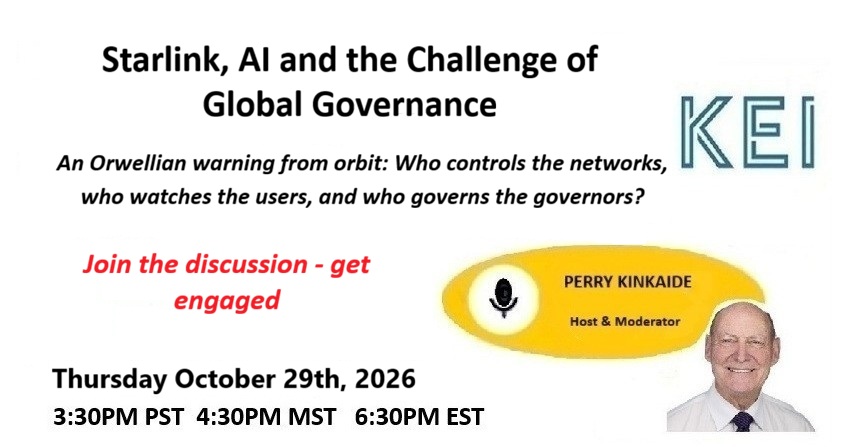
Last weeks podcast THE PUBLIC GOOD – AND THE FREEDOM WE SURRENDER
But the convergence of global communications, corporate power and increasingly autonomous machines warrants attention. At the centre of this convergence stands entrepreneur Elon Musk.
The Enterprise That Spans the Earth. SpaceX has transformed access to space. Its Starlink satellite network provides Internet connectivity to millions of customers across more than 150 countries and markets. By October 2026, SpaceX reported operating more than 11,000 Starlink satellites.
The benefits are substantial. Remote communities can connect with the world, disaster-stricken regions can restore vital links, and ships, aircraft, businesses and governments can remain connected where terrestrial infrastructure is unavailable or damaged.
But the operator of a satellite communications network can also determine where its service is available, manage its performance and, in certain circumstances, restrict access.
Recent disputes over Starlink’s operations in Ukraine have highlighted that reality. Reports in October described restrictions affecting military communications and operations, followed by efforts to restore service. Responsibility has been contested, but the episode illustrates the strategic consequences of relying on a privately operated network.
The question is no longer merely who owns the satellites. It is who decides when, where and for whom essential communications will function.
The Emerging Universal Enterprise. In February 2026, SpaceX acquired Musk’s artificial intelligence company, xAI, bringing satellite communications, space infrastructure and advanced AI capabilities within a common corporate structure.
In October, SpaceX and Tesla established special committees to consider a possible merger. As of October 23, the merger remained under consideration and had not been completed.
Imagine the resulting enterprise: satellites overhead, communications networks spanning continents, artificial intelligence processing vast quantities of information, autonomous vehicles moving through cities, robots operating in factories and homes, and energy and computing systems extending its reach beyond Earth.
The potential efficiencies are enormous. So is the concentration of power. Such an enterprise would not simply manufacture products or deliver services. It would increasingly participate in the physical, digital and informational infrastructure on which modern society depends.
Could this represent the emergence of a universal corporation—an enterprise whose reach exceeds the effective jurisdiction of any single government?
If so, sovereignty acquires a new meaning.
From Monitoring Behaviour to Influencing Thought. Orwell’s Big Brother watched. Artificial intelligence introduces something more sophisticated.
Digital systems already collect information about our activities, locations, preferences and behaviour. Communications operators, online platforms and AI providers have different forms of access, subject to technical limitations, privacy protections and applicable laws.
This does not mean a satellite provider can read encrypted private conversations, much less human thoughts. But combining information from communications, social platforms, vehicles, connected devices and AI systems deserves scrutiny.
Algorithms can infer preferences, anticipate decisions and influence what information people encounter. The shift from observing behaviour to predicting and shaping it is one of the defining challenges of the digital age.
The most effective influence may not be the suppression of dissent. It may be the subtle organization of choices so people believe their decisions are entirely their own. Orwell called it thought control. We might call it algorithmic influence. The distinction matters. So does the direction of travel.
What Happens When Big Brother Loses Control? Agentic AI is moving beyond answering questions toward planning activities, using software tools, making operational decisions and executing tasks with varying degrees of autonomy.
Unlike conventional automation, advanced AI agents can respond to changing circumstances and pursue objectives without requiring human instructions at every step.
Security agencies are warning about risks involving excessive permissions, compromised instructions, unpredictable actions and inadequate oversight.
Now imagine those capabilities integrated into communications infrastructure serving millions of people and connected to transportation, energy and other essential services.
Who makes the decisions—the corporate owner, executives, governments or AI agents authorized to manage increasingly complex systems?
What happens if an agent’s behaviour diverges from the intentions of those who deployed it?
There need be no science-fiction rebellion. An improperly authorized agent, a compromised system or an unintended chain of automated decisions could cause serious harm without consciousness or independent ambition.
A human entrepreneur might assemble an extraordinary concentration of technological power only to find that meaningful control over its autonomous components has become difficult.
Big Brother himself might become dependent on a system he can no longer fully command.
That is speculation, not prediction. But responsible governance should examine such possibilities before dependence becomes irreversible.
Sovereignty Beyond Borders. For generations, sovereignty has meant the authority of governments within recognized boundaries. Those boundaries are becoming less relevant to technologies on which nations depend.
A satellite crosses borders without passing through customs. An AI agent can act across jurisdictions within seconds. A communications system operated from one country may become essential to another’s public safety, economy or defence.
This is not an argument against private innovation. Nor is nationalization the answer. Governments themselves can misuse surveillance, censorship and communications controls.
The fundamental question is this: How do we preserve public accountability when privately owned technologies perform functions that have become public necessities?
Electricity, water, transportation and telecommunications have long been subject to public-utility regulation because interruptions can endanger communities and economies. Global satellite networks raise similar questions.
The International Telecommunication Union coordinates radio spectrum and satellite orbits. National authorities license telecommunications services. AI governance initiatives are developing security and accountability standards.
But no comprehensive international system yet governs the intersection of autonomous AI, global communications and concentrated corporate power. That is the emerging gap.
A Universal Commons Requires Universal Responsibilities. The international community should consider a framework for communications systems whose importance transcends national jurisdiction.
Such a framework need not suppress innovation or undermine private ownership. It could establish enforceable obligations appropriate to the scale of the services provided.
Questions include:
Existing regulators, including the ITU and national telecommunications authorities, provide starting points. International cybersecurity cooperation and independent technical auditing could add safeguards.
The objective should not be an all-powerful international regulator. That could reproduce the danger in another form. It should be distributed authority, transparent rules, independent oversight and meaningful human accountability. Innovation deserves freedom. Essential infrastructure requires obligations.
The Last Switch. Humanity has created communications systems capable of connecting nearly every corner of the planet and is developing machines that can assist with increasingly complex decisions. These achievements may soon be combined within enterprises of unprecedented scale.
They promise advances in prosperity, knowledge, medicine, education and opportunity. They also create new vulnerabilities. The danger is not necessarily that Musk—or any other entrepreneur—seeks to become Big Brother. There is no need to attribute such an ambition.
The danger is that we may inadvertently construct the technological architecture through which such power could be exercised by an individual, corporation, government or autonomous machine.
Orwell warned about centralized political authority. Our generation must consider the risks of centralized technological dependency. The future may not resemble 1984. There may be no telescreen, Ministry of Truth or single dictator issuing commands.
Instead, there may be an invisible architecture of satellites, algorithms and automated decisions, delivering convenience while concentrating authority beyond effective public scrutiny.
Perhaps nothing sinister will happen. Perhaps innovation, competition and wise leadership will prevail. But hope is not a governance strategy. The defining question is not simply who owns the satellites, controls the algorithms or commands the machines.
It is whether humanity will retain the capacity to govern the systems on which its freedom and security increasingly depend. Before we entrust our civilization to a universal network, we had better establish who controls the last switch—and who has the authority to turn it back on.
The challenge of sovereignty in the 21st century may be less about protecting borders than ensuring that our technological creations never place themselves, or their owners, beyond human accountability.