

Newsletter Subscribe
Enter your email address below and subscribe to our newsletter


I am no historian. I have no credentials for that shelf. What I have is eighty-four years of watching and wondering why — and lately, watching the chaos roiling the United States and the West generally, I have found myself asking whether the simplest explanation might be the truest one.
What if the people are just plain weary? Weary of the incessant 24-7 blaring of ideology, politics, and economics. Weary of being shouted at by systems that never sleep and never listen. What if they feel forgotten — and what if they are right?
Voice from the Commons: I have lived long enough to watch the blaring get louder and the listening get rarer. That is not nostalgia. That is arithmetic. Continued below

Last week’s podcast YouTube recording of Starlinks, Ai and the Challenge of Global Governance HERE
Continued from above The historians have formal versions of this hunch. Joseph Tainter, in The Collapse of Complex Societies, argued that societies do not fall to conquerors so much as to arithmetic: complexity keeps costing more while returning less, until people quietly stop investing. My “weariness” is what declining marginal returns feel like from the kitchen table.
Six centuries earlier, Ibn Khaldun gave it a name: asabiyyah, the social cohesion that founds dynasties and erodes with every comfortable generation, until no one will lift a spear for the thing anymore.
And Rome gives us the photograph. In the fifth century, Roman peasants were fleeing imperial taxation to live under the so-called barbarians. Salvian of Marseille wrote that they sought among the barbarians the humanity they could not find among Romans. That was not ideology. That was exhaustion with the machine.
The Deeper Pattern: every falling empire is first abandoned — not stormed, but quietly left — by the people it was supposed to serve.
Now the honest objection, because it deserves one: Hesiod was complaining that the young don’t work like they used to and the world is going to hell around 700 BC. Every age feels weary. So weariness may be a constant of civilization rather than a countdown clock. What varies is whether the system still delivers enough that people tolerate the blaring.
And here is what is genuinely new in our time: the blaring itself. No previous civilization wired every citizen into a machine that never sleeps — an outrage-and-anxiety engine running around the clock, calibrated to the individual nerve. The mood is ancient. The medium is unprecedented.
Which brings us to the fork in front of us, and to the question this October series has been circling all month.
Artificial intelligence — or more precisely, the AI agent — is the first technology that can take over knowing itself. Not muscle, not arithmetic, but research, synthesis, analysis, drafting: the cognitive labour the Age of Reason crowned as humanity’s highest faculty. And it cuts both ways.
Deployed as the ultimate persuasion engine, the agent perfects the blaring. Exhaustion, optimized. The practical test is simple: what does it help us do? A tool that helps someone understand a public issue expands their capacity to act; a feed that consumes the afternoon leaves them with less of it. The weariness deepens, because the machine now knows exactly which nerve to touch and never gets tired of touching it.
But there is another path, and it is the one this newsletter has argued for all October. Deployed as a genuine agent — working for the person, not the platform — it absorbs the knowing and hands back the one thing the machine cannot do: the relating. Presence. Trust. Care. Moral judgment. The kitchen-table things. Three centuries ago the Enlightenment wagered that reason would set us free; instead we industrialized reason into bureaucracy, metrics, and the blaring machine — the very exhaustion described above. The failure was not the ambition — public education, health care, and pensions were substantial achievements. It was that serving millions taught institutions to treat people as categories, and somewhere between the policy and the person, individual needs could disappear. If the agent takes over the knowing, what remains is the human. Institutions would finally be judged on their humanity, because their information-processing would be mere infrastructure.
And there is a generation now running this experiment to its conclusion. The generations that built the complexity — the institutions, the metrics, the machines, the blaring itself — are reaching the age where aging takes its toll. And something instructive is happening: the life-extending technologies, the comforting technologies, the clever devices fade in relevance. They do not stop working. They stop mattering. What re-emerges, stark and simple, is human relevance — a hand held, a room sat in together, an afternoon that asks nothing of anyone.
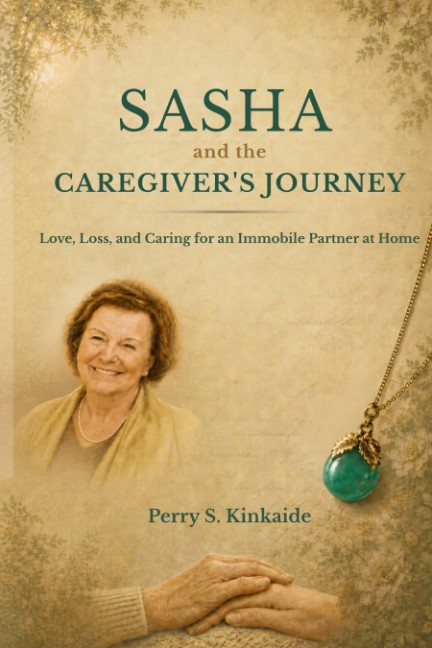
I wrote about this in Sasha and the Caregiver’s Journey. Its thesis is not complicated: two people, knowing their journey is ending, find joy in being together as never before. Not in being informed, or optimized, or extended — in being together. If that sounds like a small claim, try living it. It turns out to be the largest one: the proof, from the far end of a life, that the relating was the point all along, and the knowing was ever only the scaffolding.
Call it the extension of the Age of Reason into a truly humanistic age: knowing relegated to the agent, relationships promoted to the point. The sovereignty this series has examined — Alberta’s at the ballot box, humanity’s over its machines — was never really about declarations. It was about who the systems serve. Moving power from one capital to another does not automatically bring it closer to the citizen. We began October asking who decides Alberta’s future. We end it asking what the future is for.
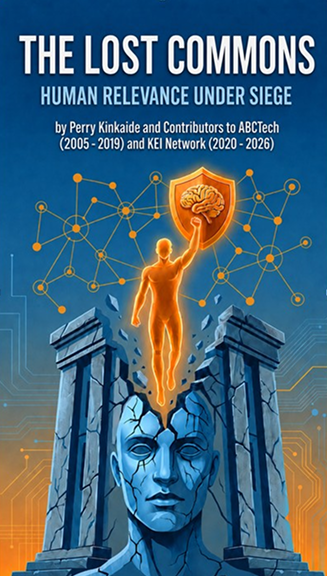
The Lost Commons: Human Relevance Under Siege asks what we have surrendered to the large systems we built to serve us. This month’s answer, from the inside: our attention, our patience, and our belief that anyone is listening. The good news is that weariness, unlike conquest, is reversible — the moment the systems start serving again. And the commons asks something in return: it cannot function as millions of private worlds, each demanding accommodation and offering none.
The question that will decide it: who sets the agent’s errand — the blaring machine, or the weary person? Prepare first. Then choose.