


Newsletter Subscribe
Enter your email address below and subscribe to our newsletter


Also consider Michael Campbell's interview HERE of Dr. Judith Currie (minutes 6 through 27) acknowledging climate change but uncertain of the risks: that the warming is an urgent existential crisis, t

Last week’s webinar “The Energy Transition Is Global – Reflecting A Newfound Respect for the Environment” can be viewed HERE https://youtu.be/RcpTC7GL42M featuring an interview of Leigh Bond and discussion with his team. Also consider Michael Campbell’s interview HERE of Dr. Judith Currie (minutes 6 through 27) acknowledging climate change but uncertain of the risks: that the warming is an urgent existential crisis, that weather events reflect climate change, and challenges the anti-capitalist activism mandating of extraordinary measures such as Canada’s Carbon Tax.
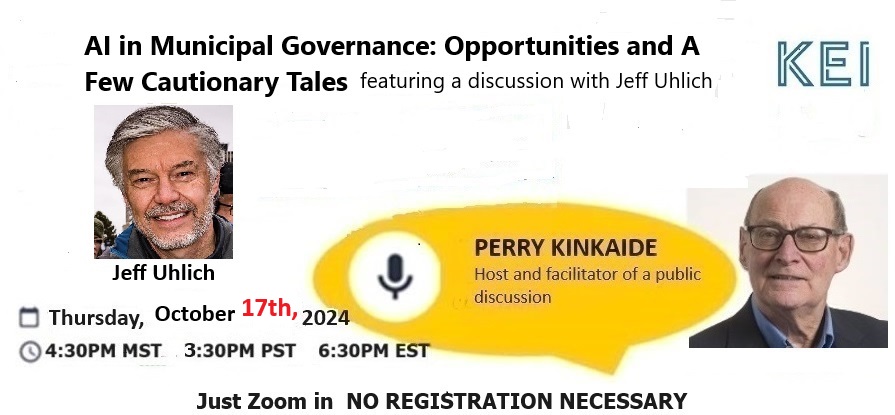
AI in Municipal Governance: Opportunities and a Few Cautionary Tales
Municipalities are increasingly using AI for various purposes, including citizen services, urban planning, public safety, administrative tasks, data analysis, public benefits, infrastructure management, and healthcare..The future of AI in municipal governance is promising but requires balancing opportunities with risks and ensuring responsible and ethical use of the technology.
 Jeff Uhlich BA, MSc HRM, is a retired human resources executive and consultant in Edmonton, who writes on the intersection of talent management, technology and governance.
A few weeks ago, Perry shared an article with some of his contacts about Nevada’s implementation of AI to help manage the State’s unemployment claims. The COVID-19 pandemic had left the state struggling with a backlog of 40,000 claims, and they turned to AI for a solution. As reported in the article, the State’s Department of Employment, Training, and Rehabilitation (DETR) is planning to use an AI system developed in collaboration with Google to process unemployment benefit appeals. This system will analyze hearing transcripts and evidence to make recommendations, with human “referees” reviewing the AI’s decisions before they are finalized.
‘In as little as five minutes, the AI will issue a ruling that would have taken a state employee about three hours to reach…’.
But the system has been controversial, with legal and labour experts raising concerns about potential errors and the risk of bias. There are also worries about the pressure on human reviewers to approve AI recommendations quickly and whether courts will be able to review or overturn AI-influenced decisions because current Generative AI models can be opaque about how they produce their response. This lack of observability and transparency is problematic and there’s been a lot of pushback from citizens who are expressing concern about abdicating human responsibility to an AI. The 173 comments posted on the article Perry shared convey this concern in very frank terms.
The Nevada example piqued my curiosity and got me exploring the bigger questions about how and where municipalities are implementing AI solutions to improve their efficiency and effectiveness. What I learned is that there’s a quiet revolution happening in municipal governance. From urban planning to public safety, municipalities are harnessing the power of AI, machine learning, natural language processing, and big data to transform the way they operate. These pioneering municipalities offer lessons to us all.
When you’ve looked at enough examples of how municipalities around the world are implementing these tools you’ll see that they fall into several categories and that there are varying levels of success in how the use of these tools is being received. There are eight big buckets:
Under the broad label of ‘AI’ there are many subcategories — it’s not a monolith. What people generally describe as AI today refers to Generative AI because of the hype around ChatGPT. But from the examples above it’s obvious that Generative AI is just the tip of an iceberg that’s been building for decades. In the area of municipal governance, machine learning, natural language processing, and big data, are as, if not more, important than Chatbots.
For municipalities implementing these tools, success seems to aggregate in the following areas:
Conversely, there are areas of use by municipalities that are facing real resistance and scrutiny:
What differentiates these use cases? What have these pioneering municipalities taught us about how and where to employee these tools? The key factors appear to be:
The benefits of using these tools are evident. Municipalities managing these factors can increase their efficiency, improve decision-making, enhance citizen engagement, proactively manage public safety, and save money through process automation and optimization.
But the risks must be understood and managed. Bias, transparency, privacy and security, job displacement, public trust and acceptance, and error correction are issues that pioneers have struggled to solve.
As more municipalities adopt AI, it’s important to address these risks proactively and ensure that the benefits of AI are realized in an ethical and responsible manner. Organizations considering future AI adoption can start by examining their people, processes, and technologies.
Municipalities need to assess the form, quality, and sources of their mission-critical data, determine what percentage is digital versus paper-based, and develop a plan to make this data machine-readable and accessible to AI systems. Then, consider this information in light of the people, process, and technology priorities I’ve described. Luckily, the new crop of Generative AI tools is now multi-modal which means they can much better process images, so ingesting text from a scanned document or even a photograph is possible and improving rapidly.
The age of AI in municipal governance is upon us and the examples set by these pioneering municipalities will pave the way for others. While larger, more technologically sophisticated municipalities are leading the charge, there are valuable lessons for smaller entities and even small businesses. We all need to stay informed and find that balance between embracing the opportunities and mitigating the risks. We can start small, invest in areas with a higher probability of success and avoid unnecessary risks. If we do that, we can shift the future of governance and service delivery in a way that harnesses the power of AI for the benefit of our communities and ensures that this technology is used effectively, responsibly and ethically.
https://us02web.zoom.us/j/84258596166?pw..
https://us02web.zoom.us/j/84258596166?pw..
Editor@KEInetwork.net
Visit KEInetwork.net