

Newsletter Subscribe
Enter your email address below and subscribe to our newsletter


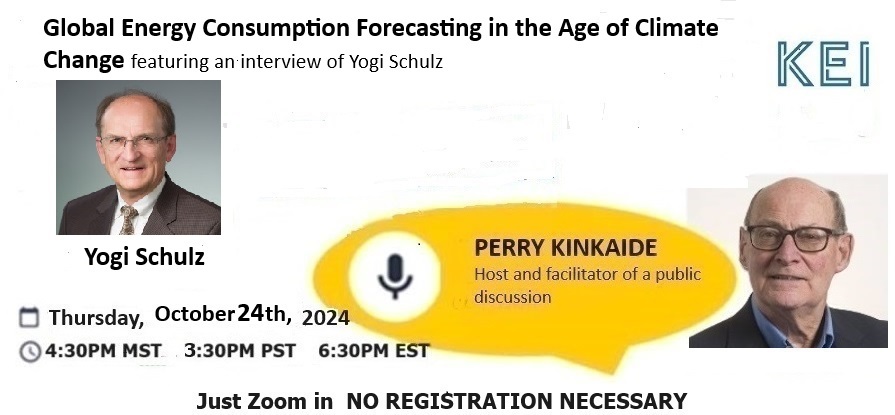
Global Energy Consumption Forecasting in the Age of Climate Change - contributed by Yogi Schulz of CORVELLE Consulting Energy consumption forecasting has become more complex due to economic and popula

Last week’s webinar “Artificial Intelligence in Municipal Governance: Opportunities and Challenges” can now be viewed HERE https://youtu.be/OYnUVz9Lsx featuring Jeff Uhlich’s presentation and a follow-on general discussion. For copies of the slides contact Editor@KEInetwork.net The importance of developing a Generative AI policy is discussed HERE.
Global Energy Consumption Forecasting in the Age of Climate Change
– contributed by Yogi Schulz of CORVELLE Consulting
Energy consumption forecasting has become more complex due to economic and population growth uncertainties. While the pace of the energy transition will not determine global energy consumption, it will determine the mix of various energy sources throughout the forecast period. Forecasting how the mix of various energy sources will evolve adds more complexity to forecasting.
 Yogi Schulz has over 40 years of experience in information technology in various industries. He writes for Engineering.com, EnergyNow.ca and other trade publications. Yogi works extensively in the petroleum industry to select and implement financial, production revenue accounting, land & contracts, and geotechnical systems. He manages projects that arise from changes in business requirements, the need to leverage technology opportunities, and mergers. His specialties include IT strategy, web strategy, and systems project management.
Many organizations and individuals have created forecasts that vary widely and are contradictory. These forecasts are heavily influenced by my:
In this presentation, I’ve been as factual as possible in discussing:
Most of the data and discussion is focused on the goal of the Conference of the Parties (COP), which is to hold the global average temperature increase below 1.5° C by 2050. COP is the UN organization chartered with the mandate to address climate change.
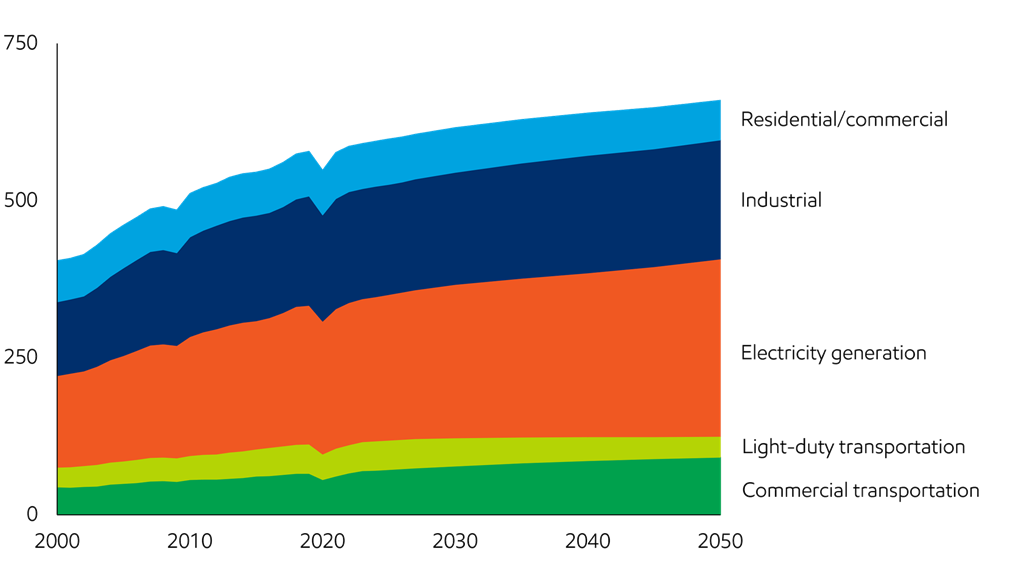
Source: Energy demand: Three drivers, ExxonMobil UK, 2019
The significant factors that will affect the energy consumption forecast are the growth rates for the following:
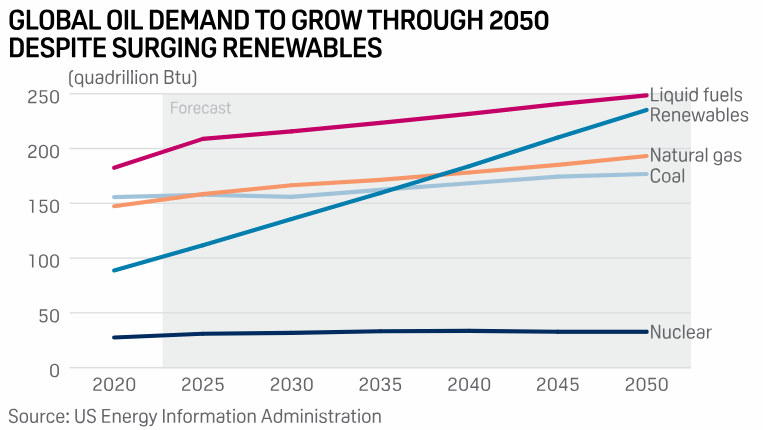
Source: Global energy demand to grow 47% by 2050, with oil still top, US EIA
I believe this forecast is quite realistic. However, it implies that the energy transition to low or no-GHG energy sources will continue well beyond 2050. You will notice that none of the fossil fuels have reached the peak of their consumption by 2050 and started on a downward trend.
Environmentalists who loudly push for a rapid energy transition to address climate change are unhappy with this chart. For example:
I’m surprised hydroelectric produces so little energy that it’s not even on the chart. I see an opportunity for hydroelectric to contribute more. Geothermal produces even less energy than hydroelectric. Again, I see an opportunity for geothermal to contribute more.
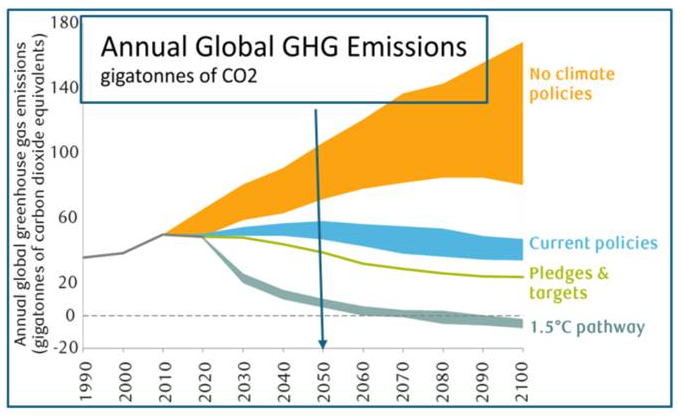
Source: Net zero: What will life be like in 2050?, RBC Wealth Management
The goal of the Conference of the Parties (COP) is to hold the global average temperature increase below 1.5° C by 2050. None of the scenarios shown on the chart achieve the COP goal. Some published charts reflect achieving the COP goal. However, these are aspirational at best for the reasons discussed below.
No climate policies. If the world makes no effort to address climate change, the global average temperature will increase by 4.1–4.8° C by 2100. The temperature increase will be the same if no climate change policies are implemented. This scenario creates a forecast with a wide uncertainty range because the mix of energy fuels individual countries will employ to meet their energy consumption forecasts is challenging to predict.
Current policies. If current policies are implemented, the global average temperature will increase by 2.7–3.1° C by 2100. The forecast shows a range because some current policies are ambiguous. Also, some countries have not developed any policies.
Pledges & targets. The global average temperature will increase by 2.4° C by 2100 based on countries delivering on pledges to reduce further emissions. The pledges are contained in the press releases issued at the annual COP meetings
1.5° C pathway. GHG emissions must decrease to zero to hold the global average temperature increase below 1.5° C. Notice how this line goes below the zero line.
To reach the target of an increase in global average temperature that does not exceed 1.5 degrees Celsius, nations must go beyond Net zero and remove an additional 5 – 8 gigatons of CO2 from the atmosphere. If we accept the Energy Consumption Forecast by Fuel Type chart above as reasonably accurate, then holding the global average temperature increase below 1.5° C will not occur by 2050 and may not happen by 2100. Attempting to hold the global average temperature increase below 1.5° C with sufficiently drastic measures will cause significant public debt, consumer price increases and inflation. Some commentators suggest such an approach will lead to economic and social collapse.
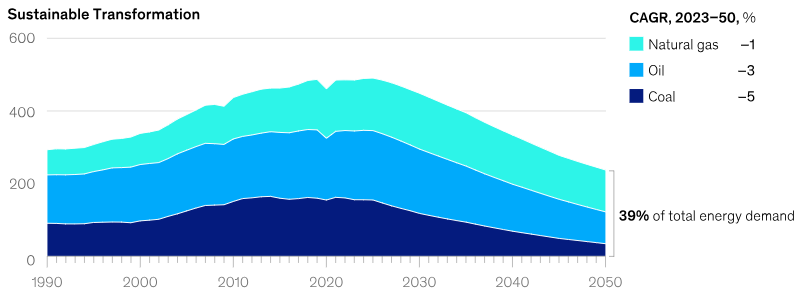
Source: Global Energy Perspective 2024, McKinsey
Some environmentalists promote a rapid energy transition to address climate change before it causes more ecological and property damage. Others suggest a more cautious approach given the following constraints:
The uncertainties around the forecast for the pace of the energy transition include the following factors:
|
Rank |
Country Name |
Millions of tons of CO2 |
Percentage of World CO2 Emissions |
|
1 |
China |
12,667 |
33.0% |
|
2 |
United States |
5,057 |
12.6% |
|
3 |
India |
2,830 |
7.0% |
|
4 |
Russia |
2,032 |
5.0% |
|
5 |
Japan |
1,083 |
2.8% |
The impact of the remaining countries is negligible individually. However, other countries should not use that fact as an excuse to avoid lowering our GHG emissions where reasonably feasible. The pace at which countries are willing or able to reduce their GHG emissions varies widely. The slow current pace suggests that the energy transition will take decades beyond 2050.
The impact of these inaccurate arguments is to create skepticism about climate change. The public expression of this skepticism delays political action and will extend the energy transition.
If governments, businesses, and households can adopt these measures more quickly, it will reduce the elapsed time needed for the energy transition beyond 2050.
Many countries struggle to formulate a political consensus on actioning the required additions to the energy infrastructure. Minimizing delays will shorten the energy transition.
Sometimes, policymakers and citizens become enthralled by silver bullets that will make the energy transition faster, cheaper and easier. Examples include:
For all required technologies, likely adopters are concerned about risk and cost. Those concerns will extend the energy transition. Government research support can reduce the time spent on development.
https://us02web.zoom.us/j/84258596166?pw..
https://us02web.zoom.us/j/84258596166?pw..
Editor@KEInetwork.net
Visit KEInetwork.net