



Newsletter Subscribe
Enter your email address below and subscribe to our newsletter

Canada spends heavily on universal health care, yet many people experience long waits, limited access to primary care and fragmented services. That contradiction becomes harder to ignore as the population ages. According to the Canadian Institute for Health Information, national health spending was expected to reach approximately $399 billion in 2025.
The OECD’s Health at a Glance 2025 reported 2.7 practising physicians per thousand Canadians, compared with an OECD average of 3.9, and fewer hospital beds per person than the OECD average. CIHI reported that only 27% of Canadian adults with a regular primary-care provider could obtain a same- or next-day appointment for a non-urgent concern in 2024. Canada’s results vary by indicator, but the access challenge is clear.
The issue is not simply that the system lacks resources. It is whether services are organised effectively enough to make the best use of those we possess. Continued below
THIS WEEKS PODCAST. Join us
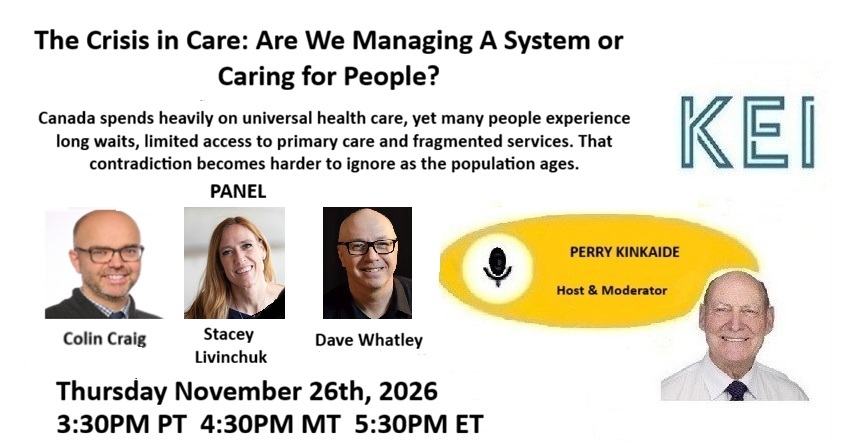
No need to register. Just Zoom in: https://us02web.zoom.us/j/84258596166?pw
Last week’s podcast: The Biology of Ageing: Can Medicine Outrun the Clock
Continued from above
The Growing Demands of Ageing. Older patients often live with several chronic conditions requiring coordinated care: cardiovascular disease, arthritis, diabetes, cognitive disorders, sensory loss and mobility limitations. A person may need primary care, specialists, medications, rehabilitation, home support and occasional hospitalisation. These needs do not fit neatly into institutional compartments.
Ageing alone does not explain rising spending. CIHI has estimated its pre-pandemic contribution to annual spending growth at roughly 0.6 percentage points; inflation, population growth, utilisation and technology also matter. Nevertheless, as the number of very old Canadians rises, the complexity of care will test coordination and continuity more intensely.
Ageing alone does not explain rising spending. CIHI has estimated its pre-pandemic contribution to annual spending growth at roughly 0.6 percentage points; inflation, population growth, utilisation and technology also matter. Nevertheless, as the number of very old Canadians rises, the complexity of care will test coordination and continuity more intensely.
Administration Is Not Management. My work in government and consulting reinforced an important distinction. Administration ensures that budgets, procedures, professional standards and reporting obligations are followed. Management focuses on whether the organisation achieves the results for which it exists. Both are necessary, but compliance alone does not demonstrate that patients receive good care.
Consider someone awaiting surgery. Administrators may measure operating-room use, staffing levels, departmental costs and adherence to budget. Patients ask different questions: how long must I wait; will the operation restore my function; what support will I receive afterward? A hospital may perform adequately against internal administrative measures while the person’s journey remains fragmented or delayed.
What matters is not just the performance of each department, but the entire service journey. Public resources must be converted into outcomes that matter to the people receiving care.
The Institutional Antibody. In The Lost Commons: Human Relevance Under Siege, I described the institutional antibody: the mechanisms through which organisations preserve established structures even when their purpose demands adaptation. In health care, many safeguards serve essential functions, especially clinical standards and patient safety. But institutional preservation becomes a problem when familiar administrative boundaries take priority over service improvement.
Responsibility is distributed among governments, professional bodies, hospitals, health authorities, home-care organisations and other providers. Each may discharge its own mandate, yet no one may have sufficient authority to organise the full patient experience. When everyone is responsible for one part, who is accountable for the result?
What Sasha Taught Me. The consequences of fragmentation became personal as I cared for my wife, Sasha. As her mobility declined, I assumed responsibility for medication records, meals, physical transfers, hygiene and communicating with professionals. I once attempted a transfer that I believed I could manage, but halfway through could neither complete it safely nor return her to her original position. I eventually called an ambulance.
The incident was frightening and humbling. It taught me that love could not substitute for professional instruction. Health-care professionals were generally caring and responsive when called upon, but what I often needed was guidance before an avoidable crisis—not emergency assistance afterward. In Sasha and the Caregiver’s Journey, I describe how safe care requires knowledge, equipment, practice and support. The experience revealed a management issue: our system is often more responsive to acute incidents than to preventing foreseeable complications.
From Privatization to Personalization. Debate over Canadian health reform often gets trapped in a single word: privatization. Yet who finances care, who delivers it and how services are organised are different questions. Public opinion reflects those distinctions. In an August 2026 Research Co. survey, 49% of Canadians disagreed that health care would improve if run by the private sector, while 37% agreed. A September 2026 Nanos survey found 57% uncomfortable with more private options that permit payment for shorter waits. But a May 2026 Santis–Nanos survey found 60% open or somewhat open to private organisations delivering publicly funded surgeries and diagnostic tests. These are differently worded questions, not proof of support for any single reform package.
The Canada Health Act already permits private organisations and practitioners to deliver publicly insured services under the public plan, subject to rules against patient charges for insured care. Private delivery is not the same as private payment, nor does either guarantee a better service. More important is whether patients receive accessible, coordinated, safe and accountable care, regardless of ownership.
I would frame the objective as personalization of supply: organising services around the needs of the person and caregiver rather than requiring them to navigate the convenience of separate institutions. For an older patient this could mean a shared care plan, coordinated appointments, home-based support where appropriate, clear responsibility for follow-up and an informed role in decisions. Personalization is not a marketing term for charging patients; it must retain universal access, clinical standards and independent evaluation of outcomes. It is a management discipline, not an ownership formula.
Caregivers need practical instruction, equipment, respite and reliable professional support. Otherwise costs reappear as exhaustion, lost work, injury, unnecessary emergency visits and premature institutional care. The caregiver must be recognised as part of a supported care team, not treated as an unlimited substitute for one.
Preparing for Tomorrow’s Medicine. The emerging biology of ageing introduces another management problem. Treatments might someday delay frailty or chronic disease; biological ageing clocks might support prevention or evaluation. But health systems will have to decide what evidence establishes benefit, how to compare new therapies with existing needs, and how to distribute expensive treatments equitably.
A drug that alters a laboratory marker has not necessarily improved survival or independence. Public decisions must remain grounded in safety, validated clinical outcomes and value to patients. Scientific progress could move rapidly; service organisation and regulation must be capable of adapting without abandoning evidence.
Reforming the Delivery of Care. Reform should align authority, responsibility and measurable outcomes. Local managers require room to coordinate services around community needs and personalize service arrangements, within clear clinical standards and public accountability. The test should not be whether supply is labelled public or private; it should be whether care is timely, equitable and responsive to the individual. Reporting should extend beyond expenditure to access, continuity, preventable complications, rehabilitation, patient experience and appropriate support at home.
Transparent comparisons among regions and institutions—adjusted for population, geography and case complexity—can expose opportunities to learn. Better links among hospitals, primary care, rehabilitation and community services can reduce the burden families face in navigating the system. Patients and caregivers should participate directly in service design. Artificial intelligence could reduce paperwork, improve coordination and identify risks, but clinical judgment, privacy and human attention must remain central.
Canada does and will need additional doctors, nurses, facilities and resources. The question is whether their work can be organised to deliver better care rather than merely sustain existing structures. Personalized care should not transfer clinical risk or unpaid work onto families; it should give them a dependable partnership in which someone is accountable for the whole care journey.
The defining question is not simply how much Canada spends, but whether anyone is genuinely accountable—and empowered—to improve what Canadians receive. We need responsible administration, but above all effective service management that never loses sight of the person being cared for.
Next: The Commons of Care—Relevance and Resilience in an Ageing Society.
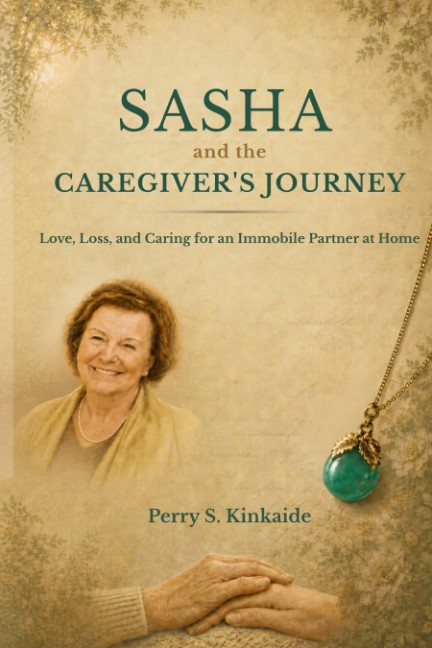
A love story and a survival manual, in one book. Perry S. Kinkaide spent nearly three years caring for his wife Sasha at home after illness took her mobility. This is what he learned, and what he wishes someone had told him on day one.
Part memoir, part practical guide. Part One traces Sasha’s life, a Czech refugee who escaped communist rule at eighteen, built a career in psychology, and spent fifty-three years married to Perry. Part Two is the caregiving handbook Perry never had: pressure injuries, transfers, toileting, burnout, palliative care, and the hundred small skills love alone doesn’t teach.
Ordering here gets you digital instantly, or choose softcover/hardcover for local pickup.
For softcover/hardcover, local Pickup only, the author can arrange pick-up and delivery for the Edmonton Region – contact pkinkaide@gmail.com
Want it shipped to your door instead? Black & white softcover/paperback editions are available on Amazon, click the Amazon button below.