


Newsletter Subscribe
Enter your email address below and subscribe to our newsletter


Small and medium-sized enterprises (SMEs) are the backbone of Canada’s economy.
More than 98% of Canadian businesses are small or medium-sized enterprises. Together they employ approximately two-thirds of Canada’s private-sector workforce and generate well over half of the country’s private-sector economic activity. Every community depends upon them. They create jobs, develop new products, serve local markets, train future leaders, and provide the resilience that has long defined the Canadian economy.
When SMEs thrive, Canada prospers. When they fall behind, the entire economy feels the consequences.
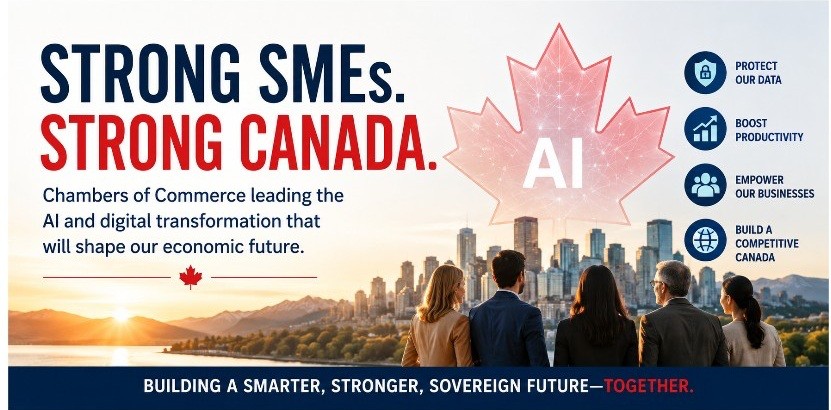
Today Canada’s SMEs face one of the most significant economic transitions since the arrival of the Internet.
Artificial intelligence is no longer an emerging technology. It is rapidly becoming a foundational capability for virtually every business sector. From manufacturing and agriculture to retail, professional services, logistics, healthcare, finance, and tourism, AI is transforming how organizations make decisions, serve customers, increase productivity, improve quality, reduce costs, and compete globally. The question is no longer whether AI will reshape business.
The question is whether Canadian businesses will help shape that future—or struggle to catch up with competitors that already have. Canada faces an important paradox.
Watch last week’s live podcast here.
Our universities, researchers, and technology companies are internationally recognized for leadership in artificial intelligence research. Yet Canadian businesses, particularly SMEs, have been slower to adopt these technologies than many of their international competitors.
The evidence is concerning. Research highlighted by the Canadian Chamber of Commerce indicates that 73% of SMEs have not yet begun implementing AI, while only 6% of small businesses and 8% of medium-sized businesses report active AI use. That gap matters.
Businesses that successfully integrate AI are expected to become more productive, innovative, and competitive. Those that delay adoption may experience rising costs, slower growth, greater difficulty attracting skilled employees, and increasing competitive pressure from firms that are able to do more with fewer resources. For Canada, the implications extend well beyond individual companies.
Canada has struggled with a productivity gap for many years. If AI adoption continues to lag, that gap could widen, affecting investment, economic growth, wages, tax revenues, and Canada’s ability to compete in an increasingly knowledge-driven global economy. This is where Canada’s Chambers of Commerce have an unprecedented opportunity to lead.
The challenge is not that Chambers have overlooked these issues. Across the country they have consistently championed innovation, digital infrastructure, workforce development, public-private partnerships, and programs that help businesses modernize. They understand that strengthening Canada’s digital economy is fundamental to long-term prosperity. The opportunity now is to build on that leadership.
Over the coming decade, business owners will increasingly look to their Chambers not only as advocates on taxation, regulation, and trade, but also as trusted partners in navigating digital transformation. Chambers are uniquely positioned to connect entrepreneurs with educators, technology providers, researchers, governments, investors, and one another.
Just as importantly, Chambers can help businesses understand another emerging issue: data sovereignty.
For many SMEs, their most valuable assets are no longer machinery or buildings. They are customer relationships, proprietary knowledge, financial information, operational data, and intellectual property. Protecting those assets while ensuring they remain governed by trusted legal and privacy frameworks is becoming an increasingly important component of business resilience and competitiveness.
Helping SMEs adopt AI responsibly, protect their digital assets, and build the skills required for the future may become one of the defining responsibilities of the Chamber movement.
Throughout Canadian history, Chambers of Commerce have helped businesses adapt to changing economic realities. Today’s reality is different in scale, but not in principle.
The mission remains unchanged: helping Canadian businesses succeed. The tools, however, are changing rapidly. Artificial intelligence is one of them.
The Chamber organizations that embrace this opportunity will not simply help their members adopt new technology. They will help shape a stronger, more productive, and more competitive Canadian economy for decades to come.