


Newsletter Subscribe
Enter your email address below and subscribe to our newsletter


The webinar concluded by tabling DRAFT Recommendations HERE and reproduced below. They are drawn from the survey, feedback and former webinar discussions. This week's webinar Friday June 4th will star
Issue #41
May 31st, 2021
Join us – share and network, discover and learn
DRFAT Recommendations for Strengthening Economic Resilience
WEBINAR
FRIDAY – 2PM MT June 4th
COPY THIS https://us02web.zoom.us/j/85896241732
To view former webinars CLICK
Last Friday’s webinar HERE featured Conclusions and 9 questions stirring participant discussion about what might be done to strengthen Alberta’s economic resilience and Innovation Ecosystem. The webinar concluded by tabling DRAFT Recommendations HERE and reproduced below. They are drawn from the survey, feedback and former webinar discussions. This week’s webinar Friday June 4th will start early – 2PM featuring a moderated panel discussion with executives currently engaged in development of Alberta’s economy and innovation ecosystem. They have each been provided copies of the DRAFT Recommendations. JOIN US this Friday 2PM MT –
https://us02web.zoom.us/j/85896241732
The Network to this point has been serving as a monitor of Alberta’s economic weather and advocate for improved economic resilience. For the first time since 2015 we have prepared Recommendations in DRAFT form that contain insights and general directions for guiding an increase in Alberta’s Economic Resilience and the associated Innovation Ecosystem. They are not intended to be prescriptive but instead have been prepared for you to consider as you each contribute to Alberta’s future.
The following have been provided to each panelist for discussion.
DRAFT Recommendations (28 MAY 21)
“Alberta will facilitate and lead Canada in the development of a superior place that is a united and strong, tolerant and sustainable, place to live and learn, work and play.”
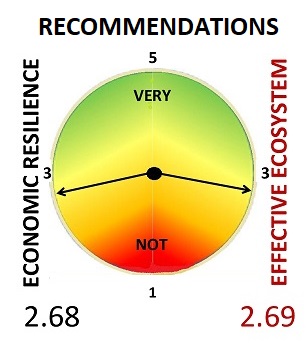
The survey reveals differences in the sentiment of Alberta’s economic resilience Overall, by Region and Sector, and since 2015. For Alberta’s economic resilience to increase from the current over-exposure to oil pricing requires diversifying into other industries while maintaining a balance of Professions and Public Services. The requisite economic development warrants: attracting others, growing local, and developing an “effective” innovation ecosystem. Those managing the ecosystem are responsible for addressing the ecosystem’s weakest elements: Management Processes and a sustained Vision and Leadership.
Energy Transitions. The impact of climate change and geopolitical measures to respect the environment make Alberta – overall, it’s Regions and all Sectors, particularly vulnerable to an economic dependence on the oil and gas industry. Development of hydrogen, progress in reducing oil sands emissions, electrification of transportation, Net-Zero incentives, accessing new-Asian markets, are all complimentary to an economy continuing to supply the global demand for energy while respecting the environment. But there must be more.
Innovation and globalization. Distance to global markets and long term supplier contracts have impeded diversification and the development of manufacturing Alberta’s rich bounty of agricultural, forestry, oil and gas materials. Today globalization and emerging technologies are creating new markets, increasing productivity, and creating new employment opportunities. Alberta should capitalize on its competitive, international advantage in many areas particularly throughout Asia.
The Digital Economy is largely independent of borders, distance, and regulation. Competition is intense. Personalization is outstripping socialization, meaning clients are transforming into consumers as their economies mature. The Digital Economy where “data is the new oil” represents an extraordinary opportunity for all Alberta Industries, Professions, and Public Services. Borders are irrelevant as data flows at the speed of light, the cost of storage has plummeted, and machine learning contributes to continuous learning. The implications are profound as appreciated by any organization committed to applying artificial intelligence to their operation. No employment Sector should be ignored and no community left behind – internet access is essential for any and all communities.
Alberta must increase measures to develop and better manage its innovation ecosystem to attract and increase the growth of SMEs and when appropriate their participation in global value chains. Of particular importance is the pooling of private investment capital and mentorship. Innovation is the enabler.
Significant growth opportunities have been highlighted, for example:
“Systems” during their development are supplier centric but once mature, transition to be more responsive to clients as customers, entrepreneurial suppliers, innovation and emerging technologies, and sustained public sector withdrawal.
Public vs Personal Service. Alberta has made extraordinary strides in the development of the publicly administered supply of health, education, and overall public services and the associated professions and public servants. But a transition of the entire public service “system” is underway.
The transition is being driven by increased expectations of clients, competition among suppliers, and emerging technologies. As uncomfortable as it may appear the Canadian cultural commitment to public health, public education, public NGOs, public oversight is vulnerable to increasing expectations of a more educated and knowledgeable population, maturing of the knowledge economy, and technologies increasing competition for service. Growth of distrust between the public and public systems is an indicator of a more informed client cum consumer and the increasing relevance of market forces in governing the professions.
The public service “systems” today are sustained by administrators committed to regulatory measures maintaining the status quo, protection, and privacy but vulnerable to claims of overprotection, demand for more choice and innovation, and public sector austerity. “Privatization” is often cited as a policy option; it is not, but “personalization” is – the acceptance of market forces in transitioning public services from being supplier driven to being consumer responsive.
As for the Professions, it is clear that their assessment of Resilience follows that of the overall economy – more a recipient than a driver. The professions in general are self-regulated and empowered by government to manage explicit processes such as in health and education, law and engineering. They retain public trust by ensuring their members adhere to regulated practice standards and to otherwise discipline their members.
Today the professions are adapting to increased expectations of clients, increased competition, increased costs, competition from apps with the capacity to store, analyze, and learn. As if these challenges weren’t enough, the professions are confronted by an increasingly litigious Society, confounding their capacity to exercise their regulated responsibilities.
Regulated professions also have an obligation to keep up with the impact of market, regulatory, and technological changes on contemporary practices, which includes field work and educational requirements. When COVID forced learning online, most were not ready. Regulated professions must anticipate continuous change through: 1. The conduct of policy research, 2. The development and timely implementation of practice standards, and 3. Collaboration with government for aligning regulations, responsibilities, and market expectations.
Special case of NGOs. NGOs are often overlooked as relevant to Alberta’s economic resilience. There are over 23,000 NGOs in Alberta – 1 for every 150 Albertans. This sub-sector of Public Services is highly fragmented and has become overly reliant on public grants. They are or should be a contributor, a source of social enterprise and innovation, sufficiently independent of government to help make change and increase resilience as an organization and for its members. Measures are needed to monitor and promote social enterprise and independence, accountability and to incentivize their consolidation.
The Survey. The objectives of the survey and reporting are to:
Draw attention to the status of the economy and the Innovation Ecosystem
We must all must all commit to continuous improvement and the engagement of others in the design, conduct, and distribution of the survey and reporting of results. This also means being open to the formation of alliances and partners to extend the reach, relevance and influence of the survey to effect change.
* * *
MODERATOR

Barry Mehr, KEI Network
Barry has volunteered to moderate the panel discussion for the KEI Network. He has extensive experience throughout his career as a senior executive in business, industry, and public services including Deputy Minister for several Government of Alberta departments: Agriculture, Innovation & Science, and Economic Development. He is a former board director with associations in finance and human resources, education and agriculture, science and innovation, and as an investor has recent exposure to emerging opportunities for Alberta in Asia.
3 PANELISTS

Justin Riemer, Western Economic Development
As Assistant Deputy Minister (ADM) with WED, Justin is working to diversify the economy while improving the quality of life of western Canadians. He leads a team in Alberta to build a strong, competitive West by focusing on business development, innovation and community development. He is a former ADM with the Alberta Government’s Health’s Innovation and External Relations Division leading his team to facilitate increased innovation adoption in the health care system with the goal of building the strongest health innovation ecosystem in Canada.
Prior roles as ADM in the Alberta Government included the Enterprise Division and Economic Competitiveness responsible for industrial development, economic development policies and programs, as well as entrepreneurship, regional and northern development. He also served as Executive Director of the Industry Development Branch of the Enterprise Division within the Ministry of Alberta Finance and Enterprise.

Lyn Brown, Alberta Innovates
Lyn is vice president of Marketing and Communications at Alberta Innovates: “By seeing beyond the possible, Alberta Innovates solves some of the biggest industry challenges. We support research, the growth of business, and we help the start-up community to build new technology and drive new ideas. We put innovation into action to build a bright future for all Albertans.”
She has extensive multi-sector experience in strategic issues communications, brand development, reputation management and transformational change. She led staff and project teams at Catalyst Paper, Aquila Networks Canada (now Fortis), TELUS, Canada Post, and APEGA.
Lyn has served community boards including the advisory committee of the UN SHE Innovates Alberta pilot, Canadian Business for Social Responsibility, GreenBlue Institute, International Association of Business Communicators, and is currently president of Canadian Public Relations Society Edmonton.
She holds an MBA from Royal Roads University, a BA from the University of Alberta, and a journalism diploma from MacEwan University. She attained the ICD.D from the Institute of Corporate Directors & Rotman School of Management and is an IABC-accredited professional.

Leann Hackman-Carty, Economic Developers Alberta
Leann has been the CEO of Economic Developers Alberta since 2009. Economic Developers Alberta (EDA) is the leading economic development network in Alberta. EDA’s broad and varied membership base includes: municipalities; towns; regions; tourism groups; financial institutions; Crown Corporations; businesses; Regional Economic Development Authorities; Community Futures Development Corporations; federal, provincial, regional and municipal government agencies; students; NGO’s; and other groups and individuals that are either involved or interested in economic development.
Leann completed a project in 2014 with 11 Alberta flood impacted communities and in 2016-17 worked with the Fort McMurray Region on business and economic recovery by setting up and operating the business hotline; validating businesses for Red Cross emergency relief; and leading a 10-member economic recovery assessment team to the region.
Leann also heads up Hackman-Carty and Associates, that is focused on community capacity building, resilience and recovery. Also, as the Canadian President of the Institute for Sustainable Development (www.isdus.org), she works with international experts on innovative long term community recovery and resiliency programs. In August 2019, she launched the MYD Global YouTube Channel where she talks “all things disaster”.