

Newsletter Subscribe
Enter your email address below and subscribe to our newsletter


Economic resilience survey results – October 2021
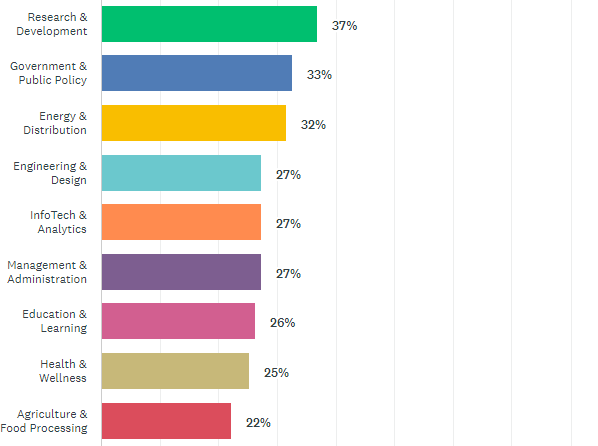
Familiarity with SECTORS of the economy – the top 9
Survey respondents’ familiarity with sectors of the economy is very broad
Industry: Energy, Agriculture, Construction, BioTech
Professions: Engineering, InfoTech, Management, Finance
Public Sector: Research, Government, Education, Health
Diversity of the economy Note. A scale of 1-5 was employed; 5 = Very, 1 = Not
Alberta’s overall resilience is weak (2.63), increasing slightly (6%) since the spring 2021, a trend evident since 2015
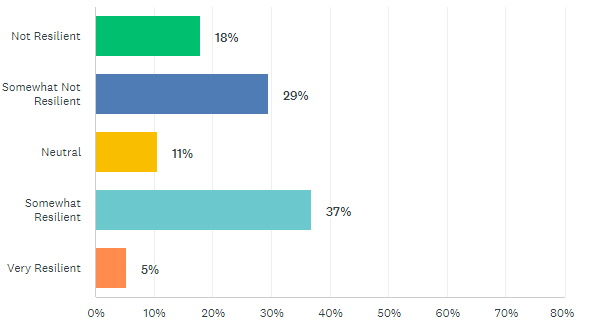
47% (-2%)
42% (+6% )
ENERGY (oil/gas) is the fundamental determinant of the state of the economy

Most Resilient Locations Note. A scale of 1-5 was employed; 5 = Very, 1 = Not
Both the Calgary (2.83) and Edmonton (2.59) Regions remain weak – under 3.00
Calgary Region has improved slightly (+0.07) and is more resilient (+0.24) than the Edmonton Region that has weakened (-0.09) since the spring 2021
Alberta 2.63 is less resilient (-0.05) than the rest of Canada 4.00 and the USA 4.50
Most Resilient Sectors:
Industries – the most resilient sector; Public Services – the least resilient
Industries 2.42 (-0.33): Energy (2.53), Agriculture (2.50), Construction (2.44) and BioTech (1.80)
Professions 2.33 (-0.39): Engineering (1.96), Infotech (1.96), Management (2.53), Finance (2.25)
Public Sector 2.19 (-0.30) : Research (1.46), Government (2.41), Education (2.42) and Health (2.38)
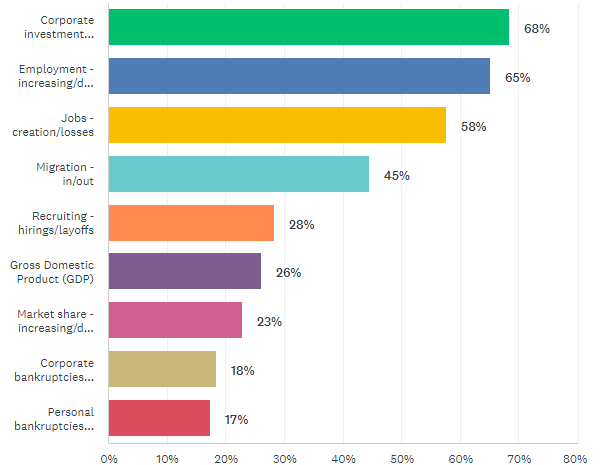
Most sensitive MEASURES OF ECONOMIC RESILIENCE
Primary measures economic resilience are Corporate investment, Employment/ Jobs, and Migration |
|
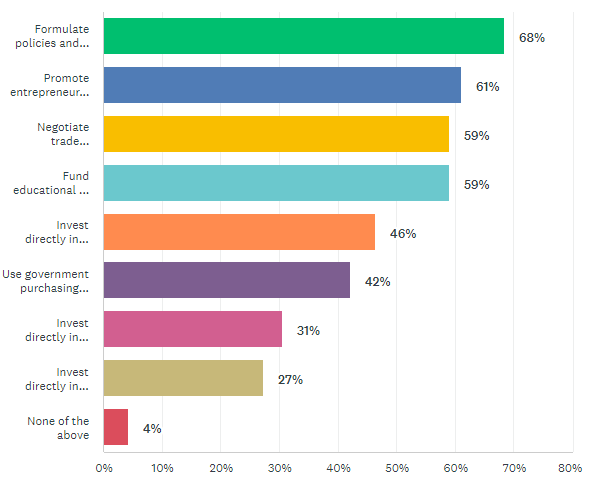
Most appropriate GOVERNMENT ROLES for making the economy more resilient
The most appropriate roles for government are in policy formulation, promoting entrepreneurship and education/training for the workforce, and negotiating trade agreements |
|
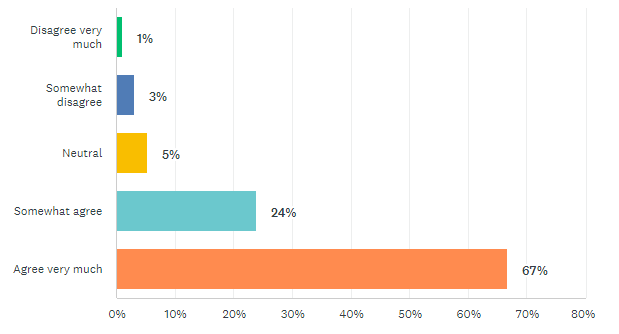
Need for an Innovation Ecosystem
Strong agreement that to achieve economic resilience/ diversification, an economy needs an effective and continuously improving Innovation Ecosystem that supports the survival, growth and retention of entrepreneurs and SMEs |
|
Innovation Ecosystem’s effectiveness Note. A scale of 1-5 was employed; 5 = Very, 1 = Non
The Innovation Ecosystem is viewed as effective (2.51) by only 28% of respondents; the first decrease (-8%) in several years … attributable to a steep decline or the Edmonton Region
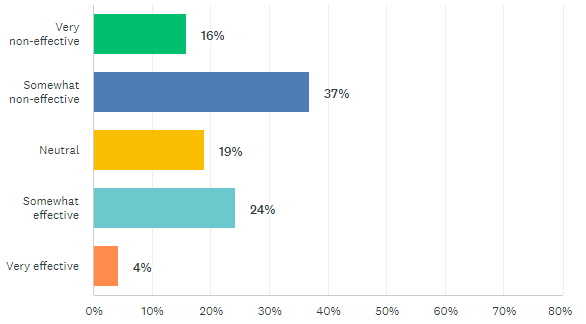
28% (-8%)
53% (+4%)
The most effective elements of the Innovation Ecosystem are viewed as Resources and the Infrastructure. The weakest are Leadership and the System’s Processes
3.14 (46%) Vision & Leadership – purpose and inspiration
3.48 (53%) Resources – talent, financing, information, facilities/land, technology
3.06 (37%) Processes – communications, decision making, networking, organization, accountability
3.40 (51%) Infrastructure – internet, transportation/logistics, research, advisory services – incubators/ accelerators
Effectiveness of elements of the Innovation Ecosystem (5= Very Effective)
Location: Calgary and Edmonton Regions compared
Calgary Region is more resilient 3.00 (3.10) with 48% viewing it as effective (-7%) while the
Edmonton Region is less resilient 2.34 (2.55) with 19% viewing it as effective (-4%)
Both Regions are less resilient than the rest of Canada 4.00 (60% effective) and the USA 4.50 (75% effective)
CONCLUSION
Alberta’s economic resilience is weak attributable to both Covid and weakness in the excessive roles of Energy industry and Public services throughout the economy as reflected in the impacts on corporate investment, employment/jobs and migration in all Regions and Sectors.
The innovation ecosystem, viewed as fundamental to supporting innovation in SMEs is strengthening in Calgary Region with several recent announcements of success in attracting and growing Infotech. Recent events in Edmonton have severely eroded views of the effectiveness of it’s Innovation Ecosystem.
The recent increase in the price of oil and gas and wind-down of Covid may be expected to buoy the sentiment of Alberta’s economic resilience impact by spring 2022.