Creating Western Canada’s Hemp Industry March 15 2019 On March 15th over 175 people gathered at Olds College in Olds Alberta to contribute to development of Western Canada’s Industrial Hemp Industry.
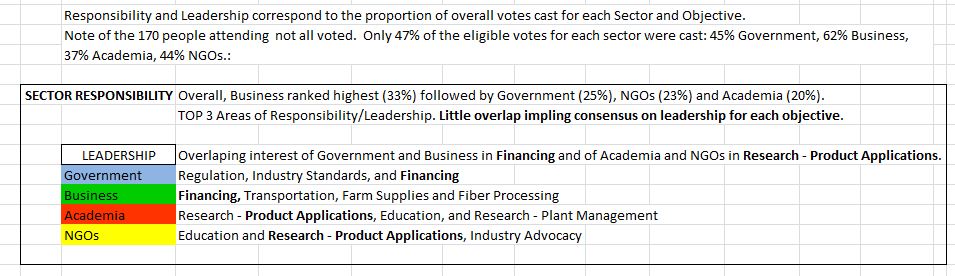
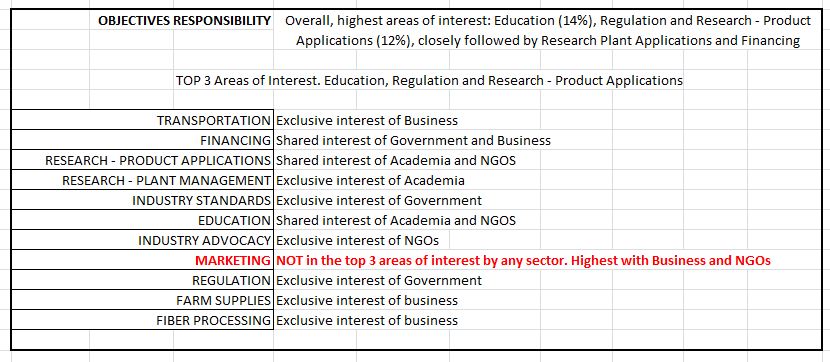
On March 15th over 175 people gathered at Olds College in Olds Alberta to contribute to development of Western Canada’s Industrial Hemp Industry. The 2nd Annual Conference was co-hosted by the Alberta Council of Technologies Society and Agriculture Food Council. The attendees were given this workbook containing 11 objectives/priorities as identified at the 1st Annual Conference in April 2018. Attendees were asked in small groups to review and revise each Objective as warranted. The comments are contained below. Also cited are the proportions of responsibility identified for each Objective for Government, Business, Academia, and NGOS – non-government organizations.
DRAFT
Objective #1 Transportation
Getting the hemp products to market efficiently and economically.
Recommendations
Notes
Action Team
Name
Contact Info
Investigate existing grain/oilseed capacity constraints for hemp seed and assess what additional capacity and alternative solutions could address the gap
Minimize the transportation effort and time for the farmer-maximize value
Harvest, storage, sorting and handling of transfer and understand what the customer wants
How do you certify for standards?
Ability to pre-sort products separately (seed, fiber) at regional depots
Drop-off capacity
Rail capacity
Sealed flexi-bags in 20 ft containers
Better to be shipping in goods rather than raw materials
Regarding decortication, how do you densify the material as early as economically appropriate? Portable decortication that is moving with the harvest season.
RISK. Vulnerability with lack of specifications and qualifications
Who owns quality – marketing councils or boards need to be created to set quality
Ho do we protect the industry from people flying under the radar and ruining the industry’s reputation?
Need to consider IP as an investable proposition
Validate ROI and Exits
Federal support through banking institutions
Action Team – Results??
Recommendations & Notes are vague
Establish PM=FTE/Emerging sector
Establish location/ environment for sustainable investment and growth
Incentives that bring investors to the table – a tax strategy.
Arrange to secure hemp shipments inside of Canada as does Export Development Bank of Canada.
Take a market-centric orientation – secure production
Develop the market
End-user demand and investment
Identify eligible grants
Identify financial networks for start-ups – private and public
Note, delete Christopher Robblee from Action Team
Easier government grants with grant facilitators to help write.
Bank 3 feasibility studies –look this up, with government incentives to get to this stage so banks will finance.
It is a standoff between government processors and the farmers
Feasibility studies would help with banks
Grant application process should be less complex and widely available with support
Relax lending restrictions to allow quicker adoption
Need education on the 3 phases – proof of concept, research, commercialization, scale-up before seeking financing
Where could entrepreneurs go to get guidelines on what needs to be done for financing, what grants are available for that industry – put on CHTA website.
Establish defined markets
Group 6: Josh Billyk, Rohit Sati, Ed Wilanowski, Dennis Halabisky, Norma Halabisky, Robert Herscovitch, Alex Lowe:
Farm Credits Purchases
Relate financing to innovation -> carry to commercialization
Attractive and be open to foreign investment. Government NOT to be involved, other than in policy formulation – less red tape.
Ecosystem
Sector
Count
Proportion
Government
13
37.1%
Business
18
51.4%
Academia
1
2.9%
NGOs
3
8.6%
TOTAL
35
100
Interest/Rank
11%
4.5th
Objective #3 Research-Product Applications
Innovation in developing value-added hemp products and their introduction to the market. Include supply chain management, plant usage, food-stock and equipment.
Recommendations
Notes
Action Team
Name
Contact Info
Research what can be done with hemp roots
Hemp juice
New technology machinery to harvest
Purpose based equipment for extraction of specific products
New products for health food areas
Hemp and lignin-hemp board with natural resin
Research for financing of start-ups for hemp products
Research on sources to develop hemp products
Research on customizing food products to the profile of the client
Hemp-crete applications, processes and engineering
Change guidelines for accessing government money
Deregulating hemp, loosening the THC limits for hemp
Grant writing guidelines, more knowledgeable people to assess applications
Market opportunities with lower THC and higher CBD’s
Barriers to the market:
Undeveloped value chain
Decortication
No fiber market secured
Whole plant utilization is important
Cosmetic and medical applications (issues with strength and quality)
Research needed on strains and genetics of CBD’s, role of CBD in the plant
Who are the people at the table?
Very little useful research on hemp bio-info
Hemp-crete
Applications engineering
Product engineering
Process engineering
Product testing with target client
Food products-customize food products to the profile of clients
More products created will create more opportunity to grow production and create opportunities in rural communities
Functional properties of hemp derivatives needs to be analyzed and published: pectin, lignin, protein, fibre (dietary), oil quality (Omegas)
How do we utilize existing resources/ research organizations more effectively.
How can we put entrepreneurs together with the research groups.
An CHTA coordinate – be an information hub?
Re new products for health food areas: healthy burger, snack/ food patty replacement, Leduc food processing
Re change guidelines.. Is government behind case?
Re: Whole plant use – Why is this important?
New name C.O.R.E. – compatible, organic, reusable, environmental.’
Re: Hemp-crete – e.g. name change from Rape to Canola
Is there a GMO for hemp?
Can we replicate soya in the markets of hemp
Agrium (Bear) – into canola not hemp.
Prioritize which results will help Alberta most
Common platform for sharing research findings
Ecosystem
Sector
Count
Proportion
Government
3
7.3%
Business
3
7.3%
Academia
22
53.7%
NGOs
13
31.7%
TOTAL
41
100%
Interest/Rank
12%
2.5th
Objective #4 Research-Plant Management
Innovation supporting hemp farming production and harvesting. Include grain growth, resilience and whole plant usage, genetics, fertilizers, water, emerging technologies, pest control, quality control, stability, standards (certified reference materials) and conveyance of innovation to farming.
Recommendations
Notes
Action Team
Name
Contact Info
Provide resources (funding etc.) to research projects (applied)
No new funding agencies, only industry committee to steer and choose products
Understand the end product you are growing for (CBD, seed or fiber)
Research is required to help aid farmers to make decisions on what to grow
Collaboration will help the industry to grow faster
Whole plant-extraction/ decortication of byproducts (shell and dust are currently unused)
Balance of income for whole plant (CBD vs. fiber) staged harvest-acres for food and fiber
Uniform maturity
Geographic traceability
Manipulate (reliably, reproducibly) chemical process control for environment
Need entire fertility package and micronutrients
Indoor vs outdoors is different (40% more plants indoors)
Need to know mechanisms for nutrition, genetics and environment
Increase grain size, adjust ratio of shell to meat
Tendency to drop seed should be reduced
Increase length of time grain is viable
Genetic foundations and library (cannabinoids etc.)
Issue with sharing and collaboration-possessive ownership
Emerging tech-spore sensors, composition analysis, hand-held devices for quality and health
Unlocking competitive advantages
Collaborate to get ahead
There is a huge opportunity to create a new machine to collect CBD
Educate farmers and producers to increase ROI
More research is needed to get a good crop
Genetics are a large component to growing
Comments 2019.
Ongoing
Recommend renaming Objective to Agricultural Research & Development
Since late 2018 several new programs have appeared. By October 2019 expect the regulation of edibles and topicals.
Canadian Agricultural Program (CAP Funding)
CleanTech
NRC – National Research Council – IRAP
Alberta Innovates Voucher Program
Facilities like Vegreville
Brooks, AB’s new programs include:
Variety assessment
Field Day in July
Latest farming practices
Decortication plant
New harvesting techniques for flowers and buds
Development and approval of new CBD varieties
Converting dust to pellets for fuel
Only 3 labs in process to conduct analysis
Keeping quality control high
Needs of licensing producers ( Farm to Pharma):
What are the requirements
Contract harvesters
Drying technologies – quality of CBD’s- reducing mold.
Research programs – Allow easier research paths for industry.
A more transparent contracting process between producers and processors. Modeling the right hemp varieties.
Regional studies
Alberta Agriculture is not involved – hemp needs to be their priority for Alberta.
Who is doing the agronomic worth on extract removal from a fibre crop?
Why is Alberta Agriculture not involved in providing producer recommendations on fertility and harvest?
Funds were available through ACIDF but cut by government.
Can colleges (Olds, Lakeland, Norquest) plus seed producers assist in education.
Re opportunity to create new machine to collect CBD. More input from harvesting machinery manufacturing for development
Ecosystem
Sector
Count
Proportion
Government
8
22.9%
Business
8
22.9%
Academia
13
37.1%
NGOs
6
17.1%
TOTAL
35
100%
Interest
11%
4.5th
Objective #5 Industry Standards
Creating safety standards for hemp products and production.
Recommendations
Notes
Action Team
Name
Contact
Testing or technology procedure at the farm level for THC levels
Develop industry quality and processing standards at and international level-include full value chain in and independent process which will be seen by an independent process which will be overseen by and independent or government agency
Include full value chain-producer to processor
Platform for marketing and traceability
Certification throughout the supply chain
Avoid contamination risk
How do you certify for standards and quality?
Standards appear to be in place today-refer to Health Canada-Industrial Hemp Safety Standard Operating Manual
Independent control/oversight that is independent of marijuana
Canadian sourced
International body
Industry driven
CFIA needs to be a partner
Need processor at the table
ASTM program
Barry Mehr
mehr@mehrholdings.com
Comments 2019.
No further requirements if licensed
Testing protocols contaminants of remediation (intumb)
In place
In the works
Industrial hemp initiative:
What is governments role?
When is testing done?
Define CBD as either NHP or Pharma?
Stability data
Grain elevators concerned with contamination, capacity, process
Establishing standardization
Grading system
Independent body
Parallel industries that would be consulted
Harvest at specific moisture content (Range?)
Flame-ability of product
Excretion of volatiles- an issue?
What about storage?
Security? Build public awareness.
Use technology to maintain security.
Contamination? Ecoli? Storage and handling-> standard
Canadian Grain Commission should help develop grading standards.
GMP is standards
OH&S Is standard
On farm safety recommendations for farmers/ educational.
Ecosystem
Sector
Count
Proportion
Government
16
55.0%
Business
3
10.3%
Academia
1
3.4%
NGOs
9
31.0%
TOTAL
29
99.9%
Interest/Rank
9%
6th
Objective #6 Education
Ensuring continuous and contemporary learning fitting for each industry segment. Include public, farmers, investors processing and government.
Recommendations
Notes
Action Team
Name
Contact
Education program (Grow Calgary)
Bring more public participation into the industrial hemp conferences
More workshops and video workshops
Educational grants
Education of producers
Start a hemp grower council
Advisory board from grassroots to end user
Investors-strategic introduction of hemp into the value chain targeting specific industries-prepping industries to use hemp products
Teaching the young
Stop media and the government from turning pot into the “celebrity”
Old school conferences are not as successful anymore-kitchen table or smaller events are more effective
Public sector is the easiest to educate
Key message is the difference between hemp and marijuana
History of prohibition or marijuana-negative stigmatism if racism
Education of farmers to potential markets. Education of communities on the value of hep product to help demand
Plan growth of the industry through education
General consumer education programs
University programs fro plant-based products
A growers council makes sense, nut as hemp is a small industry, working together on the CHTA makes sense at this point.
Make smoke shops remove hemp from their name!
Accredited courses.
Agro facilities.
Institutionalize in education – proven, scientific approaches involving: farmers (growers, industrial production (processing), manufacturers for Investor education, end users (consumers), and government.
Government supports education through youth employment programs. Farmers need different types/forms of education – specificity.
One size does not fit all: depth of knowledge and appropriate education delivery platforms (analog/digital/print): hands on vs. theoretical, digestible.
Segmented education supporting diversification.
Validation accuracy – no BS.
Re-training for oil and gas facilities engineer out of work. Skills are transferable as are logistics.
See other pages, i.e. Can colleges (Olds, Lakeland, Norquest) plus seed producers assist in education
Group 6: Josh Billyk, Rohit Sati, Ed Wilanowski, Dennis Halabisky, Norma Halabisky, Robert Herscovitch, Alex Lowe:
Promotion via print media oor run adds on TV
Use social media platform (Facebook/ Twitter)
Design a course (continuing education) at the U of A or other universities
Specific courses in Engineering and Chemistry
Streamline province
Specific/ core basics and understanding (Hemp 101)
Better name re: marketing such as replacing rape with canola
Webinars/ seminars re YouTube, etc.
Celebrity sales person
Stronger media engagement and participation
Education for investors (Investor Tax Credit Program, Carbon Credits.
Do specific focus groups (Young/ Youth, etc.) to broaden beyond aligned professionals and go to K-12 for transition to post-secondary
Site tours and tangible experiences (Farm Tours)
Ecosystem
Sector
Count
Proportion
Government
7
15.2%
Business
7
15.2%
Academia
19
41.3%
NGOs
13
28.3%
TOTAL
46
100%
Interest/Rank
14%
1st
Objective #7 Industry Advocacy
Establishing cooperative relationships essential for business to prosper. Include communications and public affairs and the roles of cooperations and associations.
Recommendations
Notes
Action Team
Name
Contact
Advocate for whole plant use
Extension for general public and producers to increase knowledge capacity
Identify gaps in the supply chain and other systems
Advocating for investors
Help provinces to work together in initiatives /markets
Education on benefits of hemp
Industry regulatory body
Industry interaction with provincial government-federal
Education of potential members of coop benefits
Study the working models (Home Hardware)
Need to connect with producers to find out what their needs and barriers are
Producers need more info on regulations
Need to determine supply chain issues
Increase general public knowledge on hemp
Advocating to government to change regulations (CBD)
There is a challenge with everyone having different agendas and competing
Advocate to investors to invest in decortication
Create a list of producers with primary interests for sourcing purposes
Advocate to funders on variety of opportunities available with hemp
On-going but need to source and clearing house concept “soils to sales”- Bart Guyon
Advocate for proper disposal of waste
Continue to advocate for cooperative people: reduces risk, ownership stake, scale, pan-Alberta co-operative e.g., Alberta Milk Producers?
Focus on education. Advocacy establishing he difference between hemp and marijuana, and federal government protection from imports/exports
Carbon policy for hemp.
Government support for cluster formation will reduce risk to financiers, knowing that the cluster is self-supporting.
A directory of producers, processors, manufacturers, etc.
An Alberta or Western Canada Hemp Collective
Create a map of where everyone is located to encourage networking and proper
Clearly layout the entire supply chain and layer it with all the different support for everyone can visualize their place.
Identify every single type of service or company required to be a complete value chain and find companies to fill their spot.
Start with an industry association for the entire value chain
Form a cannabis and Hemp Consortium
Ecosystem
Sector
Count
Proportion
Government
3
10.3%
Business
3
10.3%
Academia
3
10.3%
NGOs
11
69%
TOTAL
20
100%
Interest/Rank
6%
8th
Objective #8 Marketing
Identifying and developing hemp industry markets. Include branding, messaging, linkage to competitive products, advising farmers and the role of associations.
Recommendations
Notes
Action Team
Name
Contact
Alliance of like-minded individuals from industry, government, academia, come together with shared values for awareness, education and advocacy. Let’s get hemp in every newspaper article just like what we have seen with cannabis
Associations need to advocate and lobby
Alberta needs to help brand hemp (industrial vs. high THC) as “Alberta Hemp”
Government to connect with potential customers, especially specific products and internationally, also ID other stakeholders to develop a new industry
Develop consumer awareness
Be specific about segmenting our markets and clear on objective (farmers, health, consumers, government)
Reliable data-what are the gaps and how do we fill them?
Consistent communication to educate people
Building markets so farmers get confidence to grow
Educate farmers on big picture of hemp industry market opportunities for bi-products, selling price for farmers’ products use of marginalized land, less inputs, less water, opens soil, value in crop rotation system
Governments (municipal → national) need to buy local products to support hemp industry
Need to know end markets and educate producers on them
Connect with global organizations
Need to know how to market a new industry
Important to brand Industrial hemp vs. cannabis
Connect value chains (farmers to markets/end users)
Push the AB brand-local then export
Marketing to producers
Marketing to investors
Pushing AB ecosystem and cluster (economic diversification/full life cycle)
Be clear on objectives
Partner with livestock associations to promote use of hemp in that sector
Connect with other agriculture associations to influence farmers
Leaders need to communicate the benefits of hemp
Access global markets by setting standards of quality
Educate end customer. The customer is key to everything. Need people to but hemp.:
Co—promote dollars particularly funded by government – provincial/federal
Certified association supported by CHTA
Like a hang-age:
Target specific end-user groups by many observers marketers to their potential targets
Highly specific targeting for maximum impact
How to collect market segment data:
Central data hub, open source, wiki page
Input from individual members
Reports available to members from aggregate studies
Guidance pm how to of marketing/ market research:
Co-ordination offered through CHTA. See – mrybiak@opsinc.ca
Cottage Industry Marketplace//Government funded and promoted
Education
Partnering with livestock associations – major block due to feed restrictions
How to create a trading floor for 1st step coop processing that creates product from whole plant – so they can sell the components after initial processing
Locally marketing program for farmers markets:
Booths selling hemp products usually sell out fast
Need to fee up farm gate restrictions to allow farm gate manufacturing of hemp by-products
See micro-producing regulation changes
See Norquest College’s course promotion videos
Additional marketing from associations to general consumers:
One-minute explanations of what his available and being developed locally
Also web-presence, high SRO, so when the consumer can find bite-sized, clear explanation of features and benefits – GREAT NORTH INDUSTRIAL HEMP
Ongoing and evolving
Develop a provincial hemp marketing group – part of a National group
Insurance for hemp customized packages
Rumor control
What is our Alberta Advantage?
Trails/ showcasing
Support for research oriented toward increasing consumer awareness of the benefits of hemp food and fibre.
Need to have solid economics for farmers for irrigated/ non-irrigated – input costs/ product value. Government co-ordinate/ pull data together. i.e. Call of the Land
Government support – not lead – market and customer development. Leave leadership o industry organizations. Hemp Trade Alliance (HTA) should have a marketing are, R&D arm.
Demonstration houses, etc. show homes.
Ecosystem Sector
Count
Proportion
Government
4
16%
Business
11
44%
Academia
1
4%
NGOs
9
36%
TOTAL
25
100%
Interest
8%
7th
Objective #9 Regulations
Government regulations that recognize the differences between hemp and cannabis. Include legislation that is transparent and equitable, incentives, streamlining administration.
Recommendations
Notes
Action Team
Name
Contact
Incentives for green building products like hemp products
Regulation differential for CBD levels in hemp and cannabis
Origin of CBD-need to determine where CBD is coming from
Proper labelling for composition of CBD
Need approval for animal feed usage of hemp products and screenings
Regulate seed ownership to prevent monopoly in the future
Incentives to produce and build processing facilities in Canada
Need a common industry test for seed sampling
Ability to monetize by-products by changing regulatory approval (livestock feed)
Differentiation in regulations pertaining to industrial hemp vs medical or cannabis
Aim to have consistent international regulations
Need ability to produce different concentrations of varieties
Establish regulations that are flexible and can be revisited in the future
Involve CFIA in creating and developing regulations and the industry
Role for government to mandate use of greener products with regulation on how it will be used will help to move industry to bigger plants
Regulations need to be established
Incentives for decortication facilitates
Remove requirement of having agrologist inspecting crops annually
Concern with seed supplies vs. company like Monsanto
Incentives to have growers save seeds?
Industry has concerns with not knowing the regulations
Changing animal feed regulations
Name change for industrial hemp might help
Border crossings create challenges
Regulations should focus on creating a vibrant industry not dominated by seed sellers or cannabis companies
Applications for ACMPR -medical approvals should take considerably more time than applications for IHR- Industrial.
Standards for cleaning common seed or pedigree seed
More clearly defined regulations for small growers and how they can grow into large.
Goal: encourage small business
Challenged whether an agrologist has to inspect all crops annually
Very important – the concern with seed supplies vs company like Monsanto
Future regulations re GMO production
Goal: Accelerated industry growth not being implemented
Business side. Small producers need less regulation than the larger players. Develop a “Bridging System” to grow small to large.
Where did regulations re THC content come from – Dr. Ernie Smalls in the ‘0s. Decide 0,3% is arbitrary and these regulations must change to allow CBD industry success.
Incentives to keep companies in Alberta as they grow. The challenge exists currently with the brain drain. Keep start-ups here – rather than move outside the province.
Very important regulations do not stifle growth.
Current nomenclature is causing confusion re: Cannabis, hemp, marijuana. Industrial hemp needs to have a higher THC content tolerance to increase CBD; so it should be viewed as a single plant.
Government needs to accelerate the approval process.
Less regulations
CHTA – Fractions of whole crop.
Simplify and get government consultation.
Re: Incentives for green building products…in short term to kick-start hemp initiative
RE: Origin of CBD…Country of origin is important
RE: Need ability to produce different concentrations of varieties. Subsitute: Support for product development so it is price competitive
Reword Objective” All cannabis.: Define as low THC and higher THC I.e. >0.3
Add: Regulations for varieties that are market driven and agile.
RE: Delete Involving CFIA in creating and developing regulations and the industry. Entertain the idea of self-regulating industry.
Make regulations and legislation that support new and expanding producers
Start with an industry association for the entire value chain
Ecosystem
Sector
Count
Proportion
Government
22
54%
Business
7
17%
Academia
5
12%
NGOs
7
17%
TOTAL
41
100%
Interest/Rank
12%
2.5th
Objective #10 Farm Supplies
Ensuring the supply of good and processes for farms. Include farmers, seed, seed cleaners, fertilizer, water and contractor relations.
Recommendations
Notes
Action Team
Name
Contact
To encourage the development of appropriately scaled cooperatives that capture shared values and shared opportunities
Cooperatives at varying levels tiers) of the supply chain will further the industry
Contract securities for farmer, i.e. crop advances fa contract
To encourage industry understanding of the unique needs of hemp producers
Does the idea of coops feedback to the need for qualifications. The co-ops soulc end up controlling the quality organically.
Grants for equipment
Connecting farmers to equipment . Pooling of resources or specialty equipment )CBD Extraction) could be cooperative led.
Update the recommended growers guides.
More focus on regional recommendations.
The process should not be making recommendations to its growers froo p=crop production. Leave the agronomy to the experts.
Educate the county Ag Service reps.
Add: Coop gives better price on scale
Add: Easy and add credibility by joining coop.
Add: More understanding on coop structure
Add: Building scale to create common markets and more purchasing power via coop..
Ecosystem
Sector
Count
Proportion
Government
2
10.5%
Business
15
79%
Academia
0
0%
NGOs
2
10.5%
TOTAL
19
100%
Interest/Rank
6%
10th
Objective #11 Fiber Processing
Ensuring the availability of fiber and accessible decortication capacity.
Recommendations
Notes
Action Team
Name
Contact
De-risk the value chain with more facilities for decortication-within trucking distance of 100 kms and 30,000 acres of acres seeded (4 facilities for AB)
Need to have enough rail cars to get fiber to market
Need to determine what is the idea size of a facility
Address the issue of elevators not taking hemp seed
Solidify the value chain with farmers and communities driving the value chain
Portable decortication units
Build growth in stages
Coordination on equipment in the early stages
Fiber grading system needed
Issue with accumulation-once baled, must be stored and keep dry
Field retting to allow fiber to pull away from plant best, including turn over
Issue with dust in cases where there is too much delay in the harvest process
Education and awareness for farmers
Fiber is the largest long-term opportunity for economic development (and most stable)
Ideal range for decortication facilities is 100 km
Portable decortication units will provide more options to smaller farmers in more remote areas
Cooperatives could own units and keep fiber in rural communities where value added products could be produced and have industrial uses
Need to start with a couple portable decortication units and build on the model
Need to connect producers with sales opportunities
Need to show a vision to producers of the opportunities available with the fiber
Reduce risk for early projects-applied research funds
Coordinated use of combines to lower equipment costs
How to control identity of fibre source/ cultivar and grading/ pricing standards
Modular approach to decortication
Alteration in setting technology for optimization process control
How to identify equipment and processing other countries, like Europe that are used to working with long fibre, not cotton-based equipment from N.A.
What is the blue—print for cooperative-fibre processing:
Who is it that supplies raw stock
Who are the contractors to purchase the output
What is the training floor to sell plant components
Understand margins – opportunities across the supply chain.
Are there fractions impeding long-term economic development
Fiber processing proximate to other industry related enterprises, e.g. “Clusters”
Fibre processing next to a cannabis growing or food processor leverages people and knowledge
Fibre processing must be kept in context of the whole plant’s usage
Size of decortication units confirmed @ 4/for 20,000 acres crop and 2 tonnes/hr production
Suggest new and specific elevator concept
Portable decortication based on economics of the potential value added
Potential Equipment Coop?
Grants for technology
Create value-added opportunities of decorticators to increase the price of the product to save on shipping costs.
.Education on viable business plans before going to the bank.
Recommendations of “Need to…” should be modified to ensure needs are market driven.
RE: Build growth in stages – delete.
RE: Coordination on equipment in the early stage. Who? How? Consider Coops!!
Add: Seems like a list of ideas rather than actionable suggestions.
Ecosystem
Sector
Count
Proportion
Government
0
0%
Business
12
48%
Academia
8
32%
NGOs
5
20%
TOTAL
25
100%
Interest/Rank
6%
10th
Allocation of Responsibility
Table 1. Highlights the votes cast for allocating responsibility for each of ech of the 11 objectives between the 4 sectors
Share your love
KEI Network
KEI Network is a non-partisan platform connecting Alberta's experts, entrepreneurs, and leaders around the ideas shaping the province's future. Built on over 20 years and 15,000+ contacts across academia, government, and industry, it delivers reporting, events, and analysis without the spin.
From policy to emerging tech, KEI Network keeps you informed and connected to the people actually doing the work.





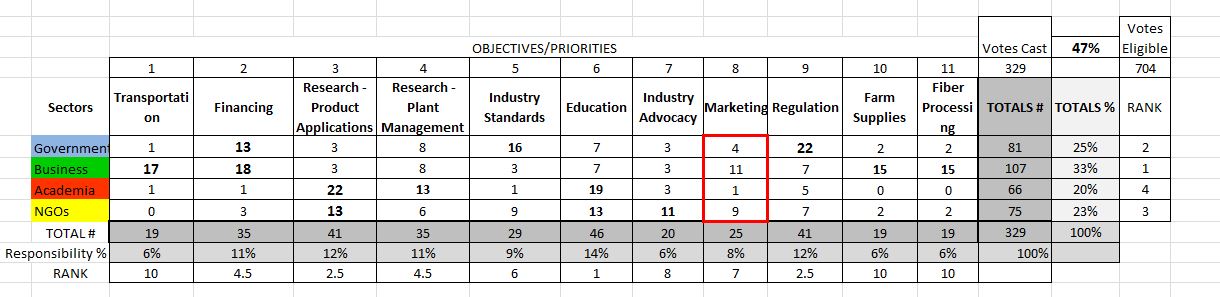 Table 1. Highlights the votes cast for allocating responsibility for each of ech of the 11 objectives between the 4 sectors