Resilience of Alberta’s Economy AND Effectiveness of Alberta’s Innovation Ecosystem – Fall ‘18 The Alberta Council of Technologies conducts a spring and fall survey of its followers for assessing the
The Alberta Council of Technologies conducts a spring and fall survey of its followers for assessing the “Resilience of Alberta’s Economy” AND evaluating the “Effectiveness of Alberta’s Innovation Ecosystem”. The following Report contains the summary results of the Surveys conducted in September 2018
Prepared for: Members of the Alberta Council of Technologies Society and the Economic Developers of Alberta
Prepared by: The Alberta Council of Technologies Society
October 2018
Monitoring Alberta’s Economic Diversification – March 2017
Monitoring Alberta’s Economic Diversification – March 2017
Monitoring Alberta’s Economic Diversification – March 2017
Monitoring Alberta’s Economic Diversification – September 2018
The Alberta Council of Technologies is “Creating the new Alberta!’ through our network of contacts sharing an interest in emerging technologies and their commercialization. Since 2015 we conduct in March and September a standard on-line survey of our followers for monitoring and benchmarking Alberta’s economic diversification and the associated innovation ecosystem. Questions should be directed to the Alberta Council of Technologies Society’s editor@ABCtech.ca
OVERALL Sentiment
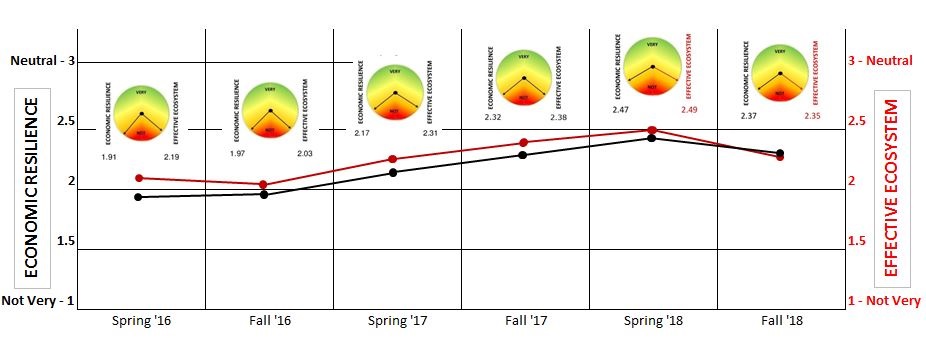
Uncertainties in the oil and gas industry and government deficits have weakened industry sentiment that Alberta’s is economically resilient with an associated decline in the sentiment that Alberta’s innovation ecosystem is effective for supporting small business innovation and diversification of the economy.
Alberta sentiment weakened further in fall ’18 for both economic resilience/ diversification and the effectiveness of it’s innovation ecosystem. The widespread gains since ’15 in economic resilience have reversed and is particularly extreme for the Calgary Region and Government & Public Policy. All industries/professions – other than Education & Research, have declined.
The shock is attributed to economic uncertainties in the oil industry: pipeline delays and the discounted price of oil, and the Alberta Government’s revenue vulnerability: budget deficits and debt.
Overall, the survey illustrates Alberta’s continuing economic vulnerability to being overly dependent on a single industry and the inadequacy of it’s innovation ecosystem to effect a transition.
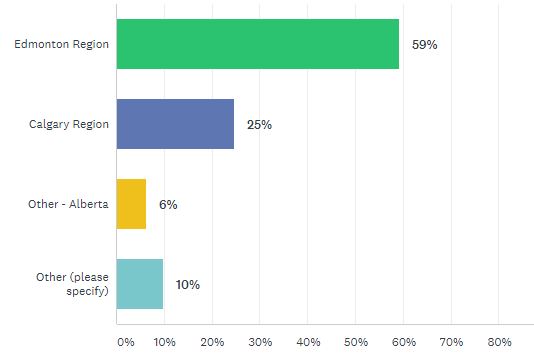
Sample – 59% Edmonton Region, 25% Calgary Region, 16% Other. *Survey extended in mid-September to include Economic Development of Alberta
First, about ALBERTA. We view diversification as the primary means of making Alberta’s economy more resilient, that is, less vulnerable and more able to recover from economic shocks. Next we portray the Regional locations of the survey respondents.
Q3. Location. What Region of Alberta do you most identify with?
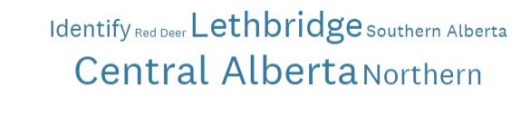
Cloud Summary of Others Specified
Spring ’18
Edmonton Region
59%
Calgary Region
25%
Other
16%
Fall ’17
Edmonton Region
59%
Calgary Region
25%
Other
16%
*Economic Developers of Alberta added in mid-September
The Edmonton Region at 59% is over-represented in the provincial sample; the Calgary Region at 25% is under-represented. Other – Alberta (16%) is comprised of non-urban Alberta respondents. The representation of Regions has remained the same between surveys.
Q1. On a scale from 1 = Not Very Resilient to 5 = Very Resilient, please rate how you view the diversity of Alberta’s economy
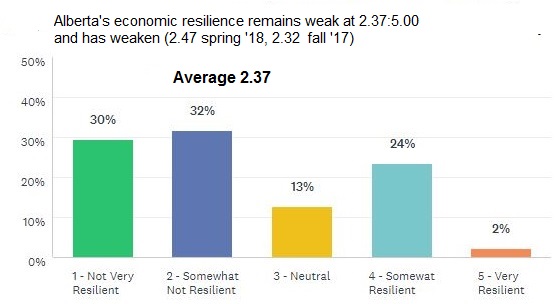
The overall sentiment is that the Alberta economy is not resilient and has recently weakened – attributed to the Calgary Region and it’s economic vulnerability to geo-political forces directed at Alberta’s oil and gas industry.
Most (62%) of respondents view Alberta’s economy as not resilient (<3.00) compared with only 1/4th (26%) viewing the Alberta economy as resilient.
On a scale from 1 to 5, with 1 being Not Very Resilient, the overall provincial average of 2.37 is negative, remaining well-below Neutral (3.00)
The provincial decline is attributed to weakness in the Calgary Region (2.05), pulling down the overall provincial index as continuing progress is evident outside the Calgary Region
The ER Index for the Edmonton Region – heavily public sector, and the Calgary Region – dominant oil and gas industry, have reversed since 2007.
Sample Comments – Alberta’s economy remains overly-dependent on the oil and gas industry
With about 40% of the provincial GDP coming from the oil industry and related activity, that leaves us at the mercy of the whims of that market. (1-Calgary)
There is no diversification in Alberta. Everyone, including the government, is hanging on the “oil droplet” for dear life! (1-Edmonton)
Dependence on Energy and Agriculture does not paint a positive picture for the future…. plus, delusions that technology will save us are just that… delusions. What happened to the Heritage Trust Fund?… pissed away and social programs. (1–Other)
Seems to be only two major sources of revenue for the province… Government contracts / Oil. (2-Edmonton)
It’s evident how Alberta, its two main cities have been affected by the stress of the oil & gas crisis. The unemployment rates continue high for more than three years. (2-Calgary)
Alberta has made good strides, particular Edmonton Region on diversification. Lethbridge is quite diversified, Calgary needs to improve still. (3-Edmonton)
I think we are in the initial phase of economic diversification and it will take another five years to actually become diversified. (4-Edmonton)
Despite the downturn in the energy industry, you still see vibrant communities in Alberta – lots of construction. Oil & Gas is a huge driver, but there’s a strong agriculture and food processing / ag processing sector; forestry; health sciences; logistics & distribution; construction; tourism etc. (5-Other)
Next, is to understand what measures underlie the assessment of Alberta’s economic resilience.
Sep’18
Q2. What factor(s) are the most sensitive measures(s) of whether Alberta’s economy is or is not resilient?
Sep ‘18
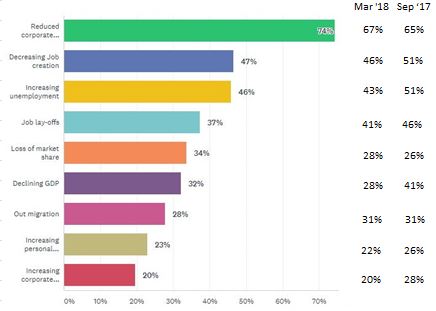
Reduced Corporate Investment and Employment/ Job related indicators are most frequently – and consistently cited as the most sensitive measures of Alberta’s economic resilience
The most sensitive (top 3) measures of resilience remain: Reduced corporate investment (74%, up 9% since fall ’17), Decreasing job creation (47%, down 4% since fall ‘17), and Increasing unemployment (46%, down 5% since fall ’17)
Most sensitive/ variable measures compared since fall ‘17: Reduced corporate investment and Decreasing job creation
Least sensitive/ variable measures remain: Out migration and Increasing personal bankruptcies.
Reduced Corporate Investment and Employment/Job related indicators are most frequently – and consistently, cited as the most sensitive measures of Alberta’s economic resilience..
The most sensitive (top 3) measures of resilience remain: Reduced corporate investment (74%, up 9% since fall ’17), Decreasing job creation (47%, down 4% since fall ‘17), and Increasing unemployment (46%, down 5% since fall ’17)
Most sensitive/ variable measures compared since fall ‘17: Reduced corporate investment and Decreasing job creation
Least sensitive/ variable measures remain: Out migration and Increasing personal bankruptcies.
Word Cluster of Other
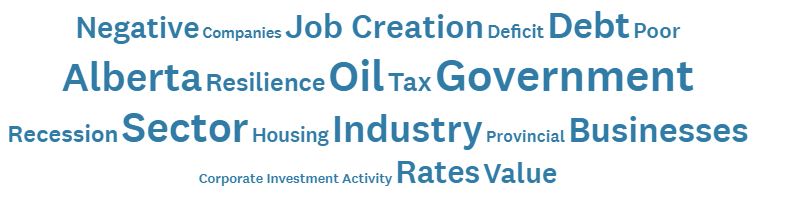
Sample Other – Other measures highlight concern with government policies, lack of job creation, and troubles affecting Alberta’s oil and gas industry
Household debt, cost of living, housing bubble. (1-Edmonton)
Increasing government employment, personal and government debt and no demonstrable plan to address this is a major concern. (1-Calgary)
Job creation numbers can be misleading. Public sector jobs, paid out of tax revenues and debt financing are not a good indicator of economic health. Private sector jobs are. (1-Other)
Investment dollars are leaving when the federal courts rule and not the government (1-Calgary)
SME job creation is the best indicator of economic health. (2-Edmonton)
Increasing Provincial Deficit.(3-Edmonton)
Number of AB innovations that have to move to the US to succeed. (3-Edmonton)
Start Up creations. (4-Calgary)
Over-reaction and lack of perspective and knowledge to the benefits and national importance of Alberta’s energy industry. The external attacks and lack of support in Canada is embarrassing and downright ignorant. (4-Other)
Why are these all negatives? Are you pre-biasing? (5-Edmonton)
Lack of respect and collaboration between industries. (5-Calgary)
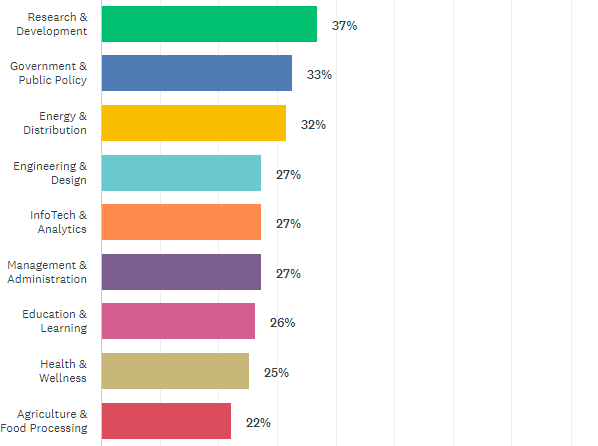
Next we investigate the sentiment of Alberta’s economic resilience by 20 industries/ professions.
Q3. What 5 industries and/or profession are of most interest to you? Choose up to five (5).
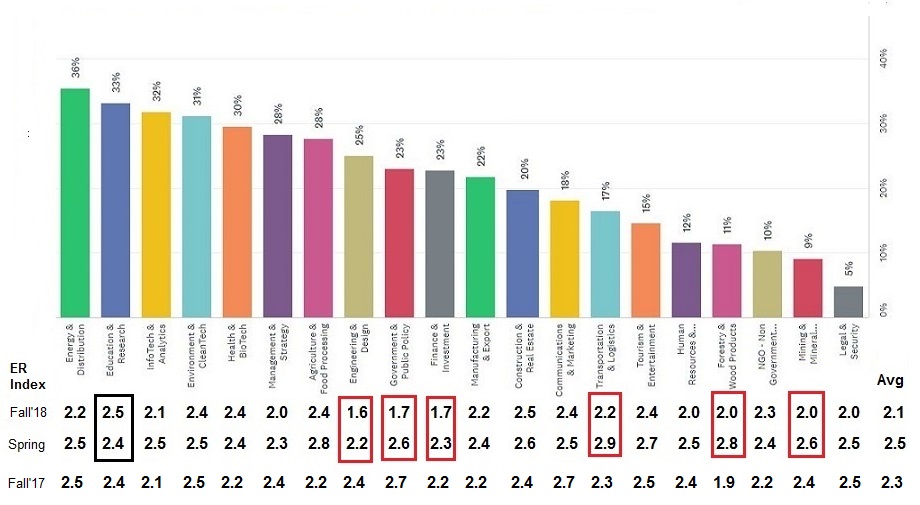
All industries/ professions with the exception of Education & Research portray a decline in Alberta’s economic resilience. The greatest declines came from those with an interest in Government, Forestry and Engineering
The Industry average for fall ‘18 declined 15% to 2.14 from 2.52 in spring ’18 and 9% from 2.34 in fall ’17
With the exception of Education & Research ALL other sectors portray a decline in Alberta’s economic resilience
Portraying the least resilience (<2.00) are: Finance & Investment (1.67), Government & Public Policy (1.69), Forestry & Wood Products (1.97).
While none are greater than 2.50, the most resilient are Education & Research (2.50), Construction & Real Estate (2.49), Communications & Marketing (2.40)
The industries portraying the greatest declines in resilience since spring ’18 are: Government -35%, Forestry -28%, Engineering -27%, Transportation -24%, Mining & Minerals -23%. Only Education increased 4%.
Next. what is the most appropriate role(s) for government to make Alberta more resilient?
Q5. What role(s) are most appropriate for government to make Alberta more resilient?
Comments Word Cluster
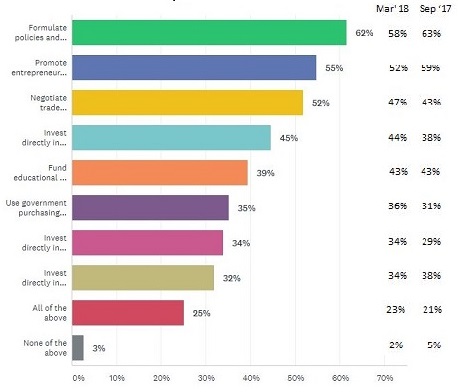
The appropriate roles for government to make Alberta more resilient are in policy formulation, promoting small business innovation, and negotiating trade agreements. Otherwise, spend less.
Most agree as appropriate: Formulate policies and employ incentives for encouraging small business innovation (62%), Promote entrepreneurship and small business start-ups (55%), and Negotiate trade agreements (52%)
Weakest agreement: Invest directly in technology commercialization (32%), Invest directly in PROJECTS that offering immediate job creation (34%), Use government purchasing power to develop and attract businesses to Alberta (35%)
Moderate agreement: Invest directly in RESEARCH offering long term job creation (45%), and Fund educational and training programs for ensuring that graduates can create new jobs (39%)
Little variation in the rank order of roles since fall ’17.
Word Cluster of Other
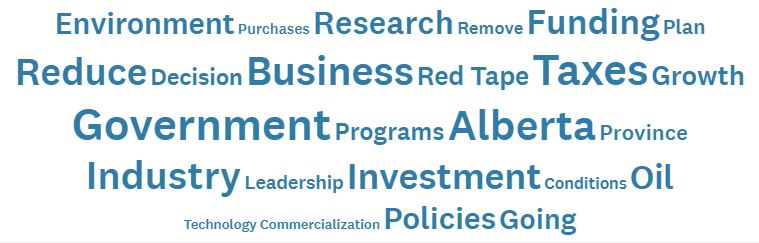
Sample Comments – A mix of recommendations for government policies and incentives supporting small business innovation and research. Frustrations with government spending and size, red tape and short-term perspective
Technology commercialization is the weakest sector in Alberta. (1-Calgary)
Governments falsely believe they can create job when it is debt they create. Create the environment, monitor, but let business do business. (1-Calgary)
Reduce taxes and regulations on small business. (1-Calgary)
Reduce red tape. (1-Edmonton)
Learn about accountability. Many programs initiated by government don’t work, yet are continued over and over. (1-Edmonton)
Reduce size and cost of government, reduce regulation, reduce tax burden, allow the market economy to improve without the CONTRAINTS of government and government over regulation. (1-Edmonton)
Cut taxes, cut regulations, reduce government by half”. (2-Calgary)
There are no policy tools to meet the need of start-up industries in Alberta. As soon as Oil & Gas picked up the focus at the political level, banks and investments returned to hope in energy.(2-Edmonton)
Research funding is needed where future industry and jobs will be (2-Other)
A lot of the above are occurring. What is not happening now are the next stages – SME growth and markets. I’m becoming very concerned about the uneven role and influence of multi-nationals across a number of sectors and particularly tech. (4-Other)
We cannot count on Government, they move too slowly and too many policies & initiatives are only for the next 4 years, elected can only see to next election and their own survival. We need serious long term planning: 10, 20 & 40 years from now (4-Edmonton)
Next we investigate the effectiveness of Alberta’s Innovation Ecosystem, but first –is the system essential for achieving diversifying the economy?
Q6. To achieve economic resilience/ diversification, Alberta needs an effective and continuously improving Innovation Ecosystem that supports the survival, growth and retention of Alberta’s entrepreneurs and SMEs. Do you agree?
Sep ‘18
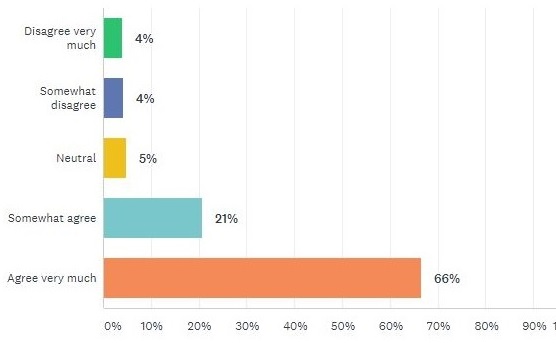
Strong agreement (87%) that Alberta needs an effective and continuously improving Innovation Ecosystem is needed that supports the survival, growth and retention of Alberta’s entrepreneurs and SMEs for achieving economic resilience/ diversification
87% agree, consistent with the spring ’18 and fall’17 (both 88%)
Only 8% disagree, consistent with the spring ’18 and fall’17 (both also 8%)
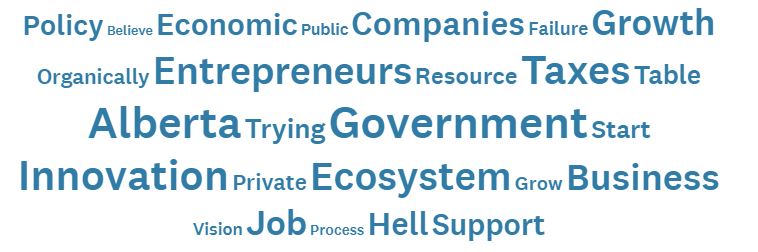
Comments Word Cluster
Sample Comments – Regardless of whether respondents agree with the need for an Innovation Ecosystem or not, ideas differ on what’s wrong with entrepreneurs, the system, and government
(Scale 1-Not and 5-Very: ER–IE Rating and Region)
Let the entrepreneurs develop their emerging technologies without the legislative and tax restrictions imposed by the government of the day. (1-1 Edmonton)
The current groups haven’t gotten it done because they don’t know anything about innovation, or technology, the key driver of innovation and technology. You will need technologists at the table in key leadership and management positions in all of these groups before anything changes, otherwise, the job of most people in current groups will remain not to understand anything because their job may be in danger, while the world passes Alberta by. (1-1 Edmonton)
Governments need to create the right conditions for entrepreneurs to flourish, regulate them so it’s not a free for all, then get out of the way. (1-1 Calgary)
Albertans are under the mistaken impression that entrepreneurs “owe” the public supports in the form of employment, benefits, intellectual property rights and Taxes. In effect, the royalty system has somehow created the idea that they can take whatever they wish from founders and treat them as I’d they have to justify their existence to the public. If there is a problem with archaic provincial-wide systems then the response is to blame the entrepreneur and not critique an antiquated system. The system of public regulation seems to be the problem. The status quo is reinforced by the old royalty thinking and this will certainly drive away innovative technology and businesses that are heavily invested in intangible assets. Innovation is important, but only one dimension for success in large business. Ecosystems and supply chain liaison is far more important to get products to markets. (2-1 Edmonton)
Current, government policy is pushing entrepreneurs to go elsewhere – we need a positive environment that is based in reality not political dogma. (2-1 Other)
Start-up ecosystem appears to only favour political insiders, money goes to high paid consultant and limited set of service providers. (4-1
I’ve worked in innovation for years and learned how leaders in the various sectors are not only investors in but also champions of innovation and sustainable operations that are good for all of us. There is absolutely no need to continually reinvent the wheel. Ask anyone in tech or innovation which ‘group’ is charting the way today and they will say ‘whichever one the government is currently funding.’ It’s a ridiculous waste of human energy, time and money. (5-1 Calgary)
SME growth IS the economic engine of any economy. (2-1 Edmonton)
Whereas as a country and a province we have been good at developing new ideas and products, we do a poor job of marketing them and retaining ownership. (2-3 Other)
Great to see the words effective and continuous in the vision. (4-4 Other)
I think we need a “business growth ecosystem”. (4-4 Calgary)
Yes, but it must be market focused and not overly reliant on tax support-it should have strong support in the private sector. (1-4 Other)
Finally how do respondents view the effectiveness of the current Innovation Ecosystem?
Q7. Is Alberta’s Innovation Ecosystem effective in supporting the survival, growth, and retention of entrepreneurs and SMEs?
Word Cluster Comments
Sep ‘18
Respondents 2:1 do not view Alberta’s Innovation Ecosystem as Effective
The average of 2.35 on a scale of 5 – Very effective and 1 – Not very effective, indicates the system overall is not effective
Few (24%) rated the system as effective and only 2% as very effective
More than twice as many (56%) rated the system as ineffective, 34% as not very effective
Litle change from 2.38 in fall ’17 2.38 but 6% decrease from 2.50 since the spring ’18.
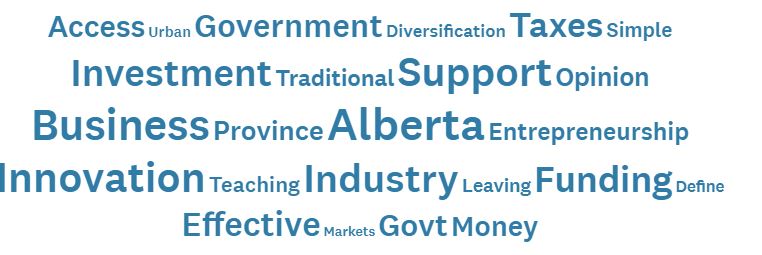
Comments Word Cloud
Sample Comments – Heavy critiquing of the Innovaition Ecosystem System is atrributed to it’s government affiliation
Again, it is so simple: align those who are already ‘doing it’ (from companies of all sizes and sectors). We have a province of brilliant, energetic and tenacious minds who are giving up because we too many organizations build independent castles. (1-Calgary)
Government’s attack on businesses has forced many entrepreneurs and investors alike to look elsewhere. (1-Edmonton)
No business can grow and no entrepreneur can be retained without ready access to the market for their products and services. (1–Edmonton)
Two new initiatives could have short term impacts, namely; allow SME employees to contribute to government pension plans with benefits that would carry forward regardless of employment/employer status, and establish a SME patent defense fund to ward off attacks from patent trolls. (1-Edmonton)
You can’t turn apples into oranges- we should embrace our natural resource based economy and do everything in our power to support it. We should layer onto it encouragement for value added manufacturing of petroleum and wood – for 2 examples. (1-Calgary)
Innovation support and investment markets have been too focused on the quick returns of the oil and gas industry resulting in underfunding other sectors. (2-Edmonton)
Retention is the problem. International companies come in to buy the local companies for Intellectual Property and move the core team out of Alberta. (3-Calgary)
Too many small businesses lack the capacity and knowledge for budgeting and long-term capital planning. As older business owners retire, Alberta runs the risk of losing key services in smaller communities, which increases costs for the average consumer and decreases the economic growth in general, and the specific economic viability of these small communities. (3-Edmonton)
We could do a lot more by teaching entrepreneurship in our schools, starting at the grade school level.(3-Edmonton)
Alberta still needs economic diversification and should be investing more in the new economy and needs to do more to build a vibrant tech sector. (4-Calgary)
Compared to other provinces, Alberta is quite effective here. It just doesn’t appear so effective when the energy industry downturns – but some of these businesses need to find their own innovative ways to diversify in order to survive. When you put all your eggs in one basket (industry or customer) then you are at higher risk when that basket disappears. (5-Other)
Survival is the wrong goal for innovation. Highly effective as evidenced by Alberta Innovates Technology Commercialization Scorecard. (5-Edmonton)
* * *
Copies available to Members of the Alberta Council of Technology Society and the Economic Developers of Alberta
KEI Network is a non-partisan platform connecting Alberta's experts, entrepreneurs, and leaders around the ideas shaping the province's future. Built on over 20 years and 15,000+ contacts across academia, government, and industry, it delivers reporting, events, and analysis without the spin.
From policy to emerging tech, KEI Network keeps you informed and connected to the people actually doing the work.





 Cloud Summary of Others Specified
 Word Cluster of Comments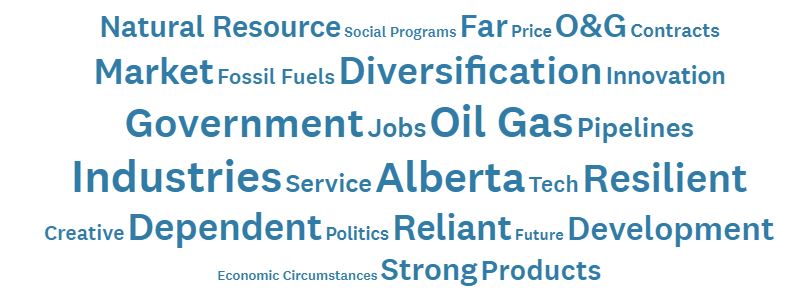
 Sample Other – Other measures highlight concern with government policies, lack of job creation, and troubles affecting Alberta’s oil and gas industry

 The appropriate roles for government to make Alberta more resilient are in policy formulation, promoting small business innovation, and negotiating trade agreements. Otherwise, spend less.
  Word Cluster of Other
  Strong agreement (87%) that Alberta needs an effective and continuously improving Innovation Ecosystem is needed that supports the survival, growth and retention of Alberta’s entrepreneurs and SMEs for achieving economic resilience/ diversification
 Sample Comments – Regardless of whether respondents agree with the need for an Innovation Ecosystem or not, ideas differ on what’s wrong with entrepreneurs, the system, and government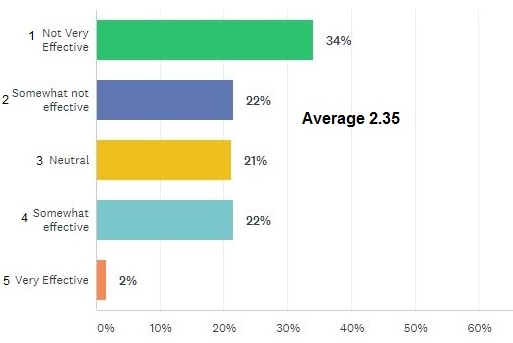
 Sample Comments – Heavy critiquing of the Innovaition Ecosystem System is atrributed to it’s government affiliation