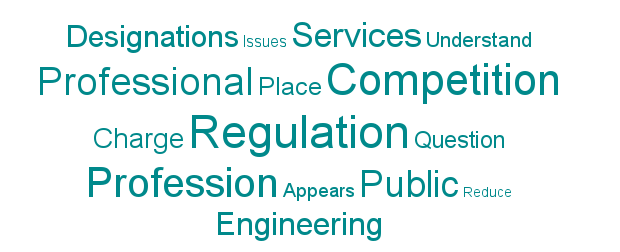
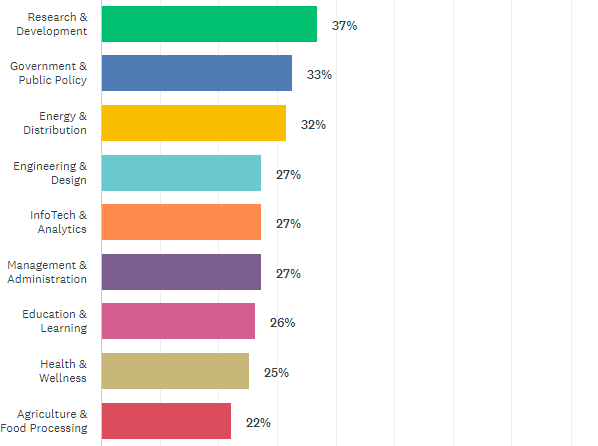
What regulated professional body(s) - up to two, governs your practice? Primary Profession – 100% Real Estate Medical CPA Researcher Professional APEGA Advertising Alberta Forestry Engineering Account
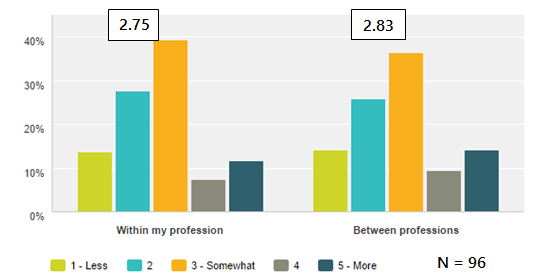
Q2. Should there be a change in the regulation of competition in Alberta between and/or within professions?
Observations:
Respondents expect increasing competition to result in less vs more regulation (1+2 vs. 4+5) both within (42% vs. 20%) and between (37% vs. 22%) professions. They also expect regulations to be less within than own profession than between professions.
Comments:
Change the notion of competition to regulations that foster collaboration
No; there should not be a change in the regulation of competition in Alberta between and/or within professions.
Since I am not affected by this, I see no need for change.
Associations should not be allowed to regulate “behind closed doors”, proceedings around compensation, practice limitations, and disciplinary actions should be available to the public. Some associations do this better than others, the behaviours of some is intolerable to the best interests of the public.
Recently changed
there already is significant competition in financial services.
It’s important to regulate professional practice. Improving discipline, reporting and follow up.
biologists doing soils work, no training, ASET promoting itself as the place for for all technologists, not accurate
entrepreneurship will regulate competition on its own
CPA is a massive monopoly that is out of control. with a massive bureaucracy. We need independent competition
its working quite well right now
AIA does not work for its members
cancel arbitrary and artificial provincial distinctions that create needless interprovincial barrier to entry
I’m not aware of any issues
We need more than our current “right to title”
Not sure I even understand the question
This question makes no sense
There is often a strong tie between Engineering & IT in the workplace.
the words management consultant should not be used unless the professional is a member in good standing with the professional body, government should not compete with the private sector by offering (unqualified) consulting services at no charge
This help differentiate the degree holders from actual experienced individuals
I believe self-regulation is the best for professions.
Libertarian
Hard to explain. My profession is made up of freelancers for the most part
College of Alberta Psychologists is regulating for the sake of regulation, rather than genuinely protecting the public and advancing the profession.
I work installing vinyl membrane systems. Decks and roofs. Builders hire us to do the job. We charge a fair price. Market is savaged on 2 sides. Low end. Low/no skill installations. Vinyl leaks. House/building wrecked. They wanted cheap. Got cheap. At the high end. Say we charge a builder 2000 for installing a membrane. The Builder charges the home owner 10000 for the vinyl. People then conclude vinyl sucks and it’s prohibitively expensive. We need a cohesive construction trades plan. The one now is not capable of handling the new sustainable construction wave that is upon us.
There is specific knowledge and potential public risk created by compromising professional boundaries. Competition should be enhanced using other methods that compromising public safety and interests.
At this point, we have not experience any issues with within professionals groups or among professional groups
Professional qualifications should be clearly defined but competition among qualified persons should be allowed.
There are so many designations you can just about pick any three letters and they’ll mean something to someone. Reduce the numbers of designations – one per profession but have ‘degrees’ of proficiency for components of education and experience.
Competition is not regulated
The regulatory level appears to be effective.
Embracing “open source” and “active sharing” is THE WAY FORWARD
There appears to be some overlap in the regulation and ethics in what the societies core functions are
While reduction in regulation is almost always a good thing, there are valid policy reasons for it. Protection of the public is key.
we are international and it would be duplication
price cutting to an extent that violates the federal Competition Act, is rampant
The bidding documentation for the projects is extremely long, complicated – government should reduce the size of such documents to make it more user friendly
Regulations updated not too long ago.
Architecture should be governed by rules developed in association with international bodies
Less because you have non designated Accountants providing Accounting services and endangering the faith in “Accountants” as a profession
The regulation needs to consistent
Multidisciplinary teams of professionals are best for most projects.
regulatory review and update is an ongoing activity in the professions already – competition has existed continuously for decades
there are area where there is not one clear profession such as engineering and environmental practices such are reclamation
When it involves public safety and their interests
many professional organizations ‘make’ members practice in a funnel or practice area. I think limited someone’s scope kills innovation.
There are so many designations. Some require school and experience, others don’t. Consolidation of designations with sub-classification (A=meets academic requirements; E = meets experiential requirements; L = meets licensing criteria etc.) would simplify things for consumers
Engineering is a regulated profession to ensure that public health and safety, as well as environmental concerns, are properly managed. Only certified engineers should be allowed to practice.
APEGA regulation very good but under review. Stove-piping between professions needs careful but open management.
Limit numbers in profession
There needs to be a defined distinction between a CMC, CMA, MBA, CPA. Confusion exists in the market place.
I have not encountered problems in this area and don’t see the need for less or more competition
CPA recently changed, legal services being done by more technicians.
Do not agree with regulating competition
do not understand. What is the context?
There needs to be more collaboration between and within professions.
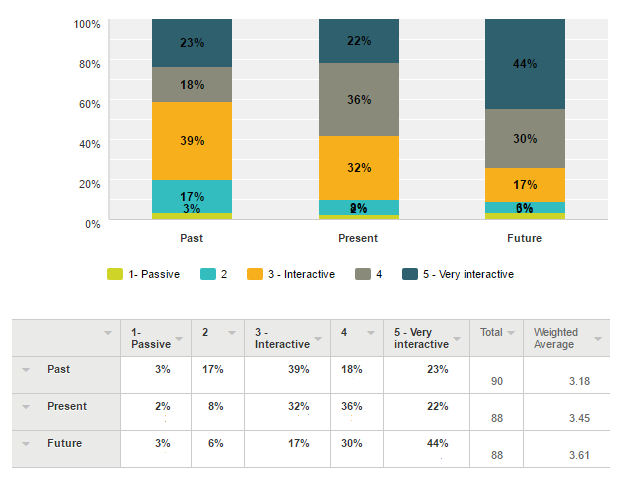
Q3. Please rate the past, present, and future relationship expected with you by your clients/customers.
Observations:
Respondents view their clients/customers as more interactive than passive, moreso in the future (74% vs. 9%) than currently (58% vs. 10%) or in the past (41% vs 20%)
Comments:
multidisciplinary educational programs
We try and educate our clients to lower support costs.
I am recently retired.
more regulations means more interaction
Retirement
continued success / survival of humanity depends on networking and networking enablers
Better informed clients
Technology leads to increased client awareness
This is total nonsense.
I need to spend more time with both professional associations, although being retired makes it more m
today, clients are expecting consultants to be more actively involved in the implementation of recommendations
Use social media more often
internet access
The nature of both psychology and consulting.
I hope things get better. They can’t get worse. Marketing. Get the ideas into the right hands and hope they are not just government appointed straw people. Talk and talk but nothing really changes.
As technology changes the academic panorama, my interaction with faculty becomes more important
Increase in accountability and transparency.
I expect that more communication among professionals on the team going forward will enhance the competiveness of any firm
Clients have less ownership of their work
Less role for Government contributes to more reliance on professionals and all this is great.
People have access to information and understand more, or think they do. Relationships are key to build trust so misconceptions can be corrected.
Healthcare is about relationships. Care requires personal relationships. High touch is a contributing critical success factor.
More electronic communication expected.
Speed of doing business – often seems like “hyper-speed”
I do not expect much change in the future
Connectivity and instant access changes expectations.
Mobile technology.
businesspersons are succumbing to doing everything too easily, online, for next to no money
The micro-grid technologies are very complex and more interaction between service provides and client is necessary to clarify the client’s needs.
Clients want to be more involved in projects and exercise more control
Design professions, generally, are becoming extremely complex and decisions governing design need to remain in the professional realm.
Technology and the democratization of knowledge access
access to people via electronic tools creates the perception that immediate response is a desired thing, even before an issue/problem/opportunity is well defined
There is a wider access to knowledge or “facts” sometimes without the knowledge of what assumptions go into the “facts”
Need to be interactive due to the lay individuals providing scopes of work for our professionals to respond to providing professional services.
More knowledge based public.
People are much more relationship-minded
Lagging economy means that our clients expect a higher level of service for less.
More clients think they know how to do engineering
younger generation want to be part of all decisions rather than delegating. More explanation required if deviating from Google path or explaining why alternatives do not apply to their circumstances.
move to more and more “turn-key” projects. Attitude is “give us something that works, and leave it.”
The need for everyone to benefit.
The changing natures of the assets that drive the economy (intangibles)
Q4. Is continuous learning by your profession’s practitioners required due to changes in technologies? Comment on what may be contributing to changing expectations.
Observations:
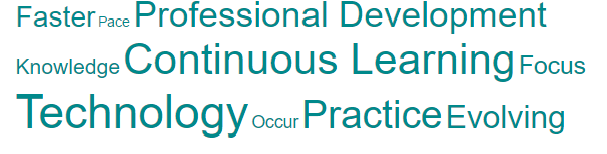
Changes in technologies are increasing the requirement for continuous learning in the respondent’s profession(s).
Comments:
professional development hours are a requirement of the practice.
In IT. Things change every 3 months.
More DIY due to the internet, less conferences and events because of cost and time commitments. Members are skeptical of online webinars – enrolment is low.
Continuous learning requirements are focused in other areas.
Continued professional development is a key aspect of Professional Engineering.
Continuing competence is regulated – new technologies require the education.
Education is controlled by the Bureaucracy a major conflict and not practical Each industry has their own focus.
a lot to catch up!
but it is not up to a arbitrary regulation body to stipulate it and regulate it.
Only those who embrace change will thrive in the constant disruption and the accelerating pace of change u
I still have no idea who you are or what you want.
mostly knowledge but some tools.
learn for free online … and faster.
Is required, but not particularly due to changes in technology.
Keeping up to date with current technologies is very much an independent pursuit.
It’s a simple thing waterproof the building with a welded vinyl membrane. Proven tech. Works. Lasts. As long as it’s done properly.
All professionals need to be up-to-date with technologies that create strategic advantage.
Good practice requires recognized upgrading.
Pharmacists must constantly maintain their competence with respect to new drug and medical device technologies. A rapidly emerging disruptive force will be point of care technologies, which will empower individuals and further empower pharmacists in their roles.
A reasonable level of CE.
YES, management consulting is evolving continually; ditto for patient safety; quality; service
This is a good thing!
World is moving towards more complex technologies, so continuous learning is MUST.
Within my profession I focus on R&D
Material technology, information technology and construction technology are changing at a very rapid pace — continual education is mandatory
Continuing education is required in my industry and technology is part of the evolution
this has been the case for decades
Things are always evolving and moving into clearer understanding or different ways in which things can be done.
It is mandatory
continuous learning requirements are more related to changes in laws and regulations
Continuous technical learning is extremely important to staying competitive and ahead of the curve – this is often overlooked by many firms.
Technology is changing faster now than in the past.
Business owners struggle to keep up with rapidly changing technologies and the impact on their firms.
more driven by legislative changes. Practice Management affected by technology efficiencies and client access
Changes occur in techniques/ methodologies, technology platforms and expectations
If change does not occur or if an organization stands still, it will be obsolete in no time.
Continuous learning is important but generally focuses on knowledge and application of such
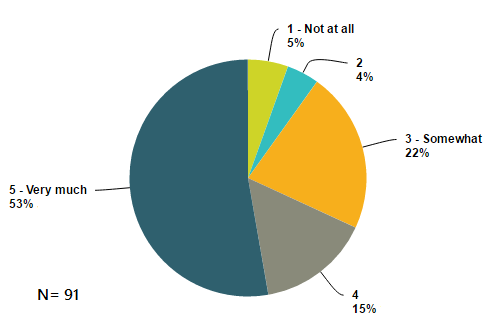
Q5. Is technology changing the expectations of clientele/ customers served by your profession?
Observations:
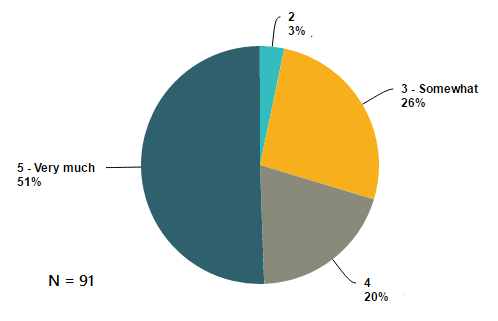
Almost all (97%) of respondents view technology as changing the expectations of their professions’ clientele/ customers. More than half view technology as Very Much changing their expectations.
Comments:
It is the interaction with the client that determines expectations keeping pace with the technological advances
Clients simply demand more…
expect short – to the point – learning tools.
Technology facilitates a temptation for clients to rely on Professor Google
drones, 3D, LiDAR, Spatial technologies
Innovation is critical with a noncompetitive environment caused by big government and waste.in all levels govts.
looking for more personalized services and more specific recommendations
Stronger better faster longer
clients expect consulting services to be delivered quickly, accurately, cost effectively and want to see the roi
clients lack vision for implementation of technology
people know when they’re getting a bad deal
Because people.
The change I see is expansion into flat roof living roofs. Roof with 18″ of soil. Urban agriculture. Edmonton has a major heat issue. Living roofs reduce the heat reflection of dense urban areas.
Research results are expected to become available faster
As communication technology improves, savvy clients will expect their vendors to be current
Internet, instant access to information, instant access to services.
Individual centered care supports individuals being the center of, and a key role player in their health decisions. Therefore access to personal information (just in time) is of increasing interest to individuals.
Timing and delivery style is evolving.
There is tremendous pressure regarding budgets and for labour (in health sector in BC)
Some, but they still want to get back to the core of operations and information
The customers’ expectations are not clearly defined; they have to be educated…
they expect instant 24 hour service, for free
Perception is access to research data is easier and software tools more robust in predictions
information technology puts resources, alternatives, and publicized work more and more in front of clients
Clients are more educated and want to be more I touch and use technology for both.
people expect quicker answers to weakly defined problems (!?)
Clientele expect the latest trends
No longer is the doctor the only one in the room who knows the facts
Technology and Innovation are the key to solving todays complex challenges and maintaining the standard of living we expect and take for granted.
Clients have access to much more information and are more educated. Sometimes they are overconfident that they understand what they are finding though.
Clients expect deliverables that accommodate and mesh well with their own systems.
Incomplete media coverage of technology change raises expectations more than the technology itself.
We are expected to stay abreast of changes and the impacts on businesses. Clients are increasingly more knowledgeable. To bring value to them, we need to know more.
access and delivery turnaround
even if the underlying technology methdology is well developed, the look/feel/user experience expectations change.
Clients and customers must be made aware of the changes in technologies and their benefits before they will change their expectations and advance.
Clients expect better turnaround time and accurate service in some areas but understand the time necessary to perform work in other areas
Q6. Should the influence of clientele/ customers be increased in regulating your profession.
Observations:
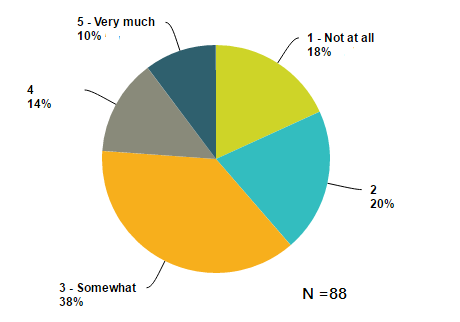
The influence of clientele/ customers in regulating their profession should be increased Somewhat or more by 62% of respondents.
Comments:
Two way communication is always the most effective in establishing best practice
Not affected by this.
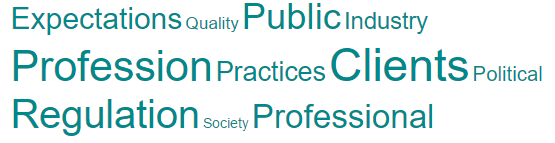
Depends. I suggest professional associations need to be better attuned to their mandate to protect the interests of the public and not their members.
Too often, clients are more influenced by emotions than by logic and depth of knowledge
Client/Public feedback is important. The profession includes a social contract/license to act in the interest of the public.
in most cases, they do not recognize the important of know-how versus know-about in delivering professional services
client driven industry
Yes in all industry especially the law society and the courts which are materially broken “wild west” a new lawyer
clients demand grossly exceed available resources
My profession is minimally regulated
we are in the business of meeting client requirements so should understand and deliver accordingly
people gave expectations today that government will solve all problems. not good.
use common sense
It would keep the level of quality up. by keeping forcing installers to be certified.
Research should be impacted more and more by industry
Professional regulations are established to maintain professional standards of performance on behalf of society, not the clients.
Customers would have a greater appreciation/understanding of the profession
We already have a commitment to engagement with the public; and our governing board includes 25% public members. Our board must govern the practice of pharmacists and pharmacy technicians with a broad perspective; addressing practices that are in the interest of individuals, families, communities, the health system, and the integrity of the professions. Safety, quality, and accessability are critical considerations; important tot sustainability for the system.
OK as is.
As client learning and expectations increase we need to stay focused on what is best for our clients.
I have absolutely no idea what this question is directed at.
As long as it does not degrade duty for safety of the public.
Government is in charge of regulating the electricity market, and thy are very, very, very slow in changing regulation. The industry cannot get modernized without government’s actions.
Already the burdens of having to be everything to everyone, are becoming impossible to bear
Clientele already have indirect input via members of the profession and impact on their services
The profession is far too complex — it even puts heavy demands on licensed practitioners — for the lay person to even begin to grapple with the design platform.
Clients should be consulted. But all levels of clients not just the ones with political or Financial influence.
this already exists. if taken to an extreme, it could create a situation where under-informed people making frivolous complaints try to change the laws of physics using political means
outside perspective of what the profession is doing or capable of doing.
They already have significant say
If it hampers the obligations of our profession to protect the safety and the public’s interests.
regulatory organizations are there to protect the public and may conflict with customer expectations, for example
We have to meet the clients expectations and be professional.
The old Realtor model is no longer relevant and survives solely because of MLS. Realtors need to redefine their value and their payment model.
As a consultant, technical independence is a staple of the service we are able to provide. I believe that the influence of clientele in regulation could compromise this independence.
No, Engineering regulation is to ensure public safety. Clients want lower cost, which is not usually consistent with increasing safety.
Non-engineers sit on APEGA Council
We are self-regulating and the clients usually have the sophistication to deal with issues as they arise. Business owners are intelligent people.
CPA merger has moved to less regulation resulting in more buyer beware but increased quantity for client choice.
see first response. There is not a regulated OR / Management Science / Analytic profession
We have enough regulation of my profession already. Clients and customers need to keep up with the changes in regulatory requirements, since they do not appreciate or understand their impact on their businesses.
Any good professional is client focused and ensures their business follows related best management practices.
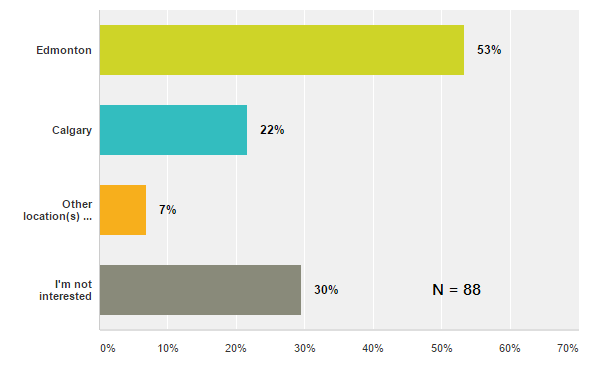
Q8. We expect to conduct a seminar on this topic for sharing the survey results. Would you attend to share your views and learn more? And where would you prefer a seminar be held? Multiple answers are OK.
Observations:
Fully 70% of respondents are interested in attending a seminar for sharing the survey results, Edmonton is preferred over Calgary and Other locations.
Comments:
Relatively close to Edmonton with few travel/overnight costs because expenditures are highly regulated
Peace River
recently retired
I’m located out of province.
this survey is biased to focusing on needs of clients, not on Alberta promoting innovation by demanding a high level of know-how by its professionals
NDP are not listening and not fixing anything. Accountability?
As this survey made no sense, I have no interest in its results.
online webinar
just do a blog
I don’t have money to pay for stuff like seminars and talks and stuff I have time to discuss tangible actions to a specific goal.
Whitehorse, Yukon
An interactive webinar will allow numerous locations to simultaneously participate.
Sure I would participate
Very interested.
Vancouver, Ottawa, Montreal or Halifax for “east”
I’m mostly in BC these days
On line seminar would create ease of participation
What ever will work for the majority.
I consider myself a leader in this topic, therefore rather than attending, I may be interested in presenting.
I would be interested in learning from others and sharing what our business does.
Q9. Who in the Alberta should we interview to gain further insight into what changes are needed – if any, in the regulation of Alberta’s professions?
Comments:
Academia (Alberta Teachers Assoc.) (University of Alberta) (Alberta Government-Social Services, Environment, Labour, Indigenous Relations)
APEGA
No one that I know of.
The disconnect between teaching staff and parent expectations. Often even other professionals who are non-teachers do not understand the demands of the teaching profession (ie. childcare services, individualization and dof
Alberta regulators of the Professional Act(s)
Regulators, patients
all the regulatory bodies should be consulted
Professional bodies and their clients
Diane Johnstone at APEGA
Certified Financial Planners
AIA, focusing on defining practice areas, practice stds and practice reviews
member organizations, CAPFT, CAPP, ASPB, ATT, etc….
Independent lawyers and accountants.
Legislature
customers that are affected by increasing regulations
Kathy Janzen of the ACPA
grads student, customers, employees
Professional Financial Planners
Start with yourselves and ask whether or not you make sense to anyone else.
the CIPS association; CA’s & APEGA
for management consultants – CMC Alberta, Government of Alberta (POARA), cross-section of organizations that hire consultants
The chancellor and science and innovation ministers
the associations
Speak with those in the areas
Go to Stanford or MIT, no one in Alberta has a clue or knows what they’re doing.
No one I can think of
psychologists who have been subjected to the discipline process; 2) discipline panel members 3) practicing psychologists 4) people who have lodged complaints against psychologists
The top 3 professional associations
Peter Josty – Alberta THECIS, Calgary
Provincial Ministry responsible for Human Resources, Jobs, Skills and Training
Not sure, assuming the obvious professional bodies as well as typical clients are able to collaborate
Erick Liebl
Gerald Chipeur
Contact professionals in related professions, for example, for Agrologists, talk to Foresters, Biologists. Senior members of the professions should be interviewed as well.
Your question is leading and presumptive.
AGEGA staff and directors.
Alberta Health & Wellness; Canadian College of Health Leaders
That is a very broad topic. I feel that you should consult with a both the professional and clients to understand both perspectives on professional organizations
Alberta Electrical System Operator should lead the regulation changes that would support microgrid technology implementation and creating prosumer (producer & consumer = one entity) market.
APEGA, Alberta Ministry of Labour
Educators
talk to the snake oil salesmen. they’ll recommend no professionals or regulations at all. then they can rip off consumers and clients more easily
Adrian Pritchard
Consulting Engineers of Alberta, Alberta Association of Architects
Consulting Engineers of Alberta and APEGA
clientele
You should talk with the Minister of Labour to get a list of the professional regulatory organizations and get them to send this survey to their members
Those in the professional that deliver and the customer that receives the service. Both are equally important.
Nadine Triska, AB Skills Labour and Training
??
Large employers
CEOs of professional associations and colleges, especially about relationships with others over boundaries.
CMC Alberta, Haskayne School of Business
under 45 owner managers
The focus should be on the evolution and changes in the regulations and not the regulation of the professions.
Robert McGarvey
I would recommend undertaking 3 tasks by profession: (1) examine the number and type of complaints made by clients over time; (2) conduct a survey with leaders of professional bodies and members about their most critical business issues that confront them today, (3) conduct a self-assessment with professional bodies and members about the extent to which their organizations are characterized by a culture of excellence and they have deployed best management practices (i.e. Organizational Excellence Framework. The resulting analysis and findings will shed light on client issues, professional issues, and the underlying cause(s) of such.
Share your love
KEI Network
KEI Network is a non-partisan platform connecting Alberta's experts, entrepreneurs, and leaders around the ideas shaping the province's future. Built on over 20 years and 15,000+ contacts across academia, government, and industry, it delivers reporting, events, and analysis without the spin.
From policy to emerging tech, KEI Network keeps you informed and connected to the people actually doing the work.