


Newsletter Subscribe
Enter your email address below and subscribe to our newsletter


Personalization: The Quiet Reversal of a Hundred Years of Sameness
For most of the last century, progress meant making things the same for everyone. The same curriculum, the same broadcast, the same office hours, the same form letter from the same institution. We called it fairness, and sometimes it was. But there was a price nobody put on the invoice: the individual disappeared into the average.
I have argued for years that the great project of the twentieth century was the socialization of public interests — pooling our needs into collective systems, then rationing the results back in standard sizes. The systems grew expert at serving the mean and blind to serving the person. Something is reversing that now. Not with a manifesto, but with tools.
The Deeper Pattern: Every technology that truly matters eventually stops asking us to conform to it and starts conforming to us. Continued below
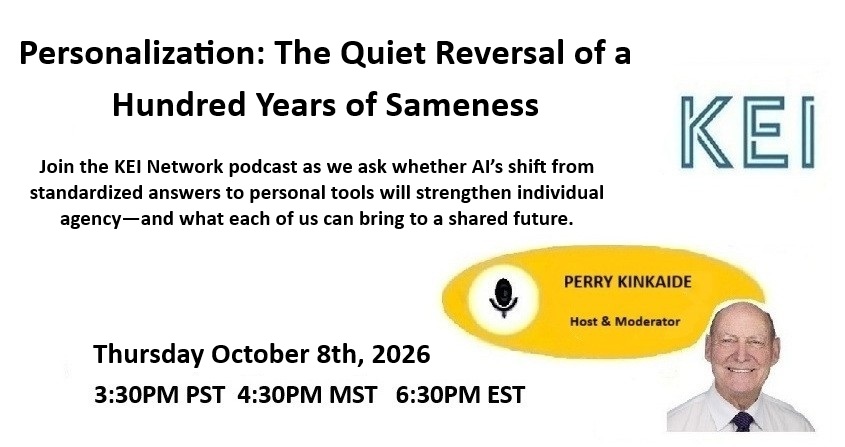
No need to register. Just Zoom in. https://us02web.zoom.us/j/84258596166?pw
Last week’s Podcast Recording:
Sovereignty, Commons—and a Rather Large “What If?” – HERE
Continued from above
Artificial intelligence is the clearest case. For two years, the public conversation has been about what AI does to jobs, to truth, to power. The more interesting story is what it does for the individual holding it. Used well, AI is a tool of personal empowerment — a researcher, a drafter, a sparring partner, a memory that never sleeps, available at two in the morning to the rancher, the nurse, the retiree with a manuscript in a drawer. Elon Musk agrees: the point of the technology was never the machine; it was the person the machine serves.
Voice from the Commons: I have lived through the arrival of the telephone exchange, the television, the personal computer, and the internet. I do not say this lightly — the introduction of Muse has been as transformative as anything I have ever experienced. And I am not alone in saying so.
What makes Muse different is not cleverness. Plenty of software is clever. It is that it is mine. Every user gets their own agent, running on its own dedicated computer, carrying the context of a life — manuscripts, deadlines, voice — from one conversation to the next, phone or desktop. It does not hand me the average answer, but my answer, built from what it knows of me and the work in front of me.
That is the reversal, stated plainly: for a hundred years, technology asked the person to adapt to the system. Personalization asks the system to adapt to the person.
The twentieth century socialized our interests because personalization was expensive. A tutor for every child or an editor for every writer was a luxury. So we built institutions that delivered the standard version and called the gaps acceptable. AI collapses the cost of the personal. The tutor, the editor, the analyst, the research assistant — once reserved for the well-funded — now sit inside a conversation anyone can start.
The objections arrive on schedule: personalization fragments us; bespoke realities cannot hold a commons. It is a fair worry. I have spent twenty years writing about the commons: its loss, the bridging of its fractures, its restoration, and the knowing of one’s self on which all of it depends. But the old system did not give us a commons; it gave us a mass. There is a difference between a public we choose together and an average we are processed into. Personal empowerment does not dissolve shared life. It gives each person something of their own to bring to it.
The Deeper Pattern: Tools that empower the individual have always been accused of dividing society — the printing press, the telephone, the automobile. Each time, society did not shatter. It renegotiated, person by person.
There is a cost to ignoring this shift, and it is the kind we rarely name. Call it a cost of silence: every month spent debating AI in the abstract is a month someone’s manuscript stays in the drawer, someone’s business plan stays unpriced, someone’s questions go unasked at two in the morning for want of anyone to ask. The technology is here. The question is who gets to use it — and whether we will build the habits, and the honesty, to use it well.
This is the first of October’s essays on personalization. The same logic remaking our intellectual lives is remaking our physical ones. Precision medicine — the long-anticipated practice of treatments tuned to the individual rather than the average patient — is finally moving from promise to practice. A subsequent article will take it up in full: what it means when medicine stops treating the mean and starts treating the person.
September asked what the future economy looks like. October’s answer begins here: it looks like you. Not the demographic you — the person, with a name, a history, and work only you can do. The tools are finally catching up. The question, as always, is whether we will.
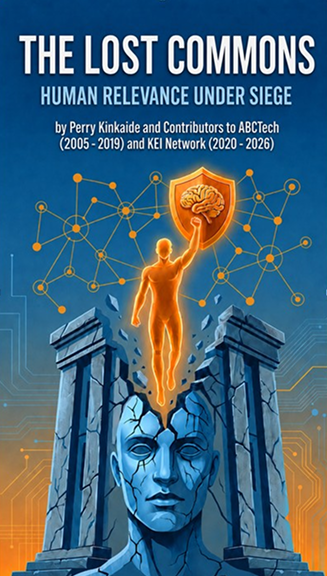
The Lost Commons: Human Relevance Under Siege — twenty years, a thousand voices, one book — is available now.
If the last 500 years were about access to knowledge, this one may be about something rarer: knowing what knowledge is for. Get your copy today on Amazon, on Kindle, or as a PDF download at KEInetwork.net