


Newsletter Subscribe
Enter your email address below and subscribe to our newsletter


September at the KEI Network has been devoted to the future economy: the forces reshaping work, technology, investment, institutions and the assumptions upon which prosperity has been built. October may be rather less tidy.
October has long had a reputation for surprises. This year in Alberta, one surprise is already scheduled. On October 19, Albertans will vote in a ten-question provincial referendum. One non-binding question asks whether Alberta should remain a province of Canada or whether the provincial government should begin the constitutional process required to hold a future binding referendum on separation. Continued below
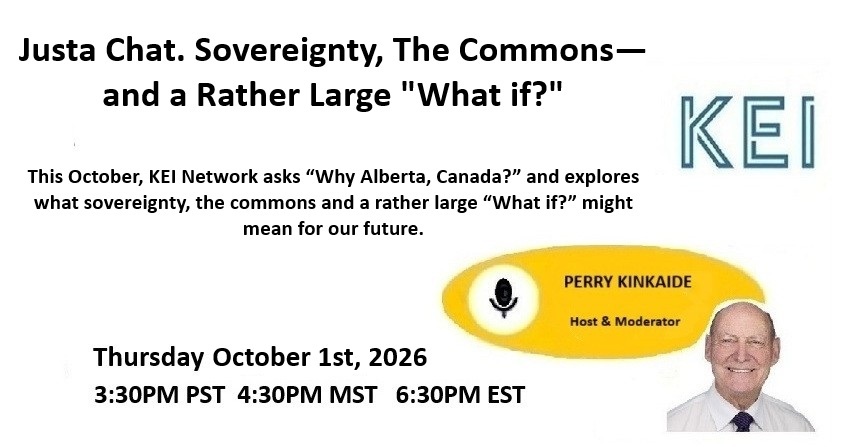
No need to register. Just Zoom in: https://us02web.zoom.us/j/84258596166?pw.
Last week’s Podcast Recording:
Change Management and the Canadian Economy – HERE
Continued from above
That is quite a question. It suggests an equally large theme for the KEI Network in October: sovereignty. The question is larger than whether Alberta should leave Canada or stay. What does sovereignty mean in an increasingly interdependent world?
The Commons beneath the argument. We began exploring Alberta’s future in September with a SPECIAL panel bringing together three perspectives: Separate, Prepare and Stay. October takes the conversation further.
The WeUnify Leadership Conference in Calgary on October 3–4 offers a starting point, with discussion of Alberta’s sovereignty referendum and the future of its institutions and communities. On Saturday, October 3, the KEI Network will revisit a question: Why Alberta, Canada? This time, the discussion will be accompanied by two publications that approach sovereignty from very different directions.
The first is serious. The Lost Commons: Human Relevance Under Siege asks what happens when the institutions, technologies and systems we created to serve us become so large, efficient and powerful that the human being begins to disappear from the equation. It asks what we have gained, what we may have surrendered, and whether the institutions governing us still represent the commons we thought we shared.
The second publication is rather less serious. At least at first. Enter Goldie Locks
Goldie Locks and the United States of North America began with a mischievous response to the suggestion that Canada might become America’s 51st state. Why, I wondered, should Canada accept the offer as presented? Why not make a counteroffer?
Once that door had been opened, Mexico became understandably annoyed at being left out. Central America appeared at the negotiating table. The Caribbean began looking north. Before long, a Canadian response had become a continental thought experiment: the United States of North America. Absurd? Certainly. Impossible? That is where the fun begins.
Satire sometimes lets us ask questions that serious political debate makes almost impossible to ask. What should remain sovereign, and what should be shared? Where does independence end and interdependence begin? Can a province be economically sovereign while depending upon national and continental transportation, defense, finance, communications and markets? Can Canada call itself sovereign while relying upon technologies, supply chains and defense systems extending far beyond its borders? And if North America’s three large countries are already deeply interconnected, what exactly are we trying to protect when we talk about sovereignty?
Too hot. Too cold. Just right? Goldilocks had the advantage of three bowls of porridge. Politics is rarely so accommodating.
Alberta’s referendum will not settle the larger questions of federalism, identity, economic dependence or sovereignty. The question concerning Alberta’s constitutional future is non-binding. Choosing the option to begin a constitutional process would not itself separate Alberta from Canada; it would point toward a later binding referendum.
But the vote will bring questions into the open. That may be its greater significance. October at the KEI Network will be an opportunity to examine the choices, assumptions and consequences surrounding them. Separate? Prepare? Stay? Or discover that the question itself is larger than Alberta? As wannabe politicians compete to take charge of your future, AI is working 24 x 7 for you, promising to empower you to personalize the future.
What if…? That phrase has followed me through much of my life.