

Newsletter Subscribe
Enter your email address below and subscribe to our newsletter


The Collaborative Media Group (CMG), of which I am CEO and part-owner, is a gazelle. But when anyone looks from the outside at the company they will see us as small. We are a team of eight, with a lar
ABCtech #15 23MAR14 Capital Growth and Intention
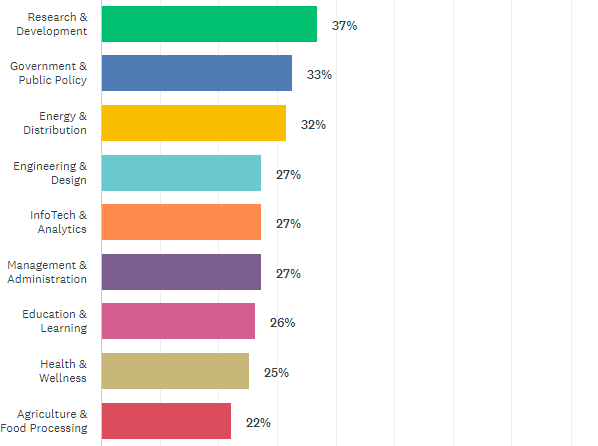
Our survey of small technology enterprises revealed much about what they view as important and what is impeding their growth. In response to the survey we have launch a series of SME site consultations across the province – April through September – VISIT www.ABCtech.ca/events In addition we have invited editorials on related subjects: financing, management consulting, leadership. Stay tuned. – Editor
Capital, Growth and the Strategic Intention of Firms
Stephen Murgatroyd, PhD – CEO, Collaborative Media Group Inc., Edmonton, Alberta
“Gazelles” are businesses with revenue from sales in excess of $1m and a growth rate of 20% or more annually for a minimum of two years or more. The Collaborative Media Group (CMG), of which I am CEO and part-owner, is a gazelle. But when anyone looks from the outside at the company they will see us as small. We are a team of eight, with a large group of part-time and contract staff we can call in if needed. We have decent premises – a TV studio, editing suites and good workspaces, decent offices, even a Nespresso coffee machine (demonstrating that we have standards) – and a solid client list with multi-year license agreements guaranteeing core revenue over time. CMG looks good, but is still small.
What inhibits our growth? Why aren’t we growing faster, hiring more people and going global? Why aren’t we now a medium sized company? After all, we’ve been at this for almost three years!
The first inhibitor is our own strategic understanding of what it is we need to achieve. We have strong clients in sports and we want to “spin out” a sports division – something we think will attract investors. But all of our clients (professional teams, a national league and Provincial leagues) are in a single sport. We need one more additional major client in this vertical for us to be confident that the return on our equity and subsequent revenue from the spin-off to the parent will reflect our estimation of value. We also need to establish two other verticals – government and business – for us to look at inward investment from a third party by means of angel and venture capital. We have established government clients and some private sector clients, we need a few more to get these verticals to be equivalent to sports in terms of impact on our balance sheet. If we don’t improve the balance sheet for each of these verticals, venture capital will dilute our equity significantly – our balance sheet need to be better and our profit better (we have no debts and did make profit in 2013) to ensure a return for the risk and cash invested. Angels may be attracted by our current position, but we are still at a “building” stage and have to invest and secure sales to meet costs and grow.
The second reason is technological. We transitioned from an old version of our proprietary software – Core Community – to a new version just a few months ago and need to add some functionality to this new version for it to be truly a market leader in providing a social media platform for communities of practice, learning and mentoring. IRAP have been truly supportive at every stage of development of our products and they continue to find ways of enabling our innovation, but we are near the end of this road both from an IRAP’s pont of view and our own. Following a phase of development with IRAP support this summer, our next “big leap” technologically will require significant new capital from market sources.
The third reason is about the leadership strength of the company. Capital flows to leaders with a proven track record of success. The leaders of this company can demonstrate this from our past careers, but need more time to demonstrate our ability to sustain the development of a new product, to grow our revenue from sales for this product family, to demonstrate our ability to combat competition and strengthen our position in each vertical. Another 12-18 months will do it, if sales revenues continue to buy us this time.
And that’s the rub. Company development requires patient leaders who are both strategic and operationally smart. If such leaders can enable growth through sales with some support from organizations like IRAP then the opportunity to start the process of “capital hunting” can begin with the prospect for a fair return on equity and performance. With 3 (or more) x EBITDA being the kinds of equity buy position our colleagues operating in similar spaces are seeing, we could see this company and its vertical spin-off’s attracting serious interest from angels and venture capital sometime soon, but not yet. As owners we want the company, its products, people and service to be successful and we intend to support this for some time. Our strategy is not that of a quick exit, but to become the best at being bespoke providers of a rich and creatively resourced, multimedia communities of practice.
In so many cases, company leaders and owners seek investment too early and fail. There are many reasons for this: they are not ready for serious investment and represent too much of a risk for both angels and venture capital; they are not the right team to lead the company to the next phase; they have a great technology and ideas for its development but no customers; they have lots of customers, but their technology and service do not match the sales pitch; they have no clear, focused and meaningful strategy that attracts investment; they are seeking the wrong kind of investment; they just want a quick exit. They chase money and investment without having the ingredients in place for a chance of success.
Our experience is that finding angel and venture capital is not impossible, but requires all parties to be “ready” for the marriage and fully cognizant of the consequences of any resultant deal, both for the short term and the long. There is in fact a lot of angel and venture capital about, it is just that many of the potential marriages look rocky from the start. Venture capital makes 75-80% of the decision to say “yes” on the basis of the team at the top and the market they are in. The rest is about capabilities and opportunities.
Company development is in part always about money, but it is also about people, plans, process and time. Good money follows the right people, who have proven their capabilities through development and sales and have clear plans and processes underway to grow the business at a speed appropriate to capabilities at the right time.
Meantime, we have a product to refine and develop, a growing group of customers to serve and a business to grow.
EVENTS
The Graphics, Animation and New Media Network of Centres of Excellence (“GRAND”) is pleased to hold a workshop at the University of Alberta on April 7, 2014 FOR MORE
CALL FOR PROPOSALS
Western Economic Diversification Canada (WD) is transitioning to a Call for Proposals (CFP) under the Western Diversification Program (WDP). The CFP will open May 1, 2014 and close May 30, 2014, and is targeted to not-for-profit organizations that are eligible for funding under the WDP. FOR MORE