

Newsletter Subscribe
Enter your email address below and subscribe to our newsletter


ABCtech #169 2008 Innovative Broadband Communities Innovative Broadband Communities 1. Intelligent Community Forum As stated by the Intelligent Community Forum ( www.intelligentcommunity.org ) the bro
ABCtech #169 2008 Innovative Broadband Communities
Innovative Broadband Communities
1. Intelligent Community Forum
As stated by the Intelligent Community Forum (www.intelligentcommunity.org) the broadband economy is an “Innovation-Driven” economy. The spread of global and local broadband connectivity has a fundamental impact on the necessity for innovation, it speed, and its economic value. Why”
“A report, conducted jointly by Ericsson (NASDAQ:ERIC), Arthur D. Little and Chalmers University of Technology in 33 OECD countries, quantifies the isolated impact of broadband speed, showing that doubling the broadband speed for an economy increases GDP by 0.3%.”
“A 0.3 percent GDP growth in the OECD region is equivalent to USD 126 billion. This corresponds to more than one seventh of the average annual OECD growth rate in the last decade.”
The challenge for communities located in the “Innovation Zone” is to ensure that they have sustainable and scalable broadband speeds to benefit from “Innovation”, because it is the new basis of sustainable economic and community growth.
2. The Economic Divide
The business case to provide scalable broadband speeds breaks down in rural communities where the population densities are lower and the cost of implementing a broadband network exceeds potential revenues. To provide affordable and scalable broadband services in rural communities, it is necessary to develop a sustainable economic model that proves the business case for a three, five, and ten year period.
Different access technologies may be deployed in rural areas to support communication services including; Fibre (Point-to-Point, GPON), Digital Subscribers Line (DSL), Satellite, Mobile (cellular), and Fixed Wireless. Each of these technologies has its benefits and drawbacks, no single technology will be suited to every community in the Innovation Zone.
The technology chosen by a service provider such as Telus and XplorNet will be primarily based on economic considerations. Can the technology chosen support a sustainable Return-On-Investment (ROI) for three, five, or ten years?
A broadband network’s Total Cost of Ownership (TCO) is calculated by estimating both the capital and operating costs over a period of time. The TCO must be less than the total revenues for a network to be financially sustainable. If the TCO is greater than the total revenues the network may have to be subsidized with either initial or ongoing government funding. The sustainability of a rural broadband network is based on market forces and the potential need for government funding. The market forces are directly correlated to a rural community’s population density.
As an example, a recent FCC study stated that it would cost $23.5 billion to deliver broadband services to $14 million estimated unserved rural residents using a combination of DSL and Fixed Wireless, and $62 billion to deploy fibre. Fibre would be the ideal broadband access technology to deploy in both urban and rural communities. The primary drawback to deploying rural fibre is the high Total Cost of Ownership (TCO) required to design, build, and operate the network.
The FCC study compared the total cost of each of broadband technologies and the estimated density of the population. The figure below illustrates that as the population density decreases (left-to-right) the total cost of wired broadband technologies such as Fiber-to-the-Premises (FTTP), Cable, and DSL (3Km) increase.
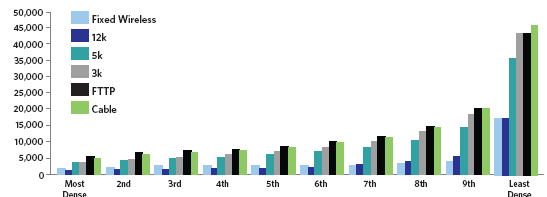
The Innovation Zone communities need to understand broadband economics before making a decision to partner with a provider or deploy a specific broadband technology in their community. The most economical rural broadband technology in a least dense area such as Parkland and Sturgeon Counties is “Fixed Wireless”. But yet there may be a business case to deploy Fiber-to-the-Premises (FTTP) in both Devon and St Albert.
3. The Fifth Utility
The first step for the communities in the Innovation Zone is to recognize the broadband communications is the “Fifth Utility”. The term public utility refers to a set of services consumed by the public and traditionally have included power, natural gas, water, and sewage. Public utilities are subject to forms of public control and regulation ranging from municipalities to federal agencies. Many governments in the world have recognized that broadband communications is a public utility and as a result have implemented regulations to ensure that the communication services provided support the rural community’s economic and social requirements.
Rural communities are responsible for the funding and operation of public utilities such as water, sewage, and power. The rural community may choose to manage these utilities in-house or out-source to a private company. As with other utilities a rural community must select a business model that fits their unique community and economic requirements.
4. The Need
The Innovation Zone communities include St Albert, Devon, Spruce Grove, Stony Plain, Parkland and Sturgeon Counties. Each of these communities may have different economic and community requirements. These requirements will directly impact the rural broadband technology deployed in their communities. The Innovation Zone is recommending that an “Innovative Broadband Communities” program be developed to improve the Innovation Zone community’s awareness and understanding of why broadband communications is a utility, how the lack of will impact their community, and what is their responsibility.
5. Trusted Advisors
Each of the trusted advisors listed below has worked with rural communities to solve the economic divide.
Name | Company | |
Allan Bly | ViTel Consulting Inc. | allanbly@vitel.ca |
Brian Olafson | Brian Olafson Management Associates | brianolafson@shaw.ca |
Al McCully | Parkland County | amccully@parklandcounty.com |
Perry Kinkaide | ABCTech | pkinkaide@shaw.ca |