


Newsletter Subscribe
Enter your email address below and subscribe to our newsletter



The Missing ‘M’ in SME – Why Alberta’s small technology businesses fail to grow
Prepared by:
Alberta Council of Technologies Society
October 20, 2014
Preface
Small and medium enterprises (SMEs) are viewed to be significant contributors to innovation, job creation and the foundation of a competitive capitalistic economy. However, a characteristic of SMEs is their high failure rate, with even fewer survivors growing from small to medium – 99+ employees. The Alberta Council of Technologies Society (ABCtech) exists to diversify Alberta’s economy through the commercialization of emerging technologies. As such we are very interested in what might be done to improve the survival and growth of small businesses – hence our adoption for 2014 of the theme: “The Missing ‘M’ in SME – Why Alberta’s small technology businesses fail to grow”. This report contains the results and recommendations derived from a survey of our subscribers and a series of panAlberta site consultation workshops with SMEs.
We want to express a sincere thank you to the many project contributors including ABCtech’s subscribers who completed the Feb/Mar On-line survey and the Institute of Management Consultants Alberta for funding – and Patrick Binns in the design, of the site consultation workbooks. Others helped serve as workshop co-hosts. Thank your for arranging the site consultations and for tolerating the many emails of the Project organizer and facilitator. You include: Drayton Valley: Lisa Fox – Sustainability Resources Ltd. and Wanda Compton – Brazeau County; Medicine Hat: Peter Wallis – Medicine Hat College, Sean Blewett and John Stroh – APEX Southeast Alberta Regional Innovation Network; Lethbridge: Sandy Lyons – Solving Debt and Renae Barlow – tecconnect/ Choose Lethbridge; Edmonton: Shauna Feth – University of Alberta’s Family Business Institute and Bryanna Kumpula – Agriculture & Food Council of Alberta; Calgary: Lisa Corcoran and Megan Zimmerman – Calgary Economic Develop-ment and Kelly Sansom and Peter Garrett – Innovate Calgary; St. Albert: Dar Schwanbeck – Northern Alberta Business Incubator (NABI) and Lynda Moffat – St. Albert Chamber of Commerce; Edmonton – University of Alberta: Alexander Suen – ABCampus and Qasim Rasi – entrepreneurship HUB; St. Paul: Paul Pelletier and Stuart Leitch – Portage College and Reuel Thomas – Lac La Biche Community Futures; Fort McMurray: Lisa Slade – Regional Municipality of Wood Buffalo and Debbie Hahn – Northern Alberta Aboriginal Business Association and Diane Slater – Fort McMurray Chamber of Commerce and Kenton Price – Wood Buffalo Community Futures and Kevin Nagel – Keyano College.
Also making a significant contribution are those who cared to prepare articles serving to enrich the issues identified and clarify the recommendations: Esir Prente, Robert McGarvey, Milan Prpric, Allan Hamernick, and Michael Flood. We also want to acknowledge and express our appreciation for the guidance received from Nicole Martel, Geoff Ritchie and Shaun Peddie of Alberta Innovation & Advanced Education and insights shared by Richard Truscott through his presentation to our AGM on behalf of the Canadian Federation of Independent Businesses – “Sizzle or Substance – The Role of Small Bussiness in Diversifying Alberta’s Economy” Thank you all!
We of course must clarify that ABCtech takes full responsibility for the contents of this Report. We hope we have met the expectations of the many contributors in our digesting of the vast and varied input and in meeting the even greater challenge of crafting meaningful recommendations for the survival and growth of Alberta’s small technology businesses. As an industry association we invite you, the reader and those in your network to consider the impact you are having on small business start-ups and survivors.
Sincerely,
Alberta Council of Technologies Society
Executive Summary
Small businesses have historically failed at a high rate, with survivors failing to grow at an even higher rate. Failure weeds out some, and serves to season others. Early-stage failure weeds out many who might otherwise put later stage investors – including banks, at risk. Yet SMEs play a significant role in the commercialization of technology, job creation and innovation. By better understanding what contributes to small business failure, measures may be taken to increase their survival and growth, thereby enhancing the contribution of SME’s to diversifying Alberta’s economy.
During 2014 the Alberta Council of Technologies Society (ABCtech) conducted a year-long, panAlberta consultation with SMEs. The project was comprised of an On-line survey of ABCtech’s subscribers “sharing an interest in the commercialization of emerging technologies” and a series of panAlberta, On-site workshops for SMEs.
The project served to engage and inform dozens of agencies and hundreds of Alberta interests. It concluded with this Report on small business growth, its relevance, and what’s important and available, internal and external factors impeding growth and agencies viewed as helping. The report includes several articles contributing to further clarification of the issues, recommendations and proposals.
The Report’s recommendations – and associated proposals, address issues of human resources, small business financing, policies and practices:
A key proposal – 2.1, is for ABCtech to facilitate collaborative economic development between jurisdictions for establishing a model Innovation Zone – a creative economy.
Proposal 2.1. ABCtech should facilitate establishing a model Innovation Zone compatible with the Zone’s socio-economic vision featuring collaborative economic development and the integration of science and culture, technology and arts enterprises AND development of the associated infrastructure, including a network of domestic and foreign investors to support small business retention and attraction and an associated network of small business incubators.
The initiative is comprised of forming small business clusters, extending the reach of networked incubators, engaging foreign investors and cultivating domestic angels. It also features engaging culture and science, arts and technology interests. The model draws on evidence for increasing the survival of small business, their successful growth, and thereby contributing to diversification of Alberta’s economy.
Table of Contents Page
Preface 2
Executive Summary 3
Table of Contents 4
A. Introduction 5
B. On-line Survey and Site Consultations 6
1. The On-line survey’s conduct 6
2. Follow-on site consultation workshops and schedule 6
3. Site Co-host’s roles 8
C. Survey Respondent’s Profile 8
1. Industries of interest 8
2. Operating an SME? 8
3. Exporting services/products? 9
D. The Relevance and Importance of Growth 9
1. Relevance of growth 9
2. Currently growing? 9
3. Interests of growing enterprises 10
4. Interests of no/slow growing enterprises 10
5. What is/is not important for growth? 10
E. Impediments to Growth 10
1. Availability impeding growth? 10
2. Important and impeding growth? 11
F. Sources of Help and Setting Priorities 11
1. Who are helping and who are impeding growth? 11
2. Priorities for survival and success 11
G. Site Consultation Issues – Nine in All 12
H. Recommendations – We Have Four 14
1. Human Resources 14
2. Innovation Zones 15
3. Funding Innovation 16
4. Policies & Practices 16
APPENDIX
A. The “Growing” Challenge – from Starting-up to Growing-up – Esir Prente 18
B. Sizzle or Substance – The Role of Small Business in Diversifying Alberta’s Economy 19
C. SME Feb/Mar Survey of ABCtech’s Subscribers 19
D. SME Site Consultation Workbook including Survey Results 20
E. How Banks Can Help Canada’s SMEs – Robert McGarvey 34
F. Establishing a Model Innovation Zone – NW Innovation Zone Advisory 36
G. Aggregating SMEs and Growth – The Alberta Way – Milan Prpric 36
H. The Networked Business Incubator – Anne Bøllingtoft and John P. Ulhøi 37
I. Human Capital Analytics – The Serial Entrepreneur – Allan Hamernick 37
J. What Role For NGOs in Growing SMEs? – Michael Flood 38
K. Clusters of Entrepreneurship and Innovation – Aaron Chatterji, et al. 39
A. Introduction
“The Missing ‘M’ in SME – Why small technology businesses in Alberta fail to grow” is the theme of the Alberta Council of Technologies Society (ABCtech) for 2014 and the subject of this Report. The theme is timely given the interest in Alberta and across Canada in the commercial-ization of technology in all forms and – more specifically, the associated role of small business in innovation and job creation.
Given ABCtech’s mission and 15,000 subscribers, and given our independence from government and corporate influence, we viewed that by sampling our subscribers and canvasing others – also sharing an interest in small business, science and technology, that we would better understand the issues of small business survival and success. This report contains what we learned and fitting recommendations for small businesses that would contribute to advancing the commercialization of technologies in Alberta.
Recent attention given to small businesses has revealed a number of issues associated with their survival and success. See Appendix A. The Growing Challenge by Esir Prente and B. Sizzle or Substance – The Role of Small Business in Diversifying Alberta’s Economy by Richard Truscott.
The high failure rates and the low proportion small businesses growing to medium are not new, but the relevance of their failure and failure to grow has increased in importance. Alberta cannot rely forever on its carbon gifts, but must learn to participate in the increasingly competitive global economy. Product innovation and job creation in and outside Alberta’s industrial economy are critical today and in preparing Alberta for a post-carbon age. Improving the survival and growth of small business as an innovation and job generator and receptor are important.
Note as well the opportunities:
In recognition of the critical role played by small technology businesses in innovation and their high failure rate, ABCtech undertook a year-long campaign to elevate awareness of the failure issues. The Campaign was designed to generate recommendations for concrete action to reduce the failure rate of tech start-ups and sustain the growth of survivors adding to an increase in medium enterprises.
B. On-line Survey and Site Consultations
SCHEDULE – SME Site Consultations
Helping small technology businesses grow
“What do small technology businesses need to grow?” This 1.5-hr. workshop will hi-lite the findings of the panAlberta survey RESULTS HERE digging deeper to learn what you think! Site consultations are planned for Alberta communities – April through September, with a final industry report to be released in the fall.
Register $25 at
www.abctech.ca/sme-site-consultation


LOCATION
Local co-Hosts
Status
Date
Time
Location Address
Drayton Valley
Town of Drayton Valley & Sustainability Resources Ltd.
COMPLETE
Apr 25th
4:30-6:00pm
Norquest College: Drayton Valley at 5056 – 50th Avenue
Edmonton
U Alberta: Business Family Institute & Agriculture & Food Council of Alberta
COMPLETE
May 6th
7:30-9:00am
Enterprise Square, Hudson’s Bay Building, Jasper Avenue
Medicine Hat
Medicine Hat College & Southeast Alberta Regional Innovation Network
COMPLETE
May 7th
4:30-6:00pm
The Courtyard Room, Medicine Hat College, 299 College Dr. SE
Lethbridge
University of Lethbridge & Lethbridge Chamber of Commerce
COMPLETE
May 8th
8:00-9:30am
Tecconnect building located at 3582 – 30th Street North
Calgary
Innovate Calgary & Calgary Economic Development
COMPLETE
Sep 11th
7:30-9:00am
Alastair Ross Technology Centre, 3553-31 St. NW
St. Paul
Portage College & Community Futures: St. Paul/ Lac La Biche
Cancelled
Sep 17th
6:30-8:00pm
Portage College, 5205 – 50th Avenue, St. Paul
Edmonton
eHub and ABCampus
COMPLETE
Sep 18th
7:30-9:00pm
eHUB 9007 on the Univ. of Alberta Campus
St. Albert
Northern Alberta Business Incubator & Chamber of Commerce
COMPLETE
Sep 23rd
7:30- 9:00am
200 Carnegie Drive
Fort McMurray
Fort McMurray Chamber of Commerce, Wood Buffalo Community Futures and Economic Development, No. Alberta Aboriginal Business Association
COMPLETE
Oct 2nd
4:30-6:00pm and
7:00-
8:30pm
Keyano College – Elements Room at 8115 Franklin Avenue
ABCtech provided the workshop facilitator and electronic site-specific posters. The workbooks were provided by the campaign co-host, the Institute of Certified Management Consultants of Alberta.
C. Survey Respondents’ Profile
The industry interests of the 169 subscribers who responded to the survey are illustrated below. Appreciate, the survey was conducted of ABCtech’s subscribers – sharing “an interest in the commercialization of emerging technologies” and the survey was generally known to members of the Institute of Certified Management Consultants of Alberta.
The top 3 industry interests of those –
Surveyed vs Responded
Management & Strategy 4.4% vs 30% +25.6%
Engineering & Design 2.5% vs 25% +22.5%
Manufacturing & Export 1.5% vs 16% +14.5%
Agriculture & Food processing 1.6% vs 15% +13.4%
InfoTech & Analytics 15.1% vs 28% +12.9%
Energy & Distribution 12.5% vs 25% +12.5%
Communications & Marketing 5.2% vs 17% +11.8%
NGOs – Non-government organizations 2.8% vs 14% +11.2%
Construction & Real Estate 3.1% vs 14% +10.9%
Government & Policy 8.2% vs 17% + 8.8%
Education & Research 12.2% vs 20% + 7.8%
Health & BioTech 4.8% vs 12% + 7.2%
Finance, HR and Legal 11.0% vs 17% + 6.0%
Environment & CleanTech 10.7% vs 16% + 5.3%
Entertainment & Hospitality 1.6% vs 6% + 4.4%
Forestry & Wood Products 1.1% vs 5% + 3.9%
Transportation & Logistics 1.6% vs 4% + 2.4%
D. The Relevance and Importance of Growth
Status of Respondent
Non-operating Companies
Operating Companies
Importance of Growth
Interested
Gov’t, Educ, NGO
Start-up or Micro
Small
Medium
Total
Avg
Not at all
0
0%
0
0%
0
0%
0
0%
0
0%
0
0%
Not Very
1
5%
1
4%
2
3%
1
2%
0
0%
5
4%
Moderate/Somewhat
12
60%
15
60%
19
32%
17
30%
2
29%
63
45%
Very
7
35%
9
36%
39
65%
39
68%
5
71%
94
51%
TOTALS
20
12%
25
15%
60
36%
57
34%
7
4%
169
100%
We assumed at the start that there are many small businesses with no interest in growth. These so called “lifestyle” companies are small and satisfied with the status quo. If they do exist and are prevalent, they – for whatever reason, did not respond to the survey or attend the site consultations. The survey therefore reflect the views of companies interested in growth.
Growing – 50% Slow/No Growth – 50%
17% rapid 15% none or declining
33% moderate 35% slow
Note. Industry Canada (2013) reports that 9-10% of Alberta’s SMEs reported or anticipated growth rates of 20% or more.
Most important for growth | Least important for growth | |
Very or Moderate | Not very or Not at all | |
Marketing 97% | Mergers & Acquisitions 39% | |
Management 93% | Government Regulations 53% | |
Manpower 91% | Professional Services 62% | |
Networking 91% | External Investors 66% | |
Business Plan 87% | ||
Product Development 86% | ||
E. Impediments to growth
Availability Impeding Growth
Very or Moderate Not very or Not at all
Manpower 68% Professional Services 49%
Marketing 64% Mergers & Acquisitions 49%
External Investors 58% Metrics 39%
Government Regulations 35%
Note. Industry Canada (2013) reports that the main internal obstacles to growth are employee recruitment and retention (43 percent), the amount of time devoted to current operations (43 percent) and maintaining sufficient cash flow (34 percent).
Most important and impeding growth | Least Important and not Impeding growth | |
Marketing 81% | Professional Services 24% | |
Manpower 80% | Mergers & Acquisitions 30% | |
Management 73% | Metrics 35% | |
Networking 71% | Government Regulations 37% | |
Internal Investment 70% | ||
F. Sources of Help and Setting Priorities
Very helpful and Somewhat helpful | Not helpful or an Impediment |
Industry Associations 46% | Banks and Financial Institutions 27% |
Incubators & Research Agencies 45% | Multi-national Corporations 24% |
Angels & VC Networks 39% | Government – Municipal Services 22% |
Management Consulting 36% |
There may be a bias here as the Survey sponsors were a management consulting and an industry association. They and incubators and research agencies, angels and VC networks, are viewed as most helpful. Least helpful are banks and financial institutions, multinational corporations, and municipal government, resources that typically attend to established businesses.
Learning to survive is essential to growth. We start-out here with the obvious because so many start-ups fail to survive. The reasons are too numerous to mention. But rarely is the “idea” – that is the “technology”, the issue. Commerce is a human enterprise; failure is due to people being unprepared for the vast array of situations to sustain the enterprise. The probability of failure decreases as learning from experience increases. Reducing failure means learning and mitigating risk. So the resolutions are obvious:
Most sources of small business support at start-up are personal as their experience, reputation and resources are too new to secure external “community” support. What is reasonable and accessible outside of family and friends, are public business services and of growing relevance, small business networks. The relevance of networks has recently been reinforced by research indicating their significance in recent successes attributed to Networked Incubators. See Appendix H. The Networked Business Incubator. Credit is also given to the emerging role of research institutes, incubators and industry associations.
As for Chambers of Commerce, they have historically been very successful in attracting and stimulating commerce among community retail enterprises. They were not viewed as today relevant to the new generation of young entrepreneurs and technology based enterprises. Their networking events are characterized as gatherings of sales agents and already established enterprises.
Banks and financial institutions openly admit to being irrelevant to small business until they have security to secure loans. Professional services are too expensive and too busy with little interest in small business. Municipal governments and their “red-tape” was frequently mentioned as impediments.
G. Site Consultation Issues – Nine in All
Given the complexity of issues facing a start-up for survival and of a survivor for success, it may be no surprise that experimentation continues in the search for the right formula for success. There is no shortage of programs, curriculum, coaching and experiences offered to small business with the promise to help. Unfortunately, the proportion of small businesses that continue to fail, and the stagnant status of small businesses failing to grow appear consistent over time with little variation across Provinces. Investors, researchers and government programs do not appear to have found a universal answer. And while incubators and research institutes are recognized as helping, and management consulting too, failure continues to be touted as the best teacher. But failure is costly as entrepreneurs drop out at a cost to innovation. What to do? Note. In discussion with a banking executive, we heard that “failure” does serve as a low cost measure for the banks, serving to separate the wheat from the shaft, purging the low and hi-risk candidates at little cost to financial institutions.
Recommendations derived from the survey and site consultations now follow as measures for reducing the failure rate and increasing growth of early-stage enterprises.
H. Recommendations – there Are Four.
1. Human Resources. Improve communications and relational skills for knowledge-based students and graduates, professions and industries.
A common problem underlying most failures and impeding growth of small businesses is the lack of interest and understanding of the relevance of communications and relational skills. The origIn of the problem may be attributed to the high value placed on technology/product with little regard to communications, and the role that people have in commerce. This conclusion stms from survey results and the consultations that identified impediments to growth as communications intensive processes: marketing, management, manpower, networking. Time and again, we observed that technology intensive entrepreneurs and small businesses lacked management skills in communications.
The issues appear in human resources – recruiting, staff relations, and management development; marketing – knowing, securing and maintaining customers; product – team work for product design and development; funding – presentation quality and investor relations. The low regard for mergers and acquisitions as a growth option may also be related to a lack of relational skills. Research universities champion knowledge and the professions, with little regard to the relevance of liberal arts and culture. Yet, entrepreneurs must be proficient in communications to survive and grow. And professionals are increasingly facing competition and well-educated, knowledgeable clients cum customers. A senior policy director for Germany revealed a major initiative to overhaul the training of engineers with the objective of developing “personality”. Similar initiatives to develop relational skills have been undertaken in many “knowledge-based” professions including medicine. Also related are initiatives to elevate the relevance of liberal arts in values-based leadership, creativity and innovation, corporate ethics and governance. Such skills are also essential for any business wanting to export and compete in markets outside their culture. Discussions with Asian interests wanting to do business in Alberta, noted the importance of understanding culture and social conventions when doing business in Asia.
Small business success in exporting warrants considerable awareness of cultural issues and savvy communications. Again, relational competences are a prerequisite.
Proposal 1.1. Incubators and educational institutions should develop a curriculum (academic and experiential) of requisite communication skills warranted at various stages of small business development. Visit Appendix I. Human Capital Analytics – The Serial Entrepreneur – Alan Hamernick
Proposal 1.2. Encourage the integration of applied communications into the curriculum of educational institutions particularly the professional schools.
Proposal 1.2. Governments at all levels need to increase the priority given to developing small business incubators linked to research institutes and universities. Visit Appendix H. The Networked Business Incubator – Anne Bøllingtoft and John P. Ulhøi
Proposal 1.4. Management consultants need to appreciate the significant value attributed to the profession by small technology businesses and convey the profession’s interest in the success of small business.
2. Innovation Zones. Collaboration should be encouraged and small business clusters developed for establishing and evaluating the success of designated innovation zones.
Over again we heard of silos, border issues, redundancy and NGO overlap. Engaging co-hosts for sponsoring and helping arrange the conduct of workshops was quite easy and well accepted. Yet, while “collaboration” was discussed as “in favour”, evidence and examples of collaborative projects were hard to identify in Alberta. Project experimenting with collaboration were readily identified in the United States, where more experience, largely positive has been documented.
Proposal 2.1. ABCtech should facilitate establishing a model Innovation Zone compatible with the Zone’s socio-economic vision featuring collaborative economic development and the integration of science and culture, technology and arts enterprises AND development of the associated infrastructure, including a network of domestic and foreign investors to support small business retention and attraction and an associated network of small business incubators. See Appendix F. Establishing a Model Innovation Zone – NW Innovation Zone Advisory and Appendix K. Clusters of Entrepreneurship and Innovation.
Once established, small businesses should be more informed about the relevance of mergers and acquisitions as a growth strategy.
Proposal 2.2. Incubators should conduct workshops on the risks and rewards of mergers and acquisitions for growth and tell stories about the success – and failures, of Alberta enterprises that have adopted mergers and acquisitions for growth. Appendix G. Aggregating SMEs and Growth – The Alberta Way – Milan Prpric
3. Funding Innovation. Cultivate local and regional networks of early stage investors and mentors and restore the role of banks in commercial lending.
Banks and financial institutions are being supplanted by creative alternatives such as crowd sourcing, equity markets and the emergence of direct funding by individuals – “angels” and VC networks. Over and over again we heard of a mismatch of investor objectives with small business interests. Respondents recognized the importance of internal investment in their early stages, and the relevance of external sources of funding once established. External funding often came with expectations of unrealistically short timelines and multiple ROIs. Alberta is not Silicon Valley. The lessons to be learned for Alberta are about what the Valley did in its formative years for small business, not what it is doing now. Given that many retirees have interest, experience and resources of value for small business, attention should be given to cultivating angels and angel networks for allocating local funds in local enterprise. Also, developing mentors as advisers and ultimately as directors, would make a significant contribution to the survival, retention and growth of small business.
Proposal 3.1. Establish evaluative measures for incubators for encouraging their networking and partnering with others engaged in identifying foreign and domestic investors and mentors/directors for local enterprises.
Banks have played an important role in financing commerce. Their success was predicated on securing loans with tangible assets. As the knowledge economy emerged – GDP has become heavily weighted by intangible services and processes. Banks have transitioned into supplying an array of services. A commercial funding gap is evident for commercializing early stage business and emerging technologies. Work needs to be done to formalize the treatment of intangibles so prevalent in the knowledge economy.
Proposal 3.2. Establish a task force of government policy makers, tax authorities, accounting professionals and corporate leaders to translate society’s asset management protocols from the declining industrial era assets to the creative assets of our knowledge-based economy. See Appendix E. How Banks Can Help Canada’s SMEs – Robert McGarvey
4. Policies & Practices. Revise procurement and regulatory, advisory and funding practices to support the development and retention of Alberta innovation and innovators and the attraction of foreign partners.
The recommendation is intended to stir governments at all levels – and where relevant, corporations, to review their practices to ensure they are aligned with policies to promote competition, innovation and small AND medium sized business formation. Policy makers may find illuminating the seminal research cited in Appendix K. Clusters of Entrepreneurship and Innovation.
Procurement practices favour established, large – often foreign, corporations. Large commodity- based corporations do little research, and small businesses are early adopters of new ideas, and as they grow they invest more in research. Multinational corporations and professional services are not viewed as sympathetic to small business interests. Yet they have advice and technologies of considerable value to small business success. Both should be encouraged find ways to engage small businesses in knowledge exchange possibly through research institutes, industry associations and incubators that are valued contributors to small business survival and growth.
Proposal 4.1. Government and industry should review their procurement practices to support small business bidding, innovative problem solving and the aggregation of bidders. See Appendix G. Aggregating SMEs and Growth – The Alberta Way – Milan Prpric and Appendix A. The “Growing” Challenge – from Starting-up to Growing-up – Esir Prente
Proposal 4.2. Review public funding and investment practices to ensure the return on investment remains with Alberta.
Proposal 4.3. NGOs should establish an advisory to provide recommendations on measures for increasing the role of NGOs in effectively serving small business survival and success. See Appendix J. What Role for NGOs in Growing SMEs? – Michael Flood
NGOs represent a special case, but have the potential to play a significant role in economic diversification and commercialization. Thousands of Alberta’s NGOs rely on government funding and facilities without accountability – often with no constituency or achievements to show. This may be an opportunity to begin a consolidation of the Alberta’s NGOs where they are given incentives to support the commercialization of technologies relevant to their constituencies.
* * *
APPENDIX
A. The “Growing” Challenge – from Starting-up to Growing-up – Esir Prente
Technologies as change agents. Emerging technologies can disrupt entire industries. Economies that are not diversified are most vulnerable. But introducing even established technologies – for increasing productivity, are of little interest when prosperity is at hand. It’s only in the face of pain, that insight and capital and know how combine to act. Rarely to companies change because its a good idea.
However, the impact of an emerging technology CAN BE devastating increasing the monitoring of what’s coming OR to be the founder, owner or early adopter of a disruptive technology. For emerging industry-changing technologies the cost of commercialization usually warrants lots of time and significant capital calling for government intervention. This is very tricky, as governments have so many priorities and the electorate can be fickle.
SMEs the foundation for diversification. The partnership of the Alberta government with multinational corporations prepared to finance agriculture, forestry and energy and the requisite transportation systems is worthy of international envy. But even the most cynical admit that carbon commodities are cyclical, and that reliance of Alberta on North America alone carries political risks. And so, Alberta needs to diversify, and the dearth of Alberta-made medium businesses impeding the development of value-added, exports. Those that have succeeded are largely in construction and energy and have employed strategies of acquisition.
The SME Ecosystem. The plight of start-ups has rarely gotten the amount of attention as it is today. Rarely does a day go by without a proclamation from on high envying economies with medium sized enterprises, businesses that can compete, have talent and capital, engage in research with a global reach. These are not small businesses. Small businesses feature innovation and risk-taking at low cost. Q. What to do? Ans. Grow’em. Eat’em. Merg’em!
Unfortunately few economies have such robust ecosystems or capital lying around – except Canada and more-so Alberta. BUT the capital is in the bank, and banks – particularly Canadian banks and citizens are among the world’s most risk averse … a feature appreciated during the global mortgage meltdown, but an impediment to recovery. So don’t count on the banks. What about Made-in-Alberta angels and VCs?
Most savvy investors strive to find low cost, high performing, innovators like Adam. They like’em a lot but not for their growth potential; they like their hunger and love to re-plant them. They know: 1) that most won’t survive, 2) that few have any interest in growing and 3) that their management experience in growth is rare. To grow is not to operate, it requires a dramatically different form of management – much more assertive, acquiring, with obsessive aspirations. Hence, the interest of VCs in seizing and exporting early stage innovators to sunny California.
Three thrusts for leadership. Grow – a nurturing ecosystem, adding brokers and incentives for financing, Transform – the communications and educational systems for rapid knowledge transfer embracing emerging technologies. Compete – be brave, encourage a more global and competitive culture. And be patient, appreciating that if prosperity reigns, most small businesses will stay the course and change ONLY when necessary.
My bet, is to mobilize forces to acquire the best and bulk up. Encourage regional mergers, target acquisitions and tax benefits for the first year of an acquisition. And establish government procurement policies and vendor management processes that benefit small enterprises to joint-bid and work together. Encourage corporations to do more spin-offs. And think growth early! Inspire a new more assertive culture.
Visit www.abctech.ca/management-and-strategy
You – know Alberta’s small business environment and are a buyer, seller, researcher or policy influencer of technology products and/or services. We – are concerned that only 2 of 10 start-ups survive 5 years and that only 1 or 2 small businesses (1-5 employees) ever grow to medium (>99 employees). We are eager to learn your opinion about whether:
1) “Growth” is or should be a small business objective? The focus of this survey.
2) What should be done to increase the survival and growth of small technology businesses? The focus of our site consultations planned for April through September.
The survey responses will be confidential with the results used to design the site consultations across Alberta. The consultations will contribute to a public Report and recommendations for Alberta business and governments and for guiding the development of our programs for developing emerging industries.
Thank you,
Alberta Council of Technologies
www.ABCtech.ca Contact – 1(866)241-7535 or local (780)990-5874
1. What is your preferred Region for the conduct of a small business consultation?
 Northwest – Grand Prairie
 Northeast – Fort McMurray
 North Rural
 Edmonton Region
 Red Deer
 Central Rural
 Calgary Region
 South Rural
 Medicine Hat
 Lethbridge
Other (please specify)
2. What Alberta industries are you most familiar? Select up to 3 from the following list:
 Agriculture & Food Processing
 Communications & Marketing
 Construction & Real Estate
 Education & Research
 Energy & Distribution
 Engineering & Design
 Entertainment & Hospitality
 Environment & CleanTech
 Finance & Accounting
 Forestry & Wood Products
 Government & Public Policy
 Health & BioTech
 Human Resources & Development
 Infotech & Analytics
 Legal & Security
 Management & Strategy
 Manufacturing & Export
 NGO – Non Government Organization
 Transportation & Logistics
Other (please specify)
*3. Do you operate a ‘micro’ (1-5 employees) or small (6-99 employees) or medium (100+) business?
No – But I’m interested. Proceed to Question #6
 No – I work in policy/government or research/education or an NGO. Proceed to Question #6.
 Yes – a start-up or micro-business. Proceed to Question #4.
 Yes – a small business, Proceed to Question #4.
 Yes – a medium business. Proceed to Question #4
Other (please specify)
4. Which of the following apply to your business? (Check all that apply)
 Alberta only – SUPPLYING technology products and/or services
 Exporter – SUPPLYING technology products and/or services
 Alberta only – BUYING technology products and/or services
 Importer – BUYING technology products and/or services
 Neither an Importer or Exporter – just starting up
5. How would you characterize your business’s growth?
 How would you characterize your business’s growth? None or declining growth
 Slow growth
 Moderate growth
 Rapid growth
 Uncertain – if uncertain, please comment
Please comment
*6. Is “growth” an important small business objective?
 Is “growth” an important small business objective? Growth is – very important
 Growth is – somewhat important
 Growth is – of moderate importance
 Growth is – not very important
 Growth is – not important at all
If “not” – please explain why not?
*7. Rank the following from the most (1) to the east (12) essential for small business growth:
Networking – linking to others essential for success
Mergers and acquisitions – for adding strength
Manpower – for staffing operations
Mentoring – knowledge transfer through friends and advisors
Professional services – legal, HR, IT, accounting support
Investors – external sources of funding for growth
Marketing and sales – securing and maintaining revenue
Business plan – for setting future direction
Product development – research and innovation
Management – setting priorities and organizing operations
Investment – internal financing of growth
Metrics – for monitoring growth and performance
8. We are arranging 1.5-hour site consultations for up to 25 attendees ($25@) in each Region, including: an orientation, a workbook, round-table discussions and recommendations. Which times would be most appealing to you:
 Morning 7:30-9:00AM with refreshments
 Afternoon 4:30 – 6:00PM with refreshments
 Evening 7:30-9:00PM with refreshments
 Not interested
 It depends. Please comment.
Please comment
9. Medium-sized businesses hire more qualified staff, invest more in research and have the internal sources to acquire other businesses as a growth strategy. What should be done in Alberta to increase the number of medium sized businesses and the capacity of small businesses to grow? If you would prefer to add more, simply email info@ABCtech.ca with the word SURVEY in the subject line
10. The Alberta Council of Technologies has developed ABCtech Media Productions with the capacity to broadcast radio and TV stories about Alberta entrepreneurs, researchers, and technology innovators. Would you be interested in being interviewed or have someone who you would recommend? If so, please enter the name of a contact and their email address.
The Missing ‘M’ in SME –
Why small businesses in Alberta fail to grow
Only 1-2 small businesses survive 5 years. Only 1-2 ever grow to medium.
SME Site Consultation Workbook


April – September. 2014
Alberta, Canada
INTRODUCTION
The Alberta Council of Technologies Society and the Certified Management Consultants of Alberta are interested in why Alberta’s small businesses buying, supplying and servicing technology fail to grow. Toward this end we surveyed ABCtech’s 15,000 subscribers, soliciting input from SMEs: start-ups and entrepreneurs, “micro” (1-5 employees), small (6-99 employees), and medium businesses. The Survey results are contained in this Workbook.
The Workbook is for guiding site consultations arranged by local co-hosts across Alberta. The consultations will contribute to the assembly of a Report with recommendations for removing important impediments to growth of Alberta’s small technology business. Your input is very much appreciated.
Thank you,

Table of Contents Page
Introduction & Table of Contents 2
SME Survey Results – Highlights 3-9
Alberta Council of Technologies – How to help 10
Q. #1. What can a small business do for itself to increase growth? 11
Notes and Recommendations
Q #2. What changes do you recommend for increasing small business growth? 11
Notes and Recommendations
A. For Buyers
B. For Sellers
C. For Governments
Other – Comments?
SME Survey Results – Highlights
ABCtech initiated an email campaign in February to March, 2014 with several reminders to its subscribers. The campaign contained the rationale and url site for completion of a 10-question survey about Alberta’s SMEs. The Survey template is reproduced on pages 9-11.
First, who responded?
The top 3 identified N = 169
Management & Strategy 30%
InfoTech & Analytics 28%
Energy & Distribution 25%
Engineering & Design 25%
Education & Research 20%
Finance, HR and Legal 17%
Government & Policy 17%
Communications & Marketing 17%
Manufacturing & Export 16%
Environment & CleanTech 16%
Agriculture & Food processing 15%
Construction & Real Estate 14%
NGOs – Non-government organizations 14%
Health & BioTech 12%
Entertainment & Hospitality 6%
Forestry & Wood Products 5%
Transportation & Logistics 4%
2. Are you an entrepreneur or operating a micro (1-5 employees) or small (6-99) or medium (100+) business?
73% of respondents were either starting up or operating a micro (36%), small (34%) or medium (4%) sized business. Of the 24% not operating a SME, they were interested or working in government, education, research or an NGO.
Select comments
I’m a business consultant Now Retired ProprietorshipWe are certified management consultants (CMC) professional service providers to SME’s Active serial entrepreneur and investor/coach/mentor
3. Which of the following apply to your business?
Excluding those just starting up, sellers, buyers and services of technology are equally represented. Alberta is their market 2:1 over outside Alberta.
Select comments:
I would also check a box for “Developing technology” I buy technology from wherever it is most readily available Note – I’m based in Ontario! Starting up a business related to sustainable agriculture and manufacturing.Technology based services offered to businesses (not the same as selling products) Smart Grid Solutions integration Also contemplating acquiring micro and small businesses soon. We are weekly newspaper so have a broader message.International.Investor is technology business. ERP software. Promote the food industry.Selling a technology consulting service locally, in Canada and globally.I don’t understand this question.Anywhere. Hope to sell our technology. May end up just marketing our patent.Evaluation of required levels of technology to sme businesses. 5% of our revenue is in Canada – 1% in Alberta. Buyer of tech – servers and cloud technologies. Technology / Business Solutions & System for Businesses of any size. We provide technology/business process services to other SMEs.
Next, about Growth
4. How would you characterize your business’s growth?
Status of Respondent x Importance of Growth | |||||||||||||||||
Status of Respondent | |||||||||||||||||
Non-operating Companies | Operating Companies | ||||||||||||||||
Importance of Growth | Interested | Gov’t, Educ, NGO | Start-up or Micro | Small | Medium | Total | Avg | ||||||||||
Not at all | 0 | 0% | 0 | 0% | 0 | 0% | 0 | 0% | 0 | 0% | 0 | 0% | |||||
Not Very | 1 | 5% | 1 | 4% | 2 | 3% | 1 | 2% | 0 | 0% | 5 | 4% | |||||
Moderate/Somewhat | 12 | 60% | 15 | 60% | 19 | 32% | 17 | 30% | 2 | 29% | 63 | 45% | |||||
Very | 7 | 35% | 9 | 36% | 39 | 65% | 39 | 68% | 5 | 71% | 94 | 51% | |||||
TOTALS | 20 | 12% | 25 | 15% | 60 | 36% | 57 | 34% | 7 | 4% | 169 | 100% | |||||
Observations: | Growth is important to all respondents, particularly operating companies. | ||||||||||||||||
Respondents who are not operating an SME under-estimate the importance SMEs attribute to growth. | |||||||||||||||||
Most operating companies view growth as “very important” | |||||||||||||||||
The importance of growth may increase slightly as companies grow. | |||||||||||||||||
Select comments
I work for an Industry organization Growth in profitability and cashflow currently outweighs growth in revenue, but clearly, they are inter-related. Need to define the meaning of growth to best ask this question. Note: There are several types of small businesses 1) One with an entrepreneurial driver seeking growth 2) A second, where the founder manages the firm for his/her employment and is satisfied staying small 3) A third that is a hobby business, driven by personal interest more than anything Growth needs to be funded. Growth is directly related to the maturation of technology and products. The growth can grow exponentially overnight. I think most small businesses are happy to remain that way. They carve out their niche and get referrals by mouth. Expansion might be thought to incorporate more headaches than gain. Could be a myth buster needed to get small business interested in medium to big business. Big also assumes takeover, ruthlessness, that might not be everyone’s preference. I wouldn’t like it if someone wiped me out, so why I should I like myself for wiping out competitors? Profitability more important. I’m retired and do not need the income so I do it for enjoyment, as an accomplishment and for special purchases like new cars, homes, etc. Making a profit is more important. My goal is to stay self-employed. The objectives of any sme have to align with the expectations/objectives of the start up owner. Most entrepreneurs don’t have the mentors involved ( not aware, too much ego ) when they begin. Growth may or may not be important. Hours/place of work; life style eg home schooling; and other personal priorities fit into the picture. Growth is related to capacity and capability and these must be developed before sales growth can be realized. Cash flow is more important for small business.
The proportion of small businesses growing, almost equates to the proportion growing slowly or not at all – excluding 26% of start-ups where it was too early to tell.
Growing – 50% Slow/No Growth – 50%
17% rapid 15% none or declining
33% moderate 35% slow
The proportion of small businesses growing, almost equates to the proportion growing slowly or not at all – excluding 26% of start-ups where it was too early to tell.
Select comments
Clients think I’m getting old I have heard from some that the business has a lot of potential. Will be “green economy”. Accounting practice was sold two years ago. It was growing at the time. 10-15% top-line organice revenue growth, so I assume this is moderate? No support from Power Industry in Alberta. Alberta iz 10 years behind the world’s leading countries. No desire for growth Potential is huge – just ‘waiting for the dam to break’. First one to three years very slow, years four to eight were rapid growth, years nine to fourteen slow. Very active in evaluating investment opportunities. Hard to overcome the dominance of oil and gas with little interest for other industry in Alberta. My first company became an NPE following the irrational logic of a self-proclaimed VC messiah. That company hasn’t had an AGM since 2008. Their CEO’s campaign to discredit me affects my ability to raise funding for my new venture, so I have to fly below the radar until my previous shareholders wake up to what is going on. Very slow. Lack of full support or difficult to get provincial and federal programs. Haven’t been able to break into the M level. Starting up just going live.
5. Is “growth” an important small business objective?
Very or Moderate
Not very or Not at all
Marketing 97%
Mergers & Acquisitions 39%
Management 93%
Government Regulations 53%
Manpower 91%
Professional Services 62%
Networking 91%
External Investors 66%
Business Plan 87%
Product Development 86%
Select comments
Finding right opportunity Businesses that fail, from my perspective are far too indebted without enough clients to support their operations. Creating lean start-ups might contribute more to the success of start-ups but I might be making a presumption.Implied in a few categories, but not explicitly mentioned, is the importance of solid financial knowledge and cash flow management. Knowledge transfer from the world’s leading experts to Alberta. It service what matters not the Product. SG Integration is service not the Product. Government’s Programs don’t support service Development. Client acquisition. Financial Planning. Access to customers and domain knowledge for technology companies is paramount. Employer-employee partnership and fluidity of communication Alignment with personal objectives/expectations Raising money for non-oil startups is next to impossible in AB. Strategic planning and execution of plan. Quality products to sell. Access to capital and affordable technologies and HR solutions. Code of Ethics – boundaries need to be established early or partnerships will fail due to perceived breaches of ill-defined social norms. Internal corporate culture , corporate vision, and how these are realised inside the firm. company growth strategy M&A ? bootstrapping? other?
6. How would you rate the following in importance for the growth of small businesses?
Very or Moderate Not very or Not at all
Manpower 68% Professional Services 49%
Marketing 64% Mergers & Acquisitions 49%
External Investors 58% Metrics 39%
Government Regulations 35%
Select comments
Leadership I am understanding the question as “Is the existence of any of the following impeding …” but I also wonder if you meant to say “Is the lack of any of the following impending …” If no one is buying what companies are selling, they’ll be out of business. I think the product development aspect is large and securing clients who want products is key. Larger than all of those aspects, the price of space to work out of bleeds businesses DRY. Space is way too expensive so having incubators where the rent / leasing fees are 10-25% of the present rate would be a huge help to small businesses looking to expand.
Alberta is closed for Smart Grid Technology cooperation with the world’s. This question is very unclear!!! Do you mean ‘Availability” or “lack of availability”? It’s generally not lack of availability, it is barriers to access, including time, money and staff, and lack of knowledge about what’s available and what difference that will make. I am not sure which of any of these factors impede growth. Micro-funding at times to deliver on large contracts. I don’t understand this question. This question does not make sense to me. Don’t understand the question. Sustained early stage capital to fund bench & pilot almost non-existent. Too much of planning at initial stage. Government focus on oil & gas sector at the expense of a more diversified industrial economy in Alberta.Customer and low price demand. Mindset – Albertans have an insecurity complex towards innovation and thought leadership. Their reluctance to embrace change or ‘get on board’ with new innovations they deem to be ‘careful’ or ‘cautious’. It’s the fear of taking risks that most impedes growth for small businesses. Both from the business leader and the client/customer being too cautious. Training for innovators and leaders is what is most needed to overcome the mental barrier for leaders. But how do you train the customer? Marketing only goes so far. External investment is more important than capital. It helps to validate a business and to move from a profitable ‘lifestyle’ business to medium sized corporation. We do not a good job of this, esp compared to the energy industry. Please see other answers to question 6. It seems to me that many firms are founded by people who are ecstatic to be making a living from their idea, but are lacking the drive, ambition or vision to take their firm to the next level. It is difficult for founders to step aside and allow others to take over their company even if it is in the interests of investors who may number individuals /institutions other than the founders. Professional services – too expensive then companies try to do it on their own or cheaply, small business doesn’t understanding the difference between marketing and advertising, managers don’t delegate to labour and often try to do both, regulations too complex or daunting for small business, small managers don’t get the time to network outside the local area.
Setting Priorities
7. Is the AVAILABILITY of any of the following IMPEDING the growth of small business?
Established as the most/least IMPORTANT and most/least available IMPEDING growth
|
| ||
Marketing 81% | Professional Services 24% | ||
Manpower 80% | Mergers & Acquisitions 30% | ||
Management 73% | Metrics 35% | ||
Networking 71% | Government Regulations 37% | ||
Internal Investment 70% |
8. Medium-sized businesses hire more qualified staff, invest more in research, have more resources to acquire other businesses, and are more likely to engage in global exporting. Please rate the effectiveness of the following sources for “helping” grow Alberta’s entrepreneurial and small businesses.
Effective in helping grow small businesses
|
|
Industry Associations 46% | Banks and Financial Institutions 27% |
Incubators & Research Agencies 45% | Multi-national Corporations 24% |
Angels & VC Networks 39% | Government – Municipal Services 22% |
Management Consulting 36% | |
Select comments
My comments are based on my needs verses my perception of industry wide needs. Regarding the Multi National Corporations is important to make regulations against monopoly positioning. Challenge is to find partners to merge with or acquire. Many of young engs and managers are keen to participate in Smart Grid. There is interest among potential Customer to use Smart Grid SOLUTIONS , there is interest among Technology providers but nobody wants to help to Integrate those SOLUTIONS. We Need Demonstration sites (test beds) u put together existing Products into smart Grid Solution. Not judging each in general, simply indicating which ones have been a help to us (possibly haven’t been because we haven’t pursued some of them, not necessarily because they wouldn’t be willing or able). For Municipal Services: they have been slow to adapt any bus routes for our staff, despite the clear need along 50th street to have some bus route. Most sources for helping entrepreneurs with their business decisions/mentoring/management are very expensive. CETAC-West in Calgary is a great organization which has a much better survival rate for their clients than national averages. They need support from gov’t and industry to keep operating – and to be able to provide services as a low cost to clients -and deferred payment options. www.cetacwest.com NRC/IRAP and the IRAP Industrial Technology Advisors are most helpful to SME’s. Few of these things help grow small businesses because small business is not the target audience. No investors; banks are useless. No experience with these agencies, no comment. An ‘uncertain’ should be included here, as the outline seems a bit leading. I don’t know enough to know the answer to this. The question is focused on ‘entrepreneurial and small’ businesses. Entrepreneurial businesses may be very large. The answers are therefore difficult to provide.
If others don’t believe in what you’re doing, or don’t believe that it can be economically successful, it’s not surprising that they’re also not helpful. The truth is entrepreneurs in Lethbridge are on our own in every way! I am not sure where this comment fits in, however, if there are no lenders or programs to give an opportunity for small technology businesses to purchase real estate for control over their unique facility needs and to actually get ahead by someday owning the facility we will always be at the mercy of uneducated/uninterested landlords impeding our chance of growing to a medium sized business. Depends upon the specific development issues The province pays lip-service to helping SMEs with financing and grants, but the grant cycle doesn’t align with business cycles and it is very hard to fit in the narrow scope. Being in InfoTech, our product does not carry much weight with non-venture entities such as banks. On the flip side, most businesses do not have the home run upside that VCs and even Angels want to see. Many good business that could grow to medium size will not. In most cases, government assistance simply requires more effort into documentation than is paid back in benefit. The documentation either requires the most senior people at the company or a highly paid consultant or expert to fill out. The above list are all enablers. their services add value yes but the value is often determined by the quality of the organisation in question. If they are good they can bring great value to the table if not they can be a factor impeding growth of the company(ies). companies perform in spite of external conditions if they are strategic and innovative.
HOW TO HELP ABCtech
PEOPLE … you are the source of ABCtech’s influence and innovation, sharing our vision of diversifying Alberta’s economy through the commercialization of emerging technologies. Member Benefits include voting and learning, networking and event discounts.
Register – $100 ($25 Students and Seniors) per year at www.ABCtech.ca
PROJECTS … corporations help us advance industry and market development influencing public policy formulation and addressing impediments for advancing the commercialization of emerging technologies.
Opportunities for corporations to co-host and sponsor our Events, AGM/BBQ, Networks, Position Papers, Consultation Studies, Newsletter – QuikTech Notes, and ABCtech Media Productions. Ideas to collaborate and initiatives welcome!
2014 – We are seeking co-hosts for the conduct of local dialogues on “The Missing ‘M’ in SME” – Why do Alberta’s small technology businesses fail to grow?” including a discussion on the role of NGOs, contributing to a year-end position paper.
For more contact – pkinkaide@ABCtech.ca
PATRONS … are the foundation for sustaining ABCtech and setting our strategic direction. Corporations, foundations and hi-wealth individuals with a vision of Alberta’s future may consider …
Contributing funding and/or secondments and serving on ABCtech’s President’s Advisory proposing our annual themes.
For more contact – pkinkaide@ABCtech.ca

EXERCISES
Q. #1. What can a small business do for itself to increase growth?
—————————————————————————————————————————-
Recommendations
Q #2. What changes do you recommend for increasing the growth of SMEs?
——————————————————————————————————————————-
Recommendations
A. For Buyers
B. For Sellers
C. Governments
Other – Comments?
A recent ABCtech survey of Alberta-based SMEs (Small to Medium sized Enterprises) laid bare the hard facts about running a technology-related business in Canada.
On the upside the ingredients for growth for SMEs were easily identified; they include better access to management, planning, marketing, manpower and product development. What was surprising, perhaps, was the realization that Canada’s banks and other financial institutions were seen to be major impediments to the growth and development of SMEs.
Considering these respected institutions came into existence (in part) to provide finance to Canadian businesses it begs the question; what’s wrong?
Well, to begin with, few of us in the general public realize how radically banking has changed in the past few decades.
Commercial banking used to be rather simple; they’d hold depositors’ savings and then recirculate those saving (on a fractional reserve basis) as interest bearing loans. Banks would lend mortgage money to home owners, supply local businesses with a variety of debt financing options and grease the wheels of commerce by making personal loans for variety of purposes.
Bankers provided a ready supply of relatively cheap capital for the industrial economy. This was possible because the loan principal (the capital invested) was secured against a tangible (collateral grade) asset. It was normally a property asset or the plant and equipment in a business. With the loan principal secured, the only risk the bank carried was payment of the interest – which was why your bank manager looked you in the eye so carefully in those days.
Almost all this has changed in the past 40 years, and the reason is obvious.
Post-industrial societies are rapidly changing their engines of growth. According to the Brookings Institution in Washington DC, today (bankable) industrial type assets only contribute 25% of GDP, (un-bankable) market services and intangible assets have exploded in importance and now contribute over three-quarters of GDP. It’s possible to see the consequences of this paradigm shift in the proportion of tangible assets to total market capitalization in Fortune 500 companies.
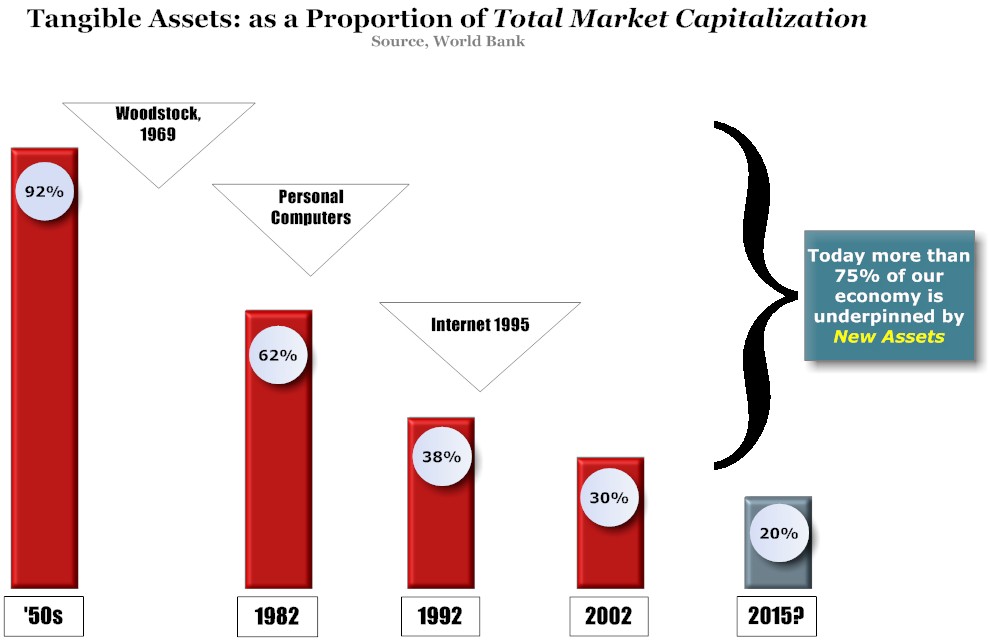
How have banks reacted to this change in the economy?
Not surprisingly, commercial and Industrial lending by banks has fallen with the decline of tangible assets from a high 60% of bank assets in the ‘60s to a low of 18% today.
Banks are no longer pure lending institutions. They’ve become broadly based service industries; profits are driven by banking services, electronic funds transfer fees, and fees associated with asset-based loan securitization. Furthermore, since the elimination of restrictions on banking activities in the later part of the 20th century, there has been a wholesale movement of banks into the highly competitive (volatile) arenas of ‘financial services’. Indeed today many of the most famous names in banking are selling insurance, brokerage and investment counseling services, underwriting equity activities, while engaging in foreign exchange and credit card transactions.
So, what can banks do to help Canada’s SMEs?
We live in a changing world. SMEs today are building knowledge-based business by developing innovative software, patented technologies, network applications and, of (increasing importance), value-based communities of practice.
The hard reality for banks is, these modern intangibles are ‘invisible’ to them, and as such they no longer have security for lending purposes: no surprise they tend to avoid the technology sector like the black plague. This new asset reality has created a financing ‘gap’ for knowledge-rich companies that is one of the principle reasons for their failure or the movement of the opportunity to jurisdictions where alternative financing is more readily available.
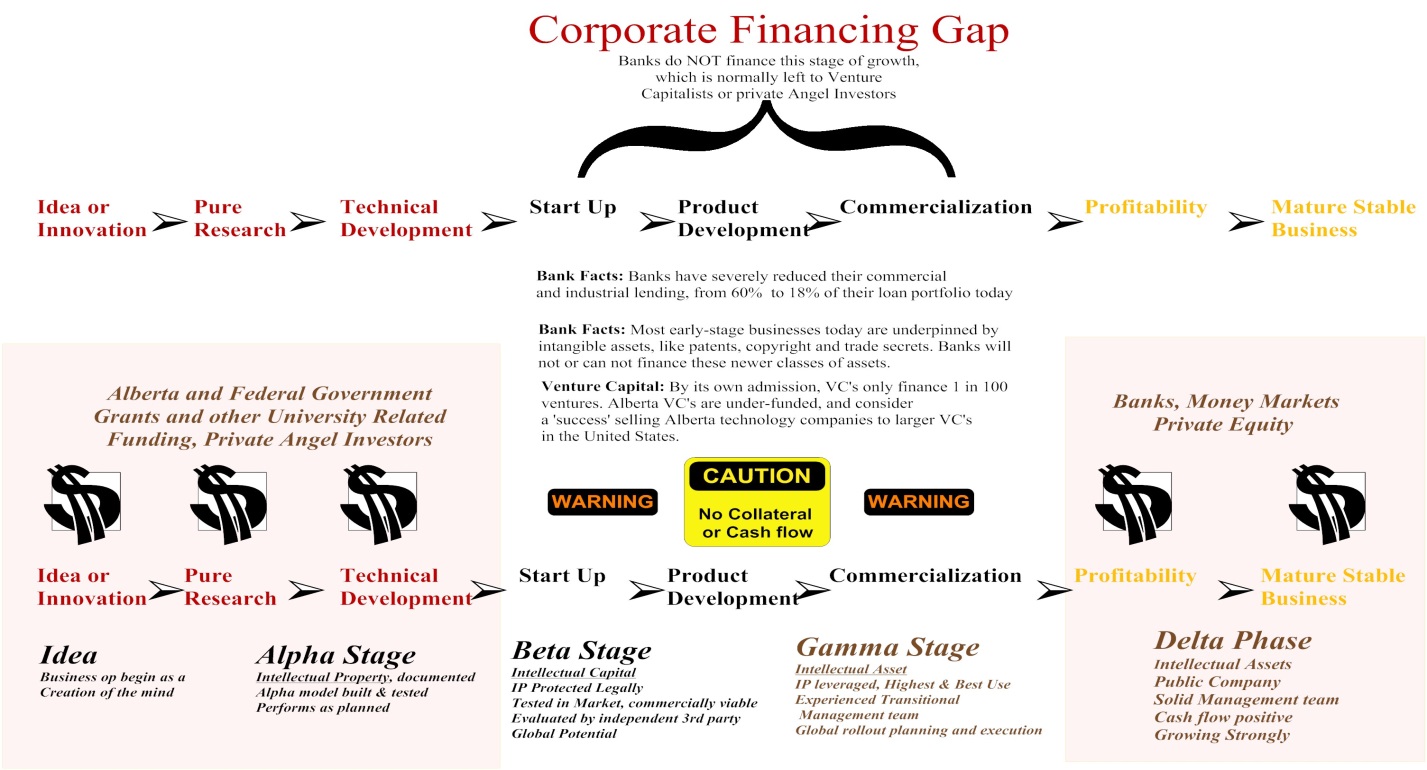
This problem is fixable, there are real assets being generated and the harder forms of intangibles are potentially collateral grade. However before we can begin to solve this problem we much recognize that it’s MUCH bigger issue that it appears.
The intangible asset problem begins with management; almost all SME’s today have ‘empty’ balance sheets i.e. they have none of their important assets identified and capitalized on their (formal) financial statements.
Why is this the case? Well very few corporate leaders recognize their true sources of value. Even fewer have the confidence to capitalize their intangible assets (according to GAAP) on their balance sheets, which are universally prepared for tax purposes (and therefore expense all associated costs).
How can banks help SMEs today? Banks have both the interest and expertise to start formalizing the treatment of intangibles so (some of them) can be collateralized for banking purposes.
Banks could take the lead; bring together important players including government policy makers, tax authorities, accounting professionals and corporate leadership to translate society’s long standing asset management protocols from the declining industrial era assets to the creative assets of our modern economy.
Given the prize that awaits; a new banking business model with the potential to extend loan and other services to existing customers and gain new banking customers, the banking industry would gain significant new profit opportunities. In addition it would make life easier for angel investors (who also need asset security) and in the process unleash the economic potential of the most knowledgeable, innovative and globally connected generation in history.
Visit www.abctech.ca/innovation-creativity
For many of us, our business is our child. We feed it, nurture it, guide it and watch it grow…I think. But…talking about growth has become cliché. Why? Well…in at least 80% of discussions I have with colleagues and clients growth is a repeated theme. It’s inevitable but also exhausting. Growth is an indispensable part of the business life cycle. It is also strategy and philosophy. We keep hearing and humoring ourselves with platitudes from various wells regarding what to do about growth and market expansion. How well has it worked so far? Especially in Alberta?
I can’t shake the feeling that Alberta may have “too many chefs in the kitchen”. Living in a modern individualistic society, we are certainly bred to believe that we should only look out for ‘number one’. As such, we become very guarded about our product and/or service and the market share we currently have. We risk losing control. Sharing in a collaborative sense is a concept that we find difficult to reconcile with the idea of being competitive. After all, isn’t exclusivity of product or knowledge something we cherish and consider an advantage?
A limitation to this thinking is that each creates their own world and becomes their own chef. In short order, there are too many chefs within a given market space. The spirit of collaboration is a far off notion. As chef, one finds themselves responsible for every aspect of their business. As such, it becomes apparent that one’s capacity to grow and to handle growth would be restricted. At this point, one looks at employing more people or out-sourcing functions. Both are good options, but there is a third…aggregation.
Without a doubt, this is a widely used strategy by many best-in-class performing companies. I can certainly think of a number of businesses that have capitalized on horizontal or vertical integration strategies. Why go through intense capital outlays in order to build an infrastructure and develop additional competencies from the ground up when there may be opportunities to join with other businesses that have invested and specialized in the needed competencies? Being mindful and innovative at spotting synergies, capitalizing on them and following up with actionable strategies are skills in themselves and can prove to be lucrative.
As an example, several years ago, I wrote a thesis on the Dynamics of Clustering and Strategic Alliances in the Okanagan Wine Industry. Several important lessons came out of this exercise. First, most wineries are usually small and can be classified as boutique operations. Second, market space for boutique wineries is typically local only, therefore limiting any growth potential. Third, in order to enter a national or international market space, it was absolutely essential to create alliances within the cluster of businesses, and approach the world as a regionally branded product.
This meant that collaboration and sharing of talent, technology and knowledge was necessary. In some cases, businesses transitioned ownership. In other cases, strong alliances evolved. Nevertheless, spillover between businesses was taking place. It was natural and proved to render the regional collaboration strategy a success. Any companies resistant to collaborating and preferring to remain in silos found themselves to be at a disadvantage in terms of capitalizing on changing technology and talent.
Aggregating businesses or at least business competencies with an end game of growing market space for all is a virtual certainty in my mind for many regions and/or industries. The question is, do others believe it to be so or do they believe one can go at it alone? If it still seems difficult to digest this mindset, one may surmise a deeper barrier provoking resistance. Is it fear? Is it fear of uncertainty? Is it trust? This is where real risk lies, but we need not continuously worry. We simply have to break through and accept that collaboration is the key means by which to move forward.
Recently, I had the opportunity to listen to Guy Kawasaki. One of his business mantras is to “let a hundred flowers bloom”. The spirit of his dialogue was to inspire entrepreneurs to not get in the way should their ideas take foothold in unanticipated directions. This is very applicable in this context. Albertans have many exemplary qualities, but if aggregation opportunities arise, will we get in the way or let it flourish? Will we join with enthusiasm and engage in action or keep discussing and searching for growth on individual terms?
Visit www.abctech.ca/innovation-creativity
A serial entrepreneur is defined as a person who has successfully started more than one business who employs others. Small and startup businesses have long been the key drivers of job creation. Research conducted by Ron Bonnstetter, Ph.D., Professor Emeritus, University of Nebraska, Lincoln, Ron Bonnstetter, MA, Chairman of Target Training International, (TTI) and DeAnne Preston identified and quantified the characteristics of serial entrepreneurs. Using the TriMetrix®DNA Assessment, data was collected on 55 different variables in three specific areas relevant to performance: motivators, behaviors and professional soft skills. Motivators tell us why entrepreneurs are motivated to do what they do, behavior describes how they do it, and professional skills reveal what they do well.
The serial entrepreneur profile provides quantitative data that can be used to identify individuals who have the characteristics to succeed in the creation and growth of business ventures. Angel investors, venture capitalists, and other funders can increase their level of due diligence by using the profile as a benchmark to compare the attributes of a funding applicant to that of a successful entrepreneur’s profile prior to investing. Educational institutions can use the profile data to establish more effective entrepreneurial development programs to help those with great ideas turn those ideas into viable businesses.
A Columbia University doctoral study conducted in 2013, used the TriMetrix®DNA Assessment to see if the characteristics of entrepreneurs varied from one generation to the next. The study revealed there were no significant differences between entrepreneurs of different generations and also validated the earlier entrepreneurial profile developed by TTI.
The entrepreneurial profile reveals high levels of motivation derived from the utilitarian and individualistic motivators, high influence and dominance behavioral styles along with a grouping of top competencies including leadership, goal orientation, employee development, interpersonal skills, presenting, persuasion and written communication.
Programs aimed at developing entrepreneurs typically focus on technical entrepreneurial skills like business plans or financing, and the development of an entrepreneurial mindset. As with most development programs, little time if any, is devoted to the study or analysis and measurement of the personal qualities and characteristics required to be a success. Consequently, the inclusion of the development of these qualities and characteristics is lacking in many entrepreneurial development programs.
According to the Service Alberta, there are over 24,800 registered non-profits in Alberta, or one for every 165 Albertans. Known as Non-Government Organizations or NGOs, there are no hard and fast definitions of what constitutes one but the most encompassing way to think about them is groups of citizens who come together for a purpose (other than money making) outside of the direct supervision of government.
Alberta NGOs fill a vast range of functions: some supply legal aid to the poor, others teach English language reading and writing to new immigrants and the illiterate. Still others advocate to protect wetlands, raise money for hospice care and fund research into rare diseases like lupus or Huntingdon’s. One important class in Alberta, the industry associations, provide knowledge sharing, spread best practices, and supply opportunities for networking, connecting new graduates with jobs.
What role could these NGOs play in supporting the growth of small and medium size enterprises in Alberta? Judging by the results of the survey documented in this report, a substantial one. A significant percentage of entrepreneurs questioned by the Alberta Council of Technology Society and the Institute of Certified Management Consultants identified industry associations as vitally important to their survival and growth. They were ranked above banks, investors, and municipal governments in terms of their utility to small businesses.
It’s not hard to see why. An industry association is, for an entrepreneur, one of their main connections to the industry they serve. Through the association they can make contacts at major corporations in their field and find clients. Many of the professionals in the associations are retired, semi-retired, or approaching retirement and can provide advice and support to managers of growing businesses, alerting them to industry issues and common problems that they will confront.
The sheer number of NGOs can present an obstacle to this mentoring and networking function. In Alberta there are over thirty energy-industry related associations. Some serve niche industries like wind or solar power, while others serve the oil and gas sector. An entrepreneur or manager at a small firm may be confronted with up to half a dozen potential associations to join. Given their limited time and resources, they will likely be able to explore the resources of one. How much knowledge may be siloed in these organizations that is vitally important to growing companies, and how many potential connections may be lost by this redundancy?
This is part of a larger problem for NGOs in Alberta: redundancy. With 8,500 non-profits, with several organizations serving seemingly every part of society and the economy, it’s worth asking whether there need to be this many. In Edmonton alone over a dozen agencies are working with the homeless, no less than eight of them providing lodging. It’s time for governments to start considering whether it is time to start fostering consolidation among related NGOs to bring more talent, knowledge, and connections under one banner rather than multiplying bureaucracies, fundraising, and connections to government.
Consolidated industry associations can do more for their smaller members and help to foster innovation and entrepreneurship in Alberta. In addition to providing knowledge, mentoring, and connections they can advocate for procurement reform on the part of provincial and municipal governments, giving an initial boost to start-up companies through “Buy Alberta” initiatives. They can connect new graduates from our universities to growing companies, helping keep our investments in advanced education within the province. They can also, by sharing knowledge, alert budding entrepreneurs and inventors to technical needs within their industry that could be major opportunities with innovation.
The post carbon economy is in sight. Whether it is ended by carbon taxes that raise the cost of fossil fuels, some new energy breakthrough like fusion or hydrogen power that renders carbon outdated, or by some combination of the two it is vital that we in Alberta start planning for what that world looks like and what Alberta’s place will be in it. While it is irking to see Alberta abused in the world media as a major polluter it is also known as a place of growth where workers and companies from around the world come seeking opportunity. If we miss our chance to foster local innovation and grow competitive companies then the world won’t be talking about Alberta’s pollution; they’ll be asking “Whatever happened to Alberta?”
Visit www.abctech.ca/government-and-policy
* * *