

Newsletter Subscribe
Enter your email address below and subscribe to our newsletter


ABCtech #160 29FEB16 Esir writes – Are the professions immune? Also, I’ve been asked to elaborate on the future of Alberta’s professions – the very source of knowledge and innovation that has contribu
ABCtech #160 29FEB16 Esir writes – Are the professions immune?
Since writing my earlier editorial – arguing that “Creating the new Alberta!” warrants vision and leadership, it became apparent from feedback received that I should differentiate what is needed for short term economic recovery and long term economic resilience. Also, I’ve been asked to elaborate on the future of Alberta’s professions – the very source of knowledge and innovation that has contributed to creating Alberta as it is today.
The appetite for short term recovery – for making the pain go away, often trumps interest in prevention – long term economic diversification! If we cave in to immediate interests, we’ll again squander the opportunity for change leaving our children with debt and no future! EI, subsidies and infrastructure spending are pain killers, they do not contribute to either recovery or for diversification. They just make us feel good. Turnarounds are not achieved through debt financing.
Recovery can sometimes be achieved simply by waiting out an economic cycle, but at a huge risk. The forces and sources of change today are geo-political, socio-demographic, economic and technological. Waiting is not an option especially for oil-for-energy economies. Norway, Saudi Arabia, Venezuela, North Dakota, Texas, Kuwait and Russia know that. Alberta and maybe Canada do to. What to do? Read on…
First, let me be clear about the role of government. It is a mess, largely of its own doing – for most debt and distrust prevail. Claims by governments of responsibility for success and blame for failure and their economic relevance are exaggerated at best. Government cannot make transformations, it cannot diversify, it cannot innovate, it can’t even reinvent. Why? Governments in a democracy follow the votes. They cannot therefore lead without a constituency and as a spender of public funds and intense, often obsessive media monitoring, governments are risk averse. Therefore, government operates to ensure there are no shocks, no disruptions. When they occur, it is not of their doing, unless they are positive leading to after-the-fact undeserved claims of credit.
Government can establish arms-length agencies, non-profits and institutions, but in the interest of self-preservation and to please the patron, most evolve a risk averse culture. In fact, in law they are governed to self-preserve.
Other than the weather, change rarely comes without a shock – most systems are designed for homeostasis – self-preservation, and suffer entropy – increasing fragmentation aligned with the system’s purpose. Shocks of relevance threaten the life source – money: economy, socio-demographic: customer, regulatory: government, technology: science.
ABctech is of the view that technology is and will continue to be the prime change agent of the 21st century reflecting the “beginning of the end of the knowledge economy!” Let me explain why the shear force of access to information is so powerful and worthy of attention.
Companies and industries, professions and most nations of the 20th century were built on the knowledge distributed as services by professions and industries as products. The knowledge was the exclusive domain of the professions, and imparted by university professional schools of education, medicine, engineering, architecture, social work, etc.
In order to ensure that the client – one step above a slave in Roman times as ignorant vis-a-vis the professional, was served and protected, governments licensed exclusive, professional associations. The professional association were to license suppliers protect the public and clients from rogue professionals.
Since the origin of the professions, several forces have evolved – predictably.
Education. The public collectively and clients individually have an education.
Value. Governments served as patrons for the professions and the dispersal of knowledge. Today, clients value and are often prepared as customers to shop and pay for service.
Costs. Professions were granted exclusivity – read “a monopoly” and costs have increased in the absence of competition.
Competition. Professional associations have grown in number and competition for exclusivity has increased.
Market. The result is that professional ethics are bending, and market ethics are transforming the professions and their colleges and institutions.
Technology. Enter the internet and machines with the capacity to remember, eliminate error, learn from experience, relate to emotion. and distribute information at the speed of light anywhere to anyone.
The tension is palpable – governments know it and have allocated responsibility to associations at arms length to manage the tension and inevitable transition to the personalization, customization, disintermediation of service.
In a democracy – response to the voice of the voter, the transition is virtually inevitable, with government relegated to ease the transition rather than halt it.
The issue is more one of managing the rate of change than the direction. But the race is on – professions and institutions, industries and government, are realizing that “he who knows the customer best has no competition.”
Apple knows it. Walmart knows it. Amazon too. The data they gather enable them to already serve and even anticipate what is needed, wanted, desired. And they have fewer impediments, are more nimble in decision making, more relational and with more incentives to get it right than governments. The important message for government is to realize that no monopoly lasts forever. Clients – come customers “say” they want public protection but then act as shoppers and give away their privacy.
The public service systems must transition – cost and quality CAN improve. But nothing is for free, competition can be ruthless, and professions will be tempted to take shortcuts undermining quality, rewarded for marketing prowess where relational skills trump knowledge. Regulation of the market will remain a shared professional and government role, but not particularly popular with practionners who will seek to gather to protect their interest, not the public. As they dither, clients in partnership with technology are transforming into customers, shopping with responsive suppliers – new found “ubers”, on-line, off-line, everywhere.
Welcome to the promise of technology. And the relevance of ethics. They SHOULD go hand in hand.
This is what ABCtech is really all about – serving as:
o “Honest broker” wanting to expedite the commercialization of emerging technologies, o “Network of networks” – connecting suppliers with common interests, o “Trusted” – independent of supplier and buyer interests, facilitating transitions when ethics warrant o “Market maker” – preparing both the buyer and seller whose interests don’t always align.
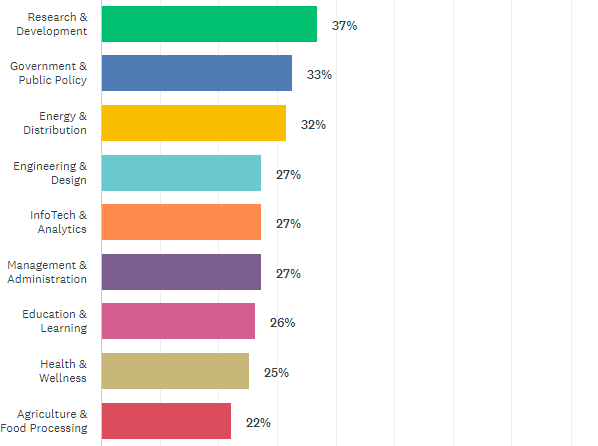
Now let’s get specific. We are not about ideology, we are not for profit or for votes. After 10 years we asked, is Alberta diversified, is it it’s economy resilient to shock. The sentiment was clearly “Not” – see HERE. What to do?
When we appealed to those interested in “Creating the new Alberta!”, a mix of short term recovery and long term resilince interests, we heard of 3 directions: A resilient economy, Leadership in innovation, and Energy transitions – see attached Proceedings.
We are continuing to monitor diversification, it is critical for as we noted above – short term pain will prompt usage of pain-killers trumping recovery and long term prevention. And as we continue to connect the committed, we are interested to learn what established industries/technologies can contribute short and long term to short-term recovery and long term resilience. Hence our fall Conference and March survey – HERE.