


Newsletter Subscribe
Enter your email address below and subscribe to our newsletter


 Prepared for Prepared by
Laura Kilcrease, Alberta Innovates Perry Kinkaide, Kinkaide Enterprises Inc.
December 27th, 2020
TABLE OF CONTENTS
Page
Episode 1. (Nov 5th, 2020) INTRODUCTION..……………………………………… 2
Episode 2. (Nov 12th, 2020) LOCATIONS..……………………………………………. 12
Episode 3. (Nov 19th, 2020) SECTORS..………..…………………………………….… 17
Episode 4. (Nov 26th, 2020) SYSTEMS……….……….……….……………………….. 39
Episode 5. (Dec 3rd, 2020) CONCLUSION…………………………………..……….. 50

We here in Alberta – like YOU elsewhere, are weathering the pandemic AND a severe downturn in our economy. The situation IS serious: lives matter and are being lost, so are the loss of jobs and business confidence.
The state of the economy and its RECOVERY warrant our full attention. That’s what I want to share and discuss with you the results of our 2020 Test of Alberta’s Economic Resilience.
Here in Alberta the downturn is more complicated driven not only by measures to contain the virus BUT compounded by global, regional, and local forces that are transforming our economy or should be … and maybe yours too.
So pay attention. Over the next few weeks I’ll be sharing with you – what you have shared with me – about YOUR economy, change and recommendations. Yes, this is YOUR ECONOMY – the source of jobs and income, taxes and public services including education and here in Canada – health.
The forces for change on the economy are usually cited as technologies – substantial, sustaining, and painful, and no easier to manage than is the virus. Add in the substantial barriers to diversification and recovery and it’s no wonder that people are concerned. What are the options? What can be done?
Well that’s what I’m here for…not to lecture you, but to share with you what you are telling me about your economy and change. For starters let’s look at the cause for change, the BIG picture – the status of the economy today and how it compares with years past reaching back to 2015.
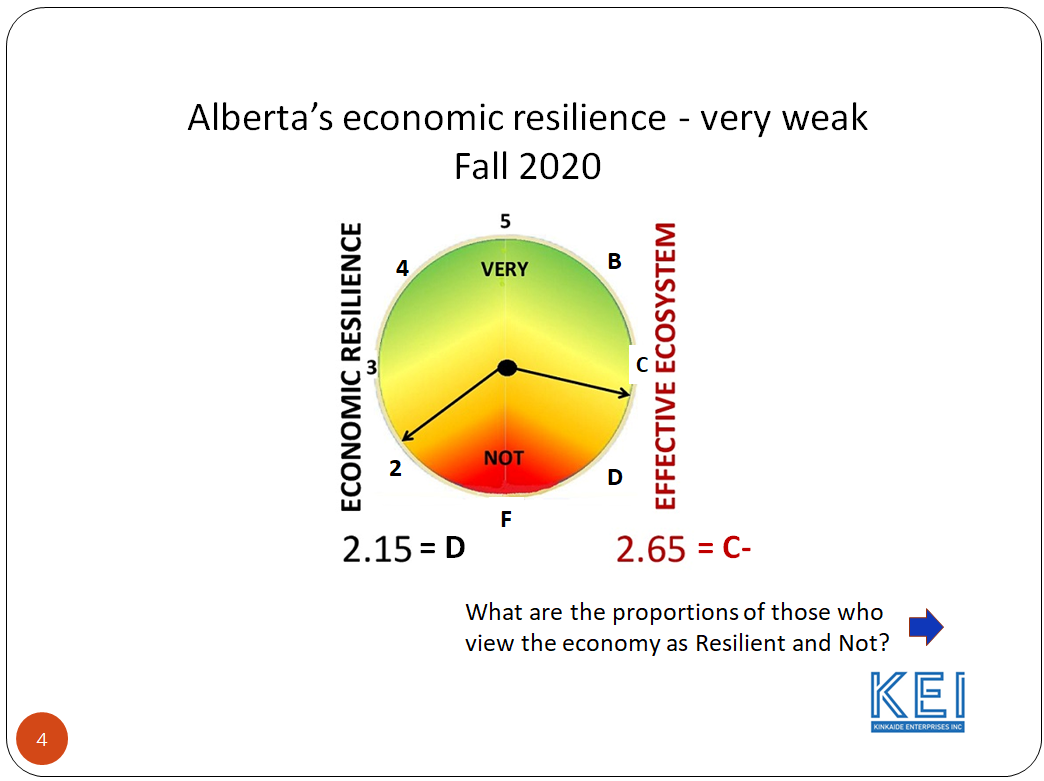
The monitor on Economic Resilience on the LEFT points to a low of 2.15 on a scale of 1 to 5, with 4 and 5 being “Resilient”. This is equivalent to a report card grade of D. I’m ignoring for the moment the rating on the RIGHT of the Innovation Ecosystem. We will be returning to that in Episode 4.
The next slide shows the proportion of you viewing the economy as Resilient and
Not.
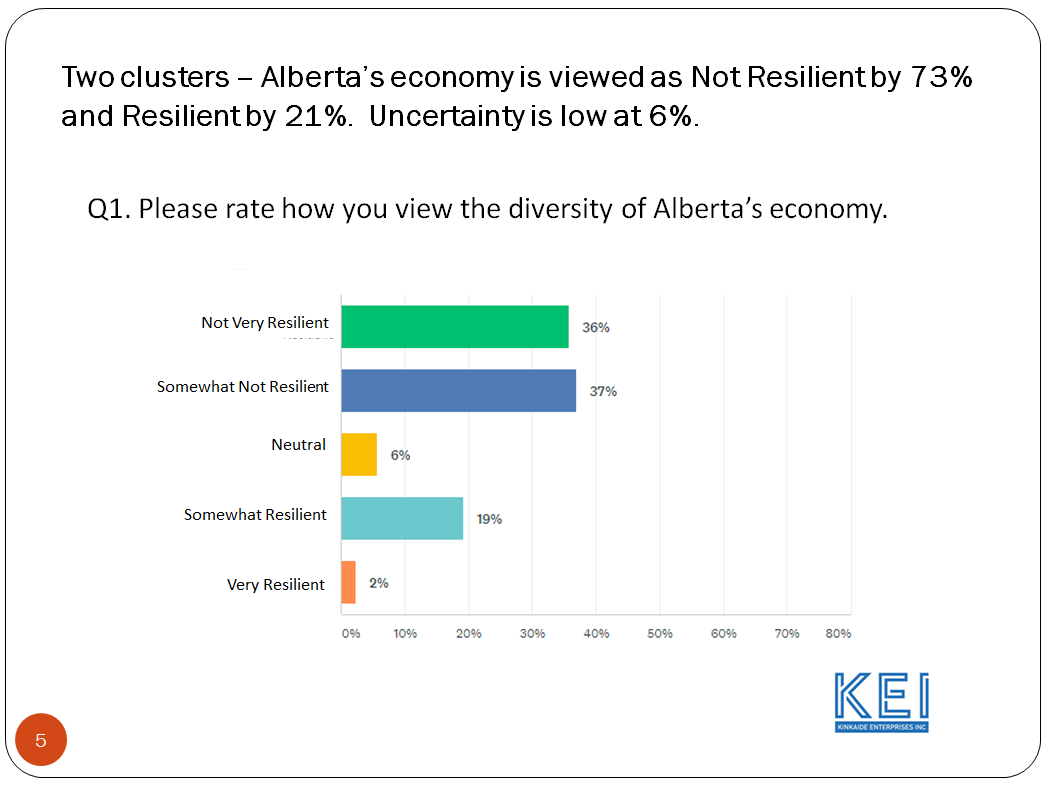
Most – more than 73% of you view the economy as NOT RESILIENT or roughly 3 out of 4 of you. Only 21% view the economy as RESILIENT with 6% on the fence – that is, Neutral. That 6% is important as it reflects the degree of “Uncertainty”. (It has changed – down from 28% in 2015 while “Not resilient” has increased from 62% observed in 2015 through 2019 to 73% today.)
As I’ll show you in a moment, the Grade of D or 2.15 represents a significant dip since last tested in 2019. What are the contributors to this reversal in progress since we first started taking diversification seriously enough to start monitoring resilience in 2015? But first…
Let me digress here for a moment. Why monitor diversification at all; and how to do it? Here in Alberta particularly with oil and gas so dominant, there has been a lot of TALK about “diversification” particularly by government and always during an election. But while acknowledging it as important, there was little agreement as how to do it, how to measure it, or where to find others to emulate.
What about Texas? Hasn’t it progressed in diversifying off oil and gas? We know it well, indeed it is SIMILAR – Yes, BUT differs in may ways: it had ready access to low cost labour from Mexico, savvy generations of wealth and committed investors, an engaged commercial investment bank, federal defense contracts, warm weather, and coastal ports.
Alberta’s well known and frequent booms and busts have been attributed to the price of oil and from time to time federal government interference. NEP still comes to mind and pipeline licensing. Is this a cycle that governments can fix? Certainly not alone. Well as we’ll see Albertans are of mixed mind on what role government should play in fixing the cycle – that is in diversifying the economy!
Alberta AND Canada are not alone in being exposed to this cycle. Energy worldwide is a volatile, cyclical, and vulnerable industry: great when up, but when down – hope and patience prevails for the expected recovery.
I for one believe we should measure what we value. Like the weather, I wanted an index – not just to measure, but to share and rivet peoples’ attention on resolving the boom/bust cycle – between elections…to sustain public interest! Unfortunately there is no agree upon standard for measuring economic diversity!
So I asked around, many discussions with governments. A lot of literature research. And many meetings with academia about what existed or could be designed. To cut to the point, no agreed upon measure existed, lots of research, but no apparent partner to help develop one.
The best measure I could find was a measure of the mix of industry revenues contributing to GDP. That was inadequate as a public measure: the public didn’t understand GDP and regardless I was told that there was no standard GDP measure or data for monitoring progress.
So ultimately out of frustration I opted for the obvious – to monitor the views of those who lived in the economy – YOU, the workers and owners, the professionals and their clients, the voters and consumers of the economy. Hence, the “sentiment” survey.
The survey is conducted each spring and fall and has been since the fall of 2015 with a break between the fall of 2019 and spring of 2020. This past October’s survey differed by including the views of others outside of Alberta. It also differs in the reporting by adding this – a personal presentation of the findings and your recommendations.
Let’s see how things look today compared year by year since 2015. Note, since then the NDP was elected and unelected. Climate change has come to the fore. Pipeline delays and protests came and went. And Covid continues to whack us since this past spring.
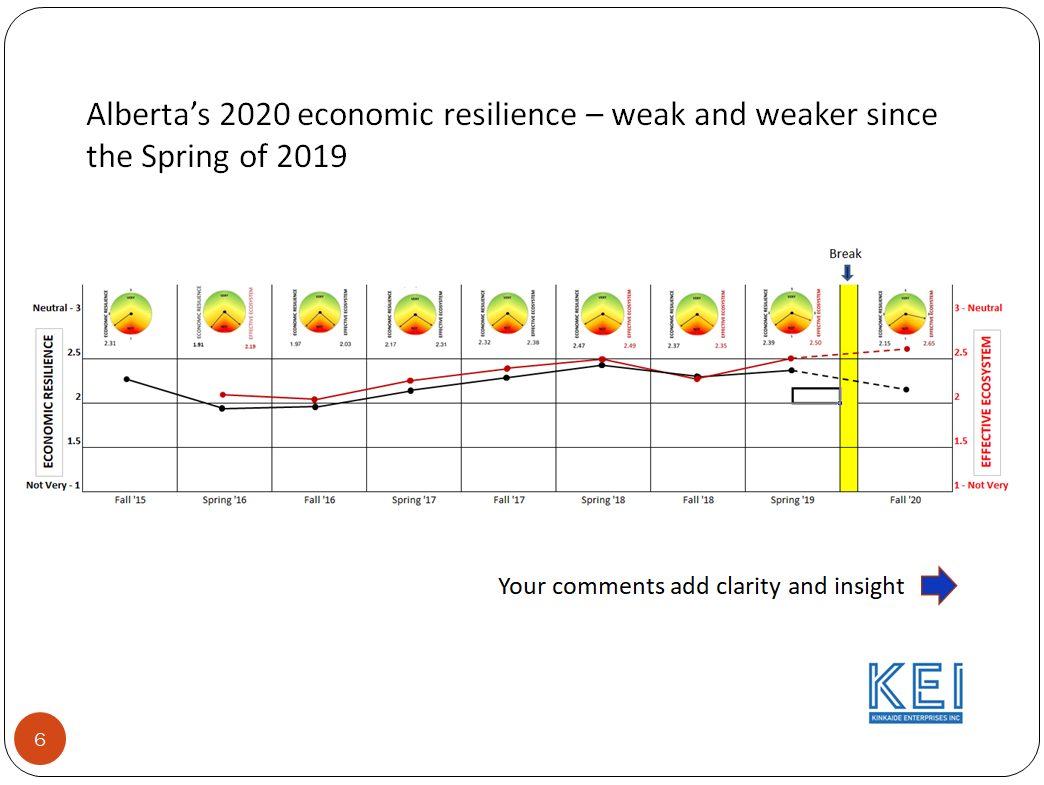
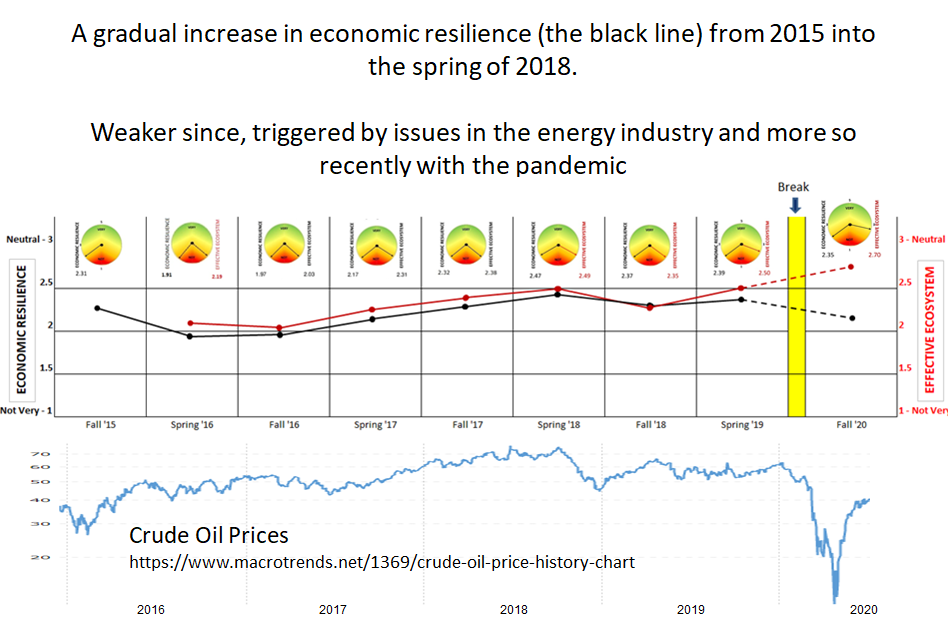
Resilience has been showing little volatility – it’s been pretty flat from season to season, year to year with some gradual, slight improvement rising to a high of 2.49, a grade of C-, in the spring of 2018. The current, big downturn to 2.15 has occurred since the spring of 2019. Why? Your comments provide some clarity and insight as illustrated here.
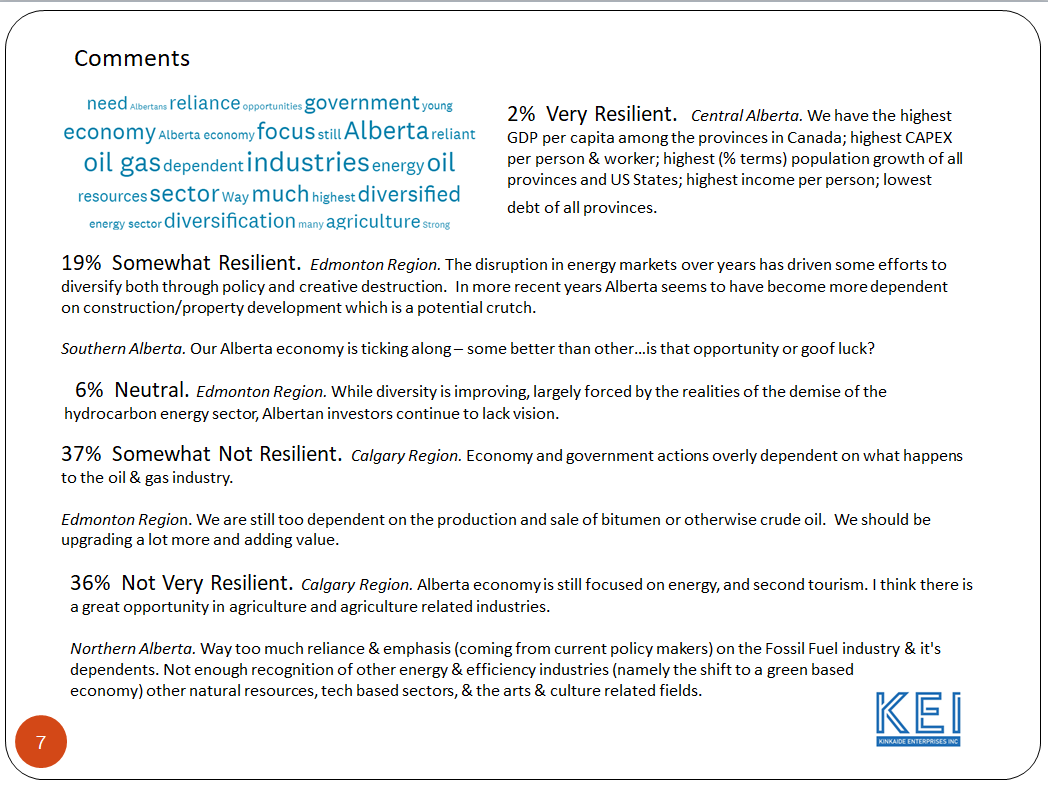
The “Sentiment Cloud” highlights the most frequent words used in your comments to the overall status of the province’s economic resilience. The comments are drawn from those who rated the economy as NOT and VERY resilient.
Overwhelming is the frequently echoed sentiment that the Alberta economy is overly dependent on the oil and gas industry and that while a transition is expected, it won’t come easy. The role of government is also a frequent topic. More on this later. But…
Before drawing any conclusions I have a burning question, “What is contributing to the index – that is, what are the underlying determinants of ‘Resilience’ ?” The data is clear and consistent.
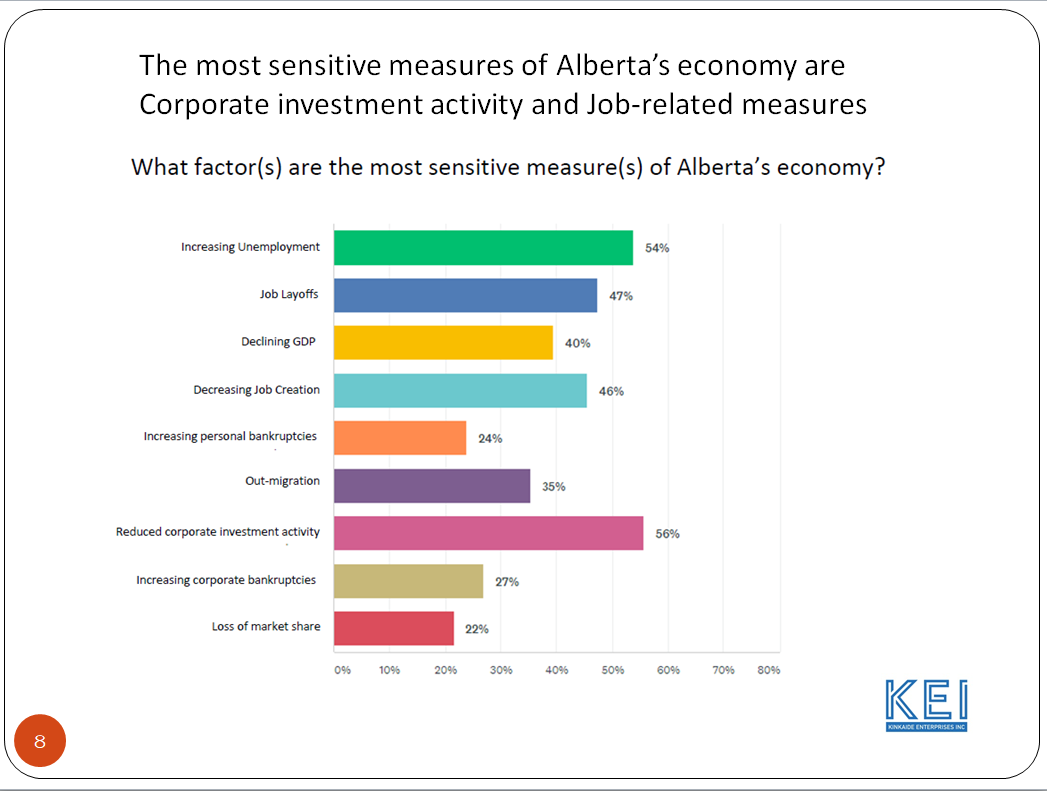
Year-after-year the sentiment is very consistent: Corporate investment (56%) – that is, industry’s confidence to finance its future, ranks highest followed closely by job-related measures of unemployment (54%), layoffs (47%), and job creation (46%). Note – the measure of “out migration,” has risen in relevance with the sustained downturn: now 35% up from 26% in the fall of 2017.
Also note, “GDP” is a measure treasured by economists. It trails other measures of
resilience though NOT in other jurisdictions. When we sampled the views of others outside Alberta, GDP receives more attention. Why?
Those surveyed elsewhere in Canada namely BC and Ontario view their economies as more diversified (50% v 22%) than do Albertans. The status of their economies and diversification are apparently of more interest to Albertans than for those in BC and Ontario, where social issues prevail. When jobs and corporate investment are failing, GDP is a less relevant measure of what’s inportant!
I witnessed this a few months ago when meeting with my Ontario advisory. At the time Calgary was suffering through layoffs in the tens of thousands. But the issue of economic diversification wasn’t on their radar, instead social issues of income disparity and social enterprise prevailed. ALBERTA IS DIFFERENT. Jobs matter.
Our Megatrends research in September showed a close link between changes in technology and the economy. Social change was more closely tied to regulatory/ government/ political influence.
So here we are, the economy is weathering a downturn and not viewed as resilient at least here in Alberta where corporate investment has dried up and jobs are vulnerable. As we will see next week, the impact is quite uneven across the province.
Next week, we’re going to look at Location, and how resilience differs across Regions: Edmonton, Calgary and Others including Northern, Central, and Southern Alberta.
So stay tuned – this is your KEI Network. Should you have any comments and/or questions please let me know by emailing me at Perry@PerryKinkaide.com
In conclusion, I want to thank Tom Dodd with Fission Media and Michelle Lessard with Websites in Edmonton and Kevin McNulty with the Canadian Institute for International Trade for their help in production of the video recording.
And last but not least a thank you to those organizations that have contributed to the Survey’s Distribution and design: Economic Developers Alberta, the Alberta Council of Technologies Society, and AB POL ECON.
Welcome again to our program on Economic Resilience. In this Episode 2, we examine how economic resilience differs across LOCATIONS in Alberta.
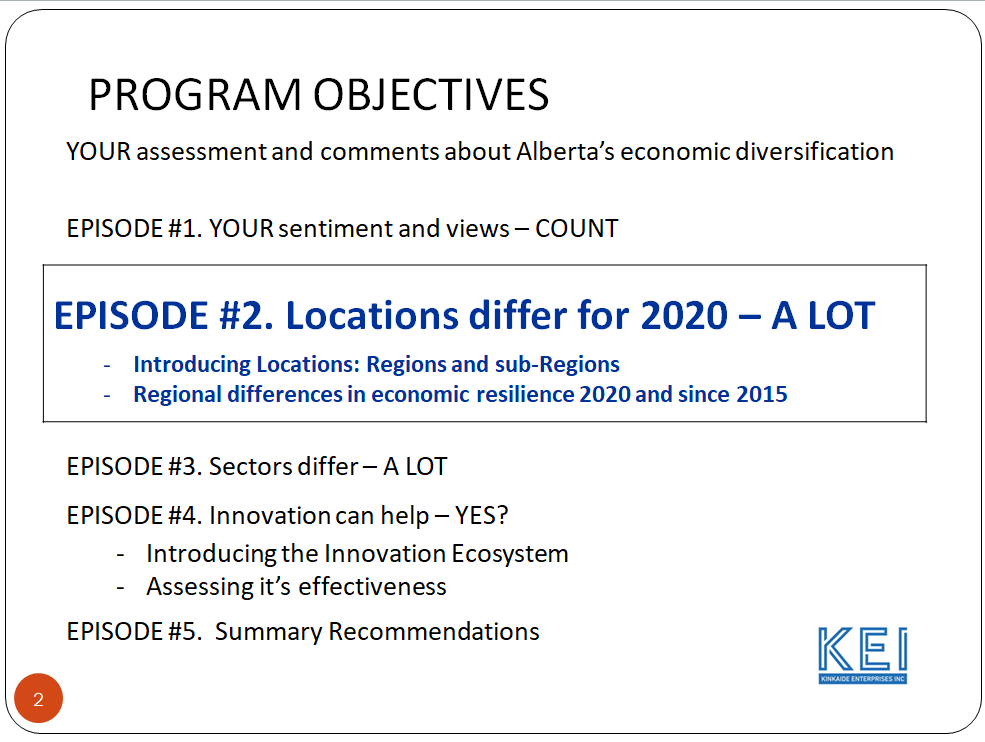
Episode #1 portrayed Alberta’s economic resilience in Alberta as very weak – a grade of D and becoming weaker – a significant downturn since 2019. Also revealed were the most sensitive measures of weak resilience: declining corporate investment and job-related factors including job loss, unemployment, and the lack of job creation. Your comments highlighted the sentiment that Alberta’s economy is overly dependent on the plight of the oil and gas industry, with public services particularly vulnerable.
Welcome. I am your host and delighted that you share with me an interest in the economy, particularly its diversification and resilience and the associated innovation ecosystem upon which economic diversification depends.
Let us begin by taking a look at your view of the economy based on your location.
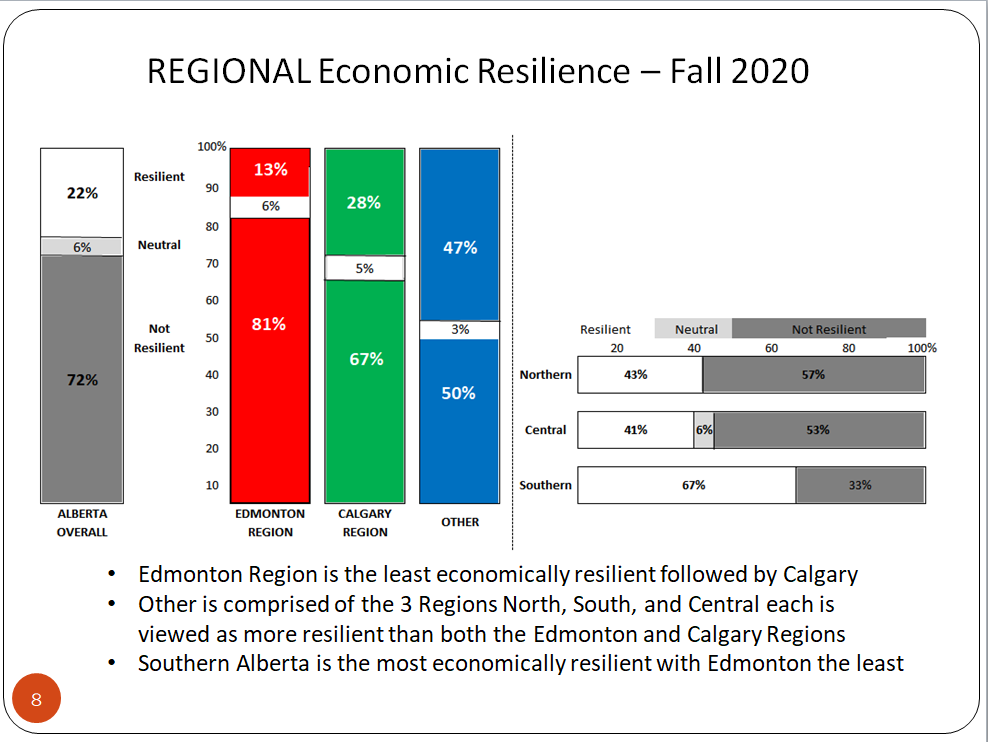
Again, employing a scale of 1 – Not Very Resilient to 5 – Very Resilient, your view of Alberta’s economic resilience differs quite a bit across Regions, with Edmonton weakest followed by Calgary and the rest or Other.
When drilling deeper into the Other Regions, strength is apparent in the North and Central and even more so in Southern Alberta. Why will be explored in Episode 3 when we investigate Sector diversity in each Region’s economy. But first…
Do the factors contributing to your view of economic resilience differ across the Regions? The following slide portrays the measures contributing to your sentiment of economic resilience in 2020 for each of the Regions.
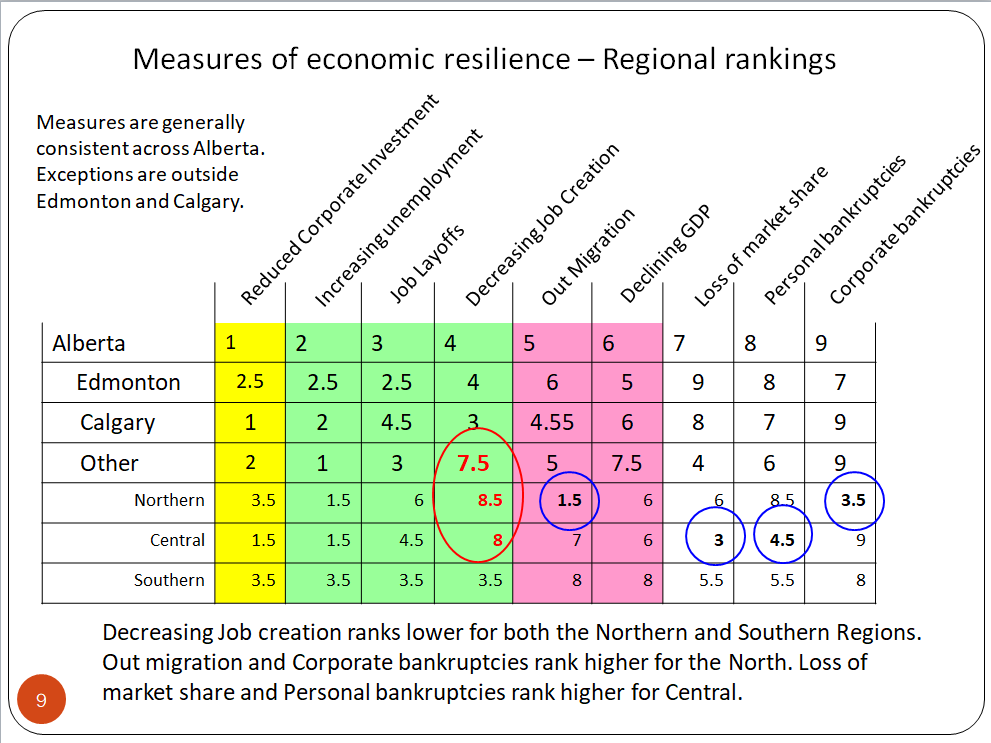
Consistency is apparent in what underpins your sentiment of economic resilience for the Province overall and for each of the Regions.
Of the 9 measures we assessed, Corporate Investment consistently ranks among highest along with Job-related factors, and then GDP and Out migration.
There are a few exceptions as indicated by the circles. The exceptions are outside Edmonton and Calgary. Decreasing Job creation is ranked lower for both the North and Central, while ranked higher for the North are Out migration and Corporate bankruptcies. For Central it is the Loss of market share and Personal bankruptcies that stand out as higher.
We saw in Episode 1 an overall downturn in economic sentiment this past year, reversing several years of a slow, gradual increase. BUT this decline is NOT the same across Regions. It is UNEVEN as illustrated here.
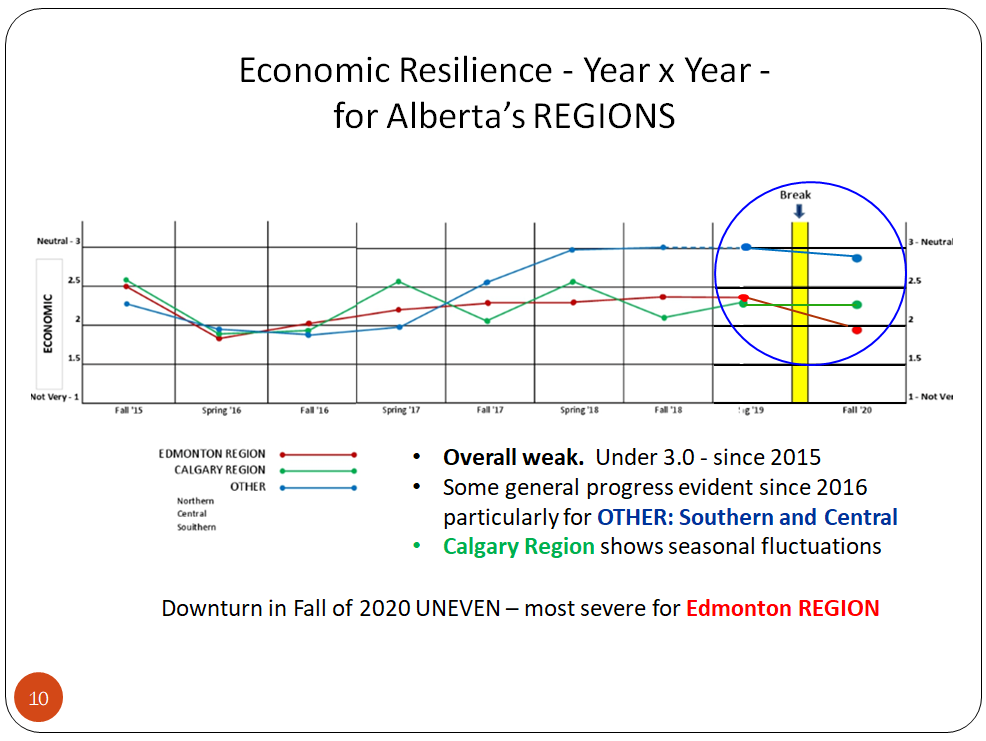
In recent years – since 2016, the Calgary Region has shown a slow, gradual increase with seasonal fluctuations, rising in the spring and declining in the fall.
Since 2019 the Edmonton Region has suffered a decline in economic resilience, more significant than Calgary and the Other Regions. In fact the sentiment of economic resilience for the Edmonton Region now trails all Regions including Calgary.
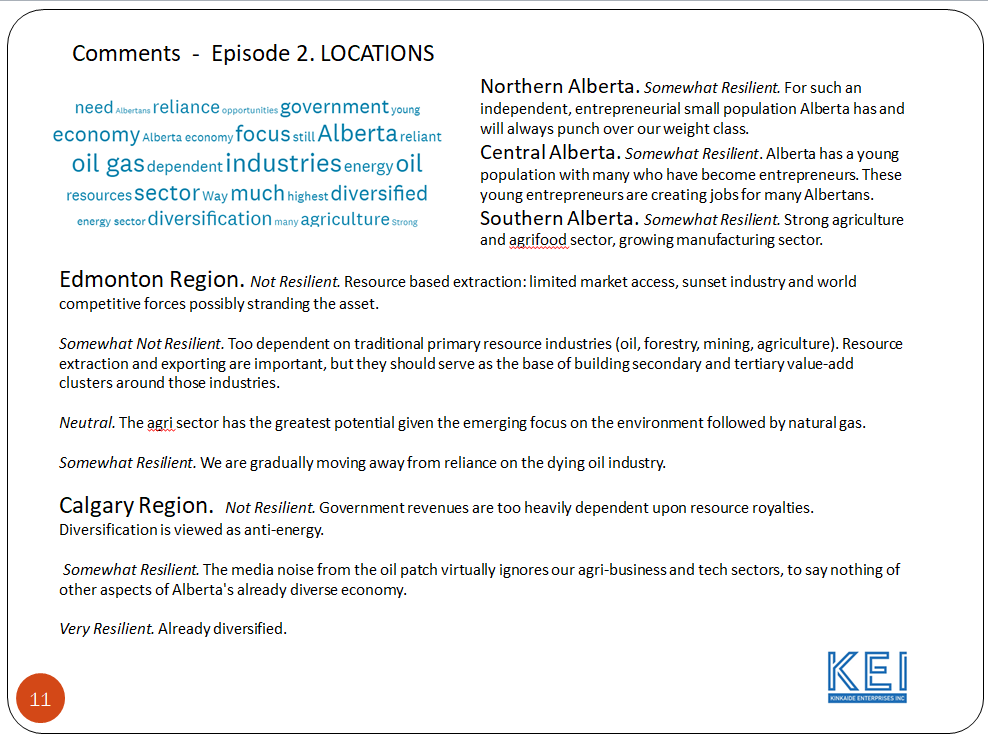
The word cloud and associated comments for each of the Regions highlight again, a sentiment that the plight of Alberta’s economy and the Regions have been overly dependent on the plight of the oil and gas sector.
We’ll investigate the contribution of the various Sectors in addition to energy and agriculture further in Episode 3. when we look at how economic sentiment differs for each of Alberta’s private, public, and professional economic sectors.
Until then – be well.
Welcome to Episode 3 featuring your views about Alberta’s economy, that is – how Alberta’s Regions and Industries, Professions, and Public Services are adapting to the forces and sources of change…social and political, economic and technology. These forces were identified in our Megatrends REPORT in August. If you want to know more visit PerryKinkaide.com
If you are new to Alberta, this Program will serve as an introduction to Alberta a place of extraordinary opportunity and potential.
And if you are in Alberta and are weathering Covid and other forces impacting your family and community, business or profession, and have your doubts about the future – well stay put. This – Episode 3, will acquaint you with the economy at a time when it’s diversity and resilience…or NOT…are being tested.
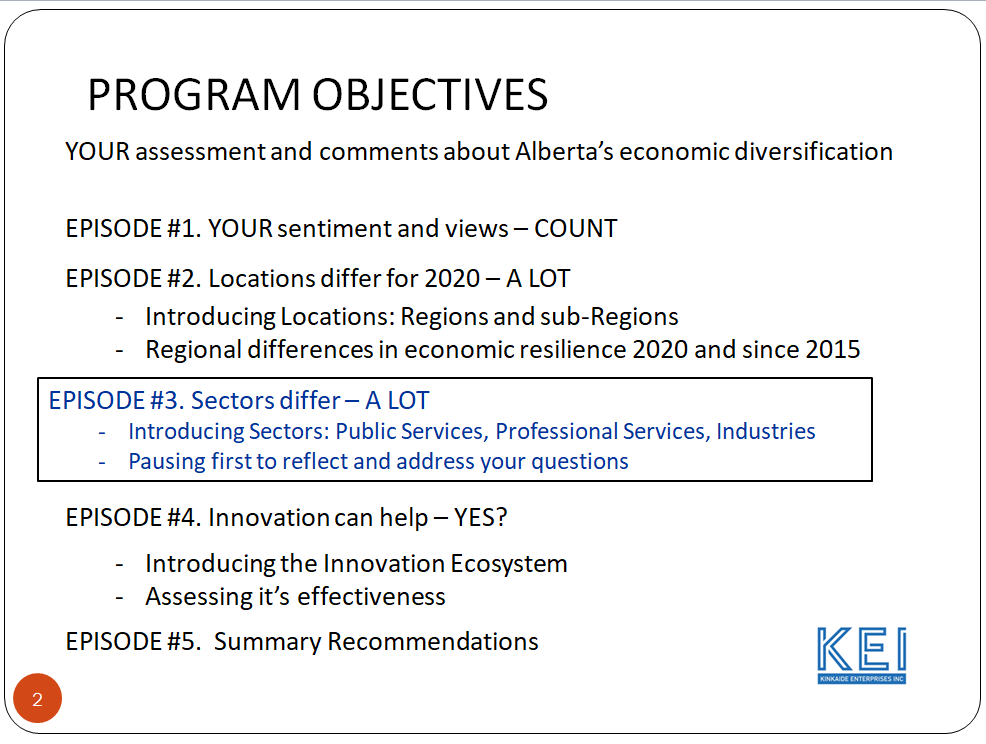
In our first two Episodes we saw that the economy is in a downturn and that the impact is uneven across Alberta’s Regions. The Edmonton Region’s downturn now exceeds that of the Calgary Region. The Other regions are holding tough – weathering the downturn somewhat – but only somewhat, better than both Edmonton and Calgary.
In this Episode we look beyond location, and we dig deeper to learn how Alberta’s various industries, professional services, and public services, are faring.
But wait…some of you ARE new to the series. Or perhaps you want a refresher. So I’ll do a brief review of what we’ve covered so far.

So welcome,
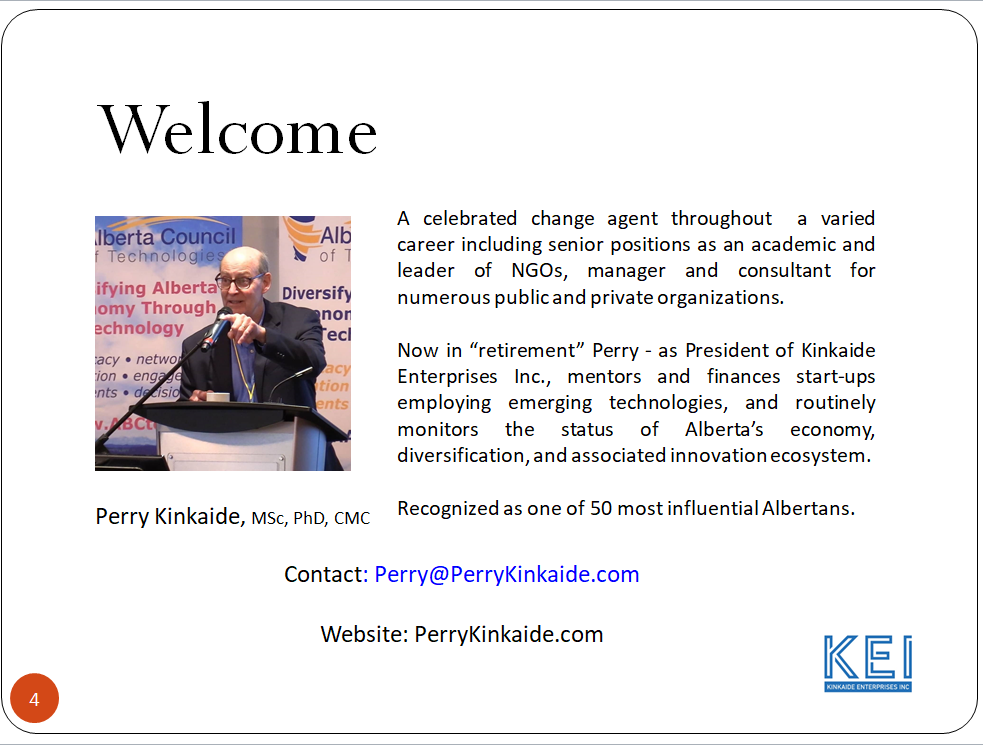
I’m Perry Kinkaide, your host. And for those of you who don’t know me. I’m passionate about Alberta, its future and with good reason.
I immigrated to Canada and Alberta from Long Island NY in pursuit of a PhD at the University of Alberta in brain research. As I tell my American friends – now left behind, there are few places on earth where hard work, family times, and networking are more rewarding.
On graduation I pivoted from academia, joining the Alberta Government as a change agent – a manager, charged first with developing an ecosystem for supporting the integration and development of people with disabilities. Then – second, to help REGIONALIZE social services, and finally to prepare public services and entrepreneurs ready to transfer to Industry. In retrospect, success was bred over and over again by attention to data, detail, and who we were serving. Let’s not forget teamwork.
The lessons learned were extraordinary, helping prepare me for my third career, this time in Professional Services as a change agent in management consulting with KPMG. Those twelve years were absolutely rich with experience coast to coast, and literally across North America.
After another twelve years with KPMG I retired – WELL SORTA, under the illusion that retirement meant lotsa golf, gardening, and grandchildren – what I call the Geriatric G-force. But retirement lasted only about 20 minutes when someone – I recall her name was Susan, asked me if I would help her find financing for her new company.
That led to the founding of Kinkaide Enterprises Inc. for financing and mentoring corporate startups. That in turn led to the founding of the Alberta Council of Technologies Society – the network of networks, and another dozen years as investor, mentor and Board appointee for several startups, professions, and industry associations.
You can appreciate that each stage of my career contributed to the simultaneous development of personal networks. It is these networks – including you, who I am now engaging in monitoring Alberta’s economic diversification.
And here we are.
One of the carryovers from ABCtech has been continuing to monitor Alberta’s economy by conducting an annual sentiment survey of the KEI Network of over 25,000 contacts.
This Program is about: 1. Alberta’s economy – our jobs and services and 2. Alberta’s innovation ecosystem including the role of government in diversification of the economy.
In Episodes 1 and 2 we learned…well, let me show you:
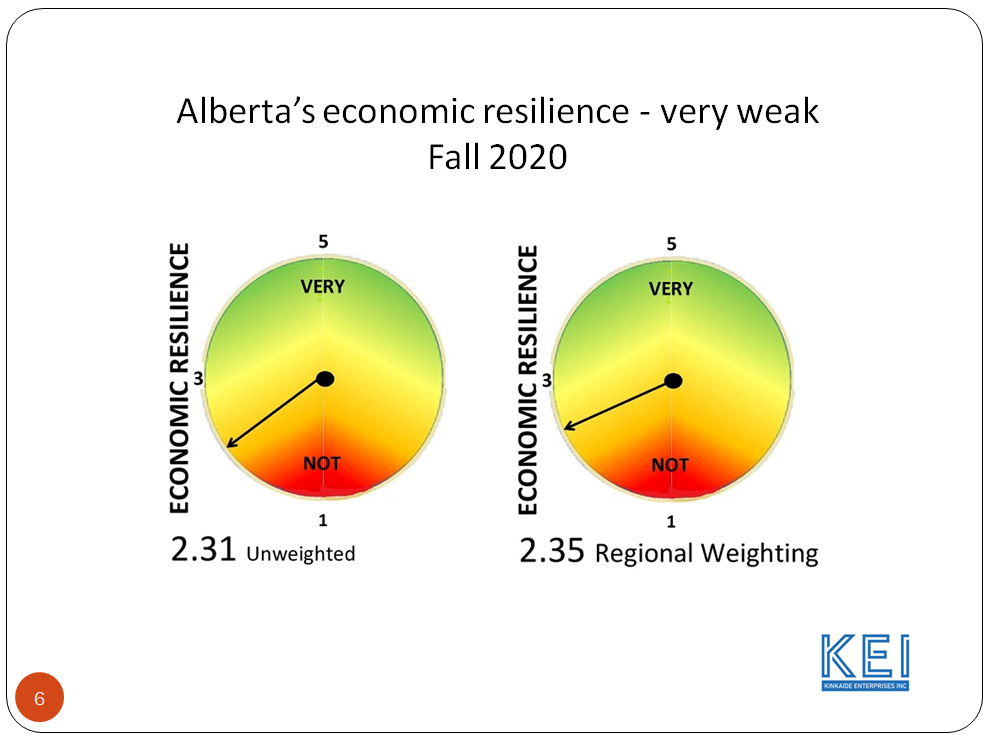
Overall we saw that the province’s economy was very weak. On a scale from 1 to 5 the rating was about 2.3.
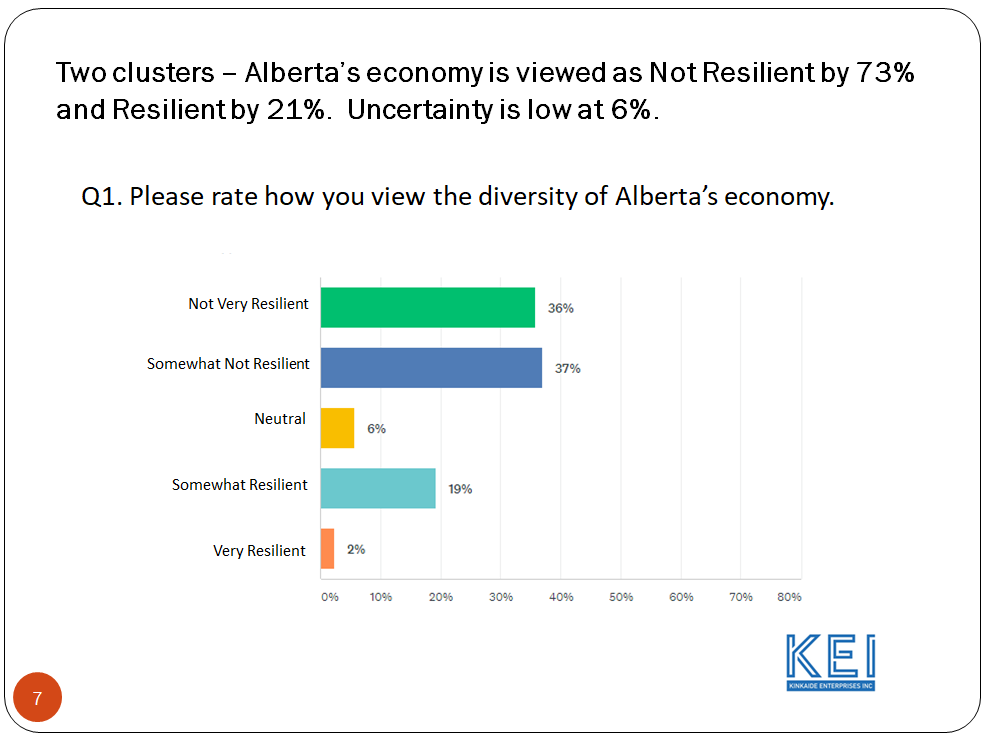
We also noted when we asked, that the province was not very resilient or somewhat not resilient at a rate of 73% and only 21% rated the province’s economy as resilient with very few uncertain as to which way they would swing with neutral at 6%. Very resilient was only at 2%.
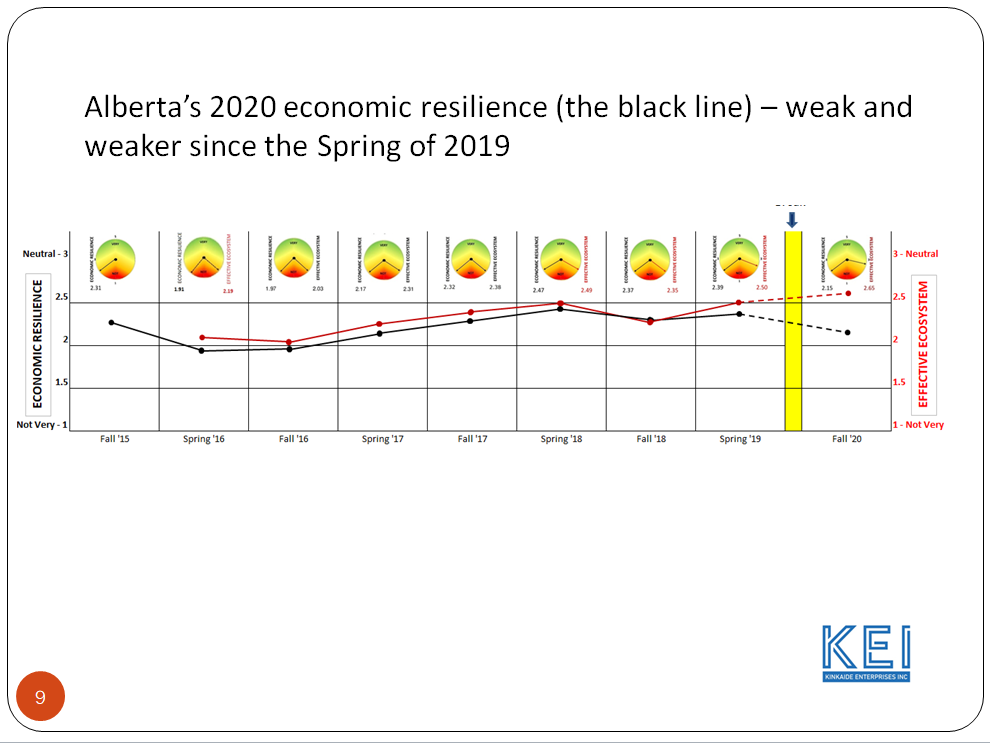
When we looked at changes that have occurred since 2015 when we launched the survey, the black line here reflecting your views of the Province’s economic resilience is quite flat between 2 and 2.5 and that is continually weak though seeing some progress to the spring of 2018 and then the significant drop since the spring of 2019 to 2020 when both energy and Covid hit the province dramatically. The red line by the way reflects the effectiveness of Alberta’s innovation ecosystem that will be discussed further in Episode 4.
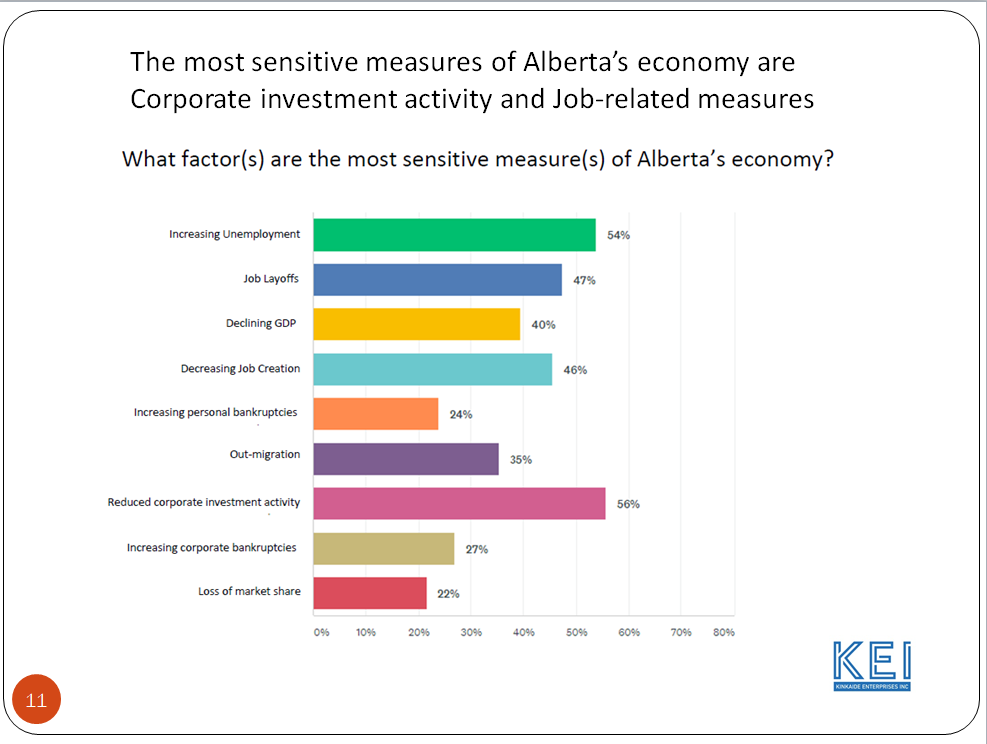
The most sensitive measures contributing to economic resilience were corporate investment and any factor that related to jobs. By the way some of these slides are quite detailed and I encourage you to use your pause button.
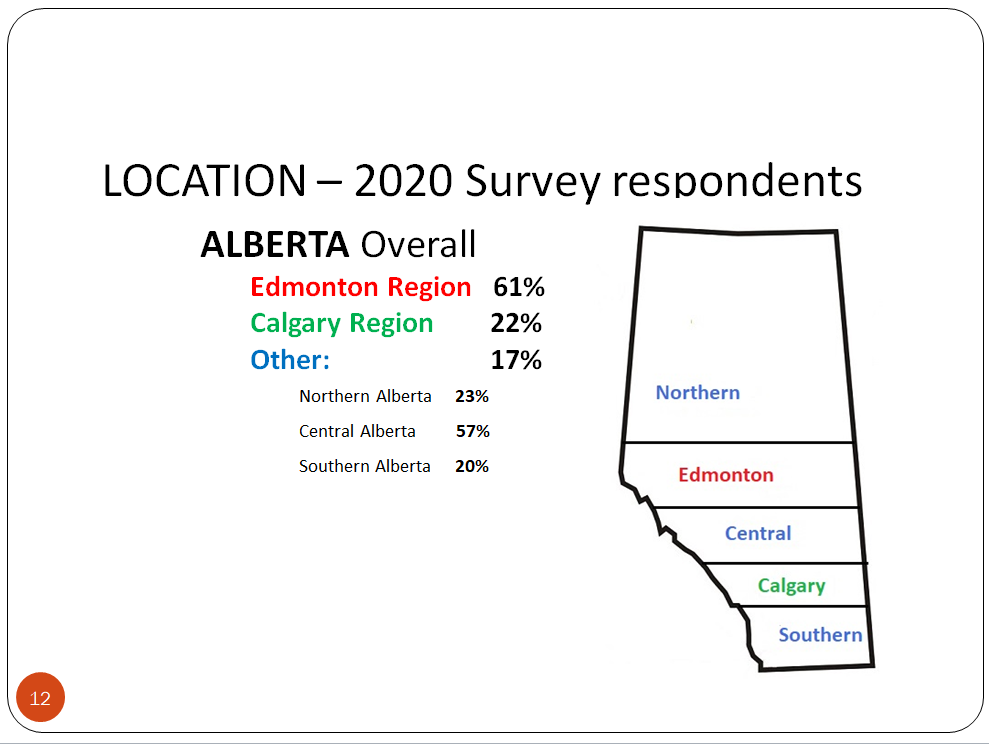
Contributing to the overall survey were respondents principally from the Edmonton Region at 61% with 22% from Calgary, and 17% Other. The breakdown of the Other Regions include Northern, Central, and Southern Alberta. Anytime we are doing a Regional analysis we use the average for the Region so that the Regions can be fairly compared.
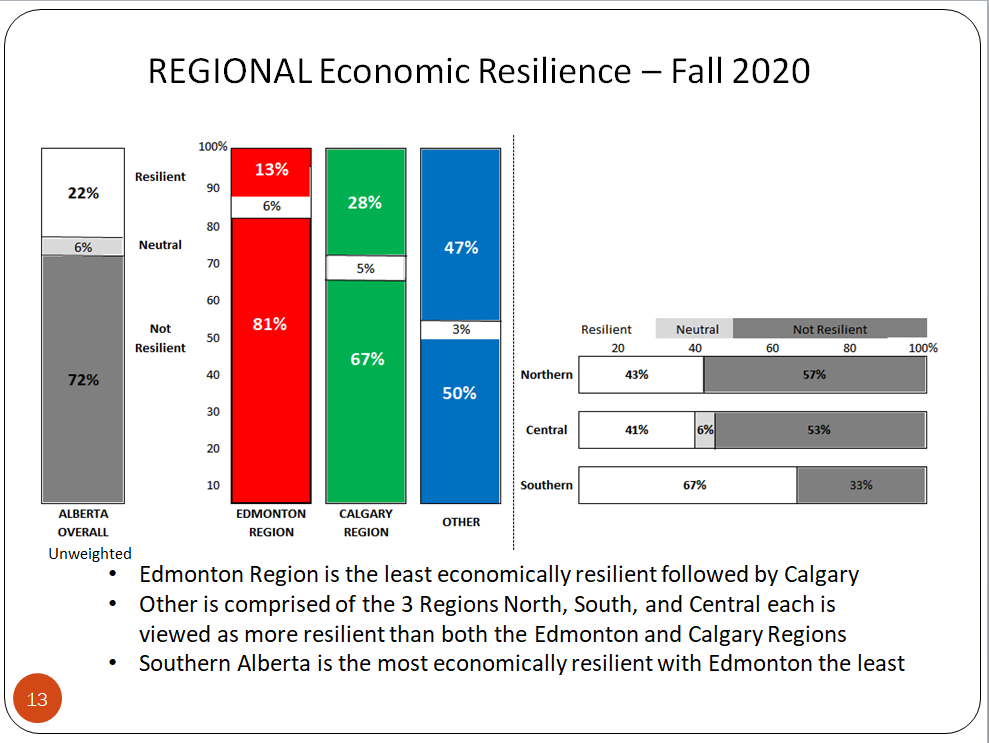
This was the overall view of how the Regions compare and as you can see the Edmonton Region was weakest with the others stronger particularly Southern Alberta. Please use your pause button to freeze the screen for a closer inspection.
.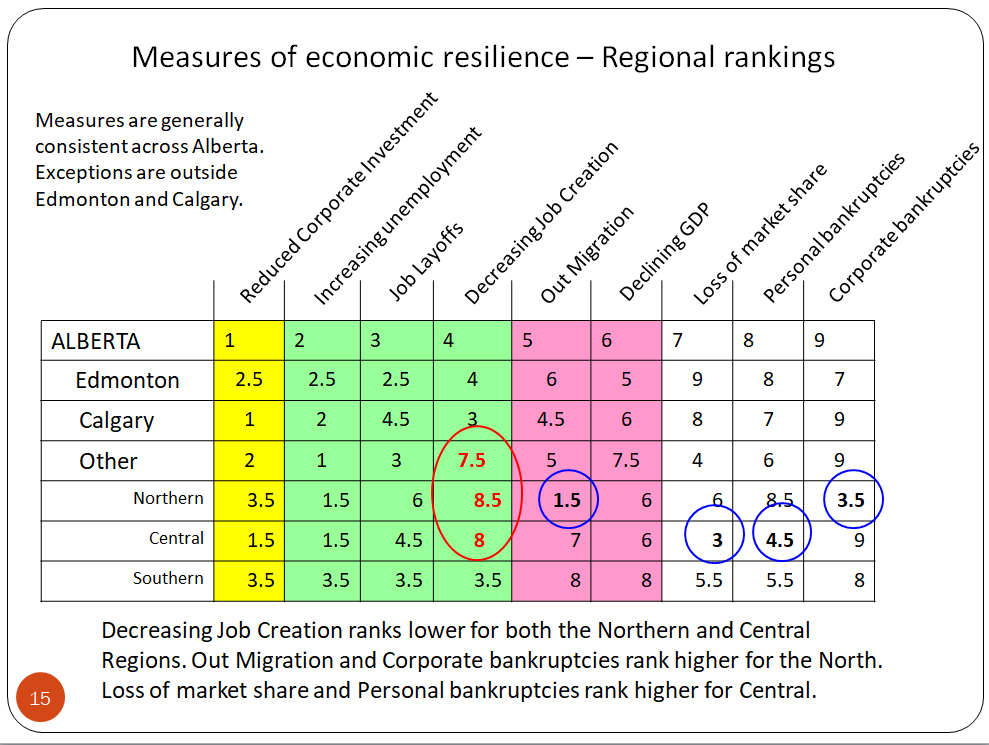
What was contributing to the sentiment by Region? All of the Regions view Corporate Investment as the primary indicator with Jobs also rating high. A minor exception is that Decreasing Job Creation was less relevant for those in the North where Corporate Bankruptcies and Out migration were rated higher and Central Alberta where Loss of Market Share and Personal Bankruptcies were rated higher that Decreasing Job Creation.
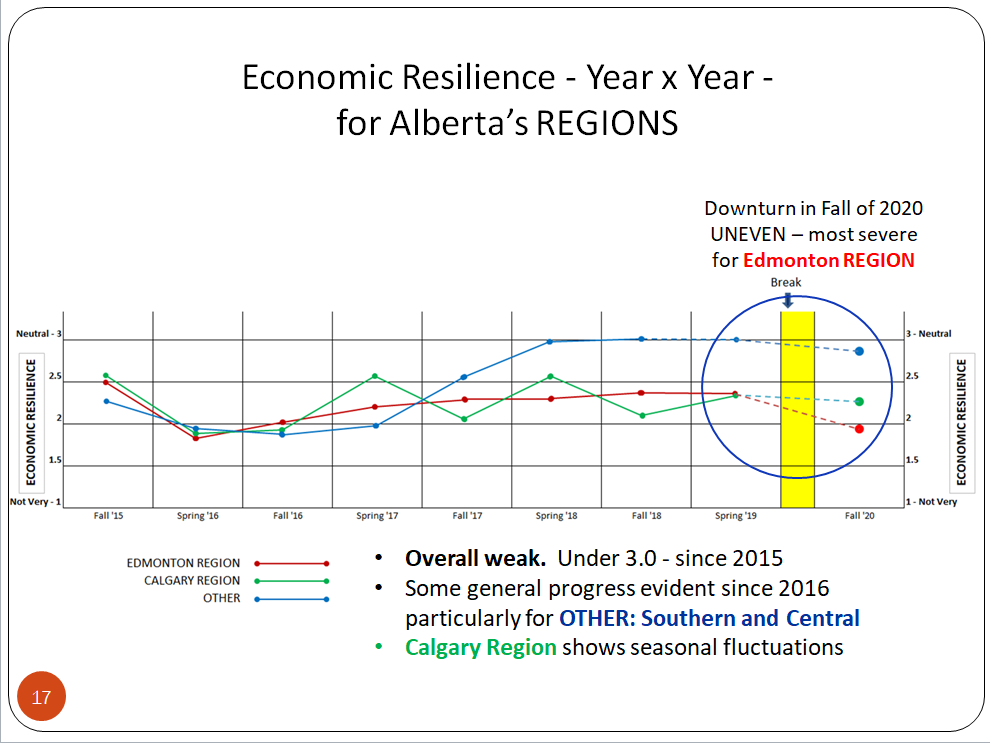
How the changes differed by Region since 2015 is illustrated here. The Blue line representing the Other Regions rose steadily to the spring of 2018 and then flattened out at Neutral 3.0. A seasonal factor is evident for the Calgary Region illustrated in green – rising in the spring and reversing in the fall likely attributed to changes in drilling activity. Resilience flattened out after 2018. For the Edmonton Region in red, it remained flat – relatively stable with a significant drop between the spring of 2019 and 2020. What happens in the Edmonton Region – that is public sector intense, lags about a year after Calgary reflecting public sector adjustments and the dependency of the province’s economy on the plight of the oil and gas industry.
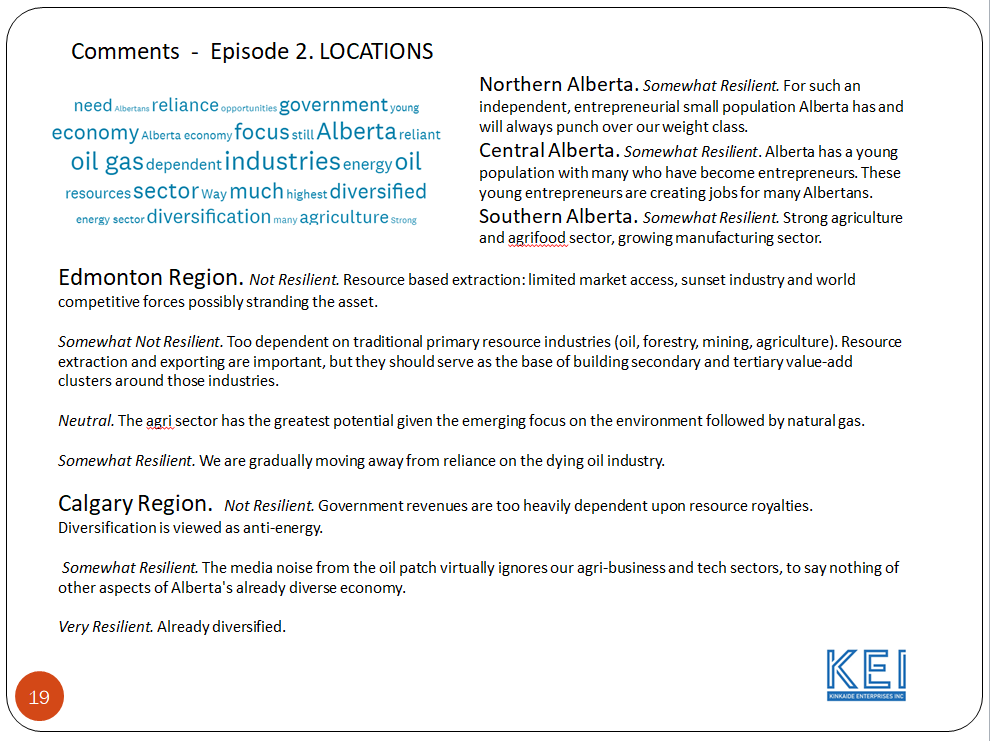
Your comments echoed exactly that sentiment – the dependency of the province on the plight of oil and gas and concerns on the role of government. Pause to reflect on comments.
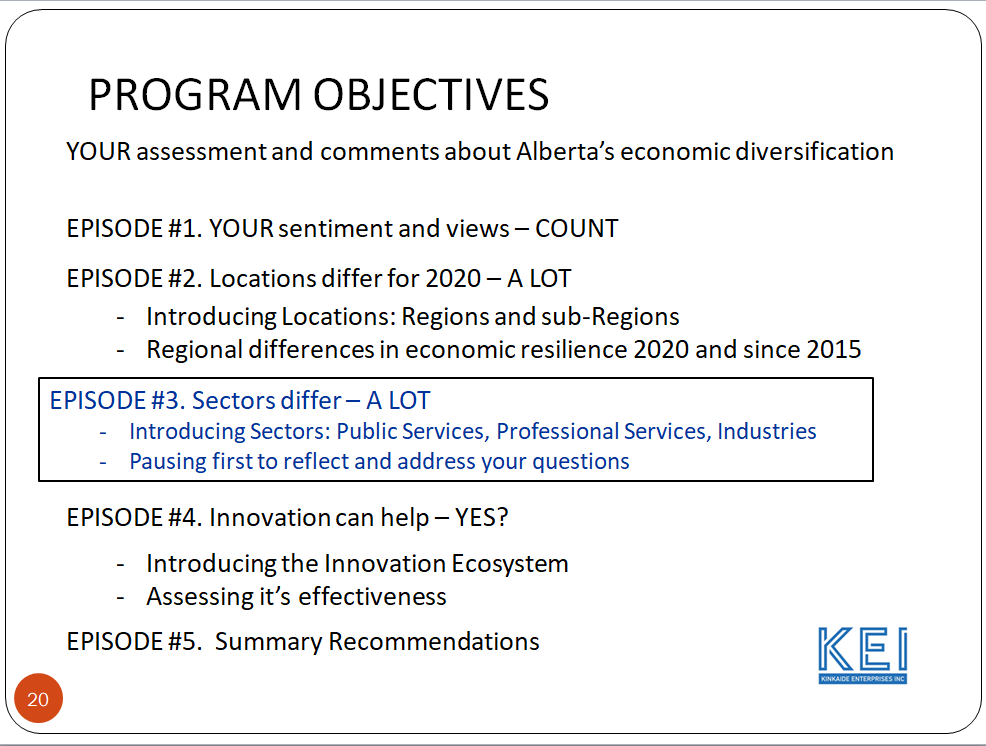
Now we arrive at the subject for Episode 3 – a more detailed look at the province’s economic resilience by economic sectors. The three sectors of interest include Public Services, Professional Services and Private Industries.
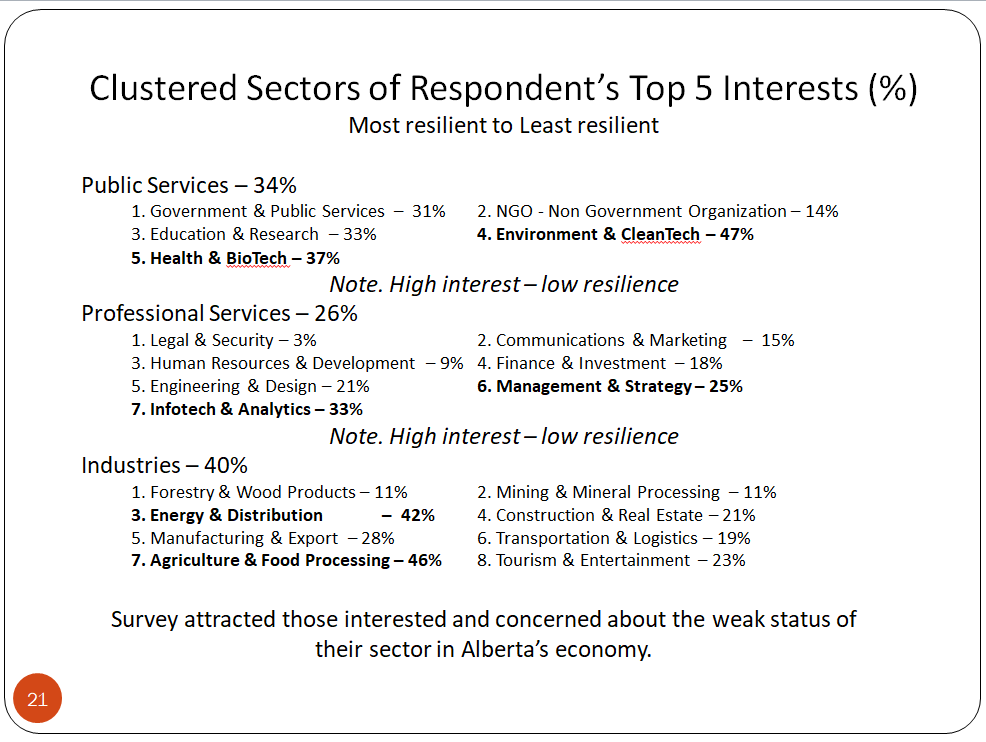
Those who contributed to the survey were asked to identify their top 5 sectors of interest- 34% cited Public Services, 26% cited Professional Services and 40% Industries. Those sectors of highest interest were also those having the lowest resilience: Health and Environment in Public Services and Management and Infotech in Professional Services. This held for Agriculture but not for Energy where Energy was of high general interest but not among the lowest in resilience. Conclusion – the survey attracted respondents in sectors experiencing weak resilience with the possible exception being energy where interest was high among all respondents.
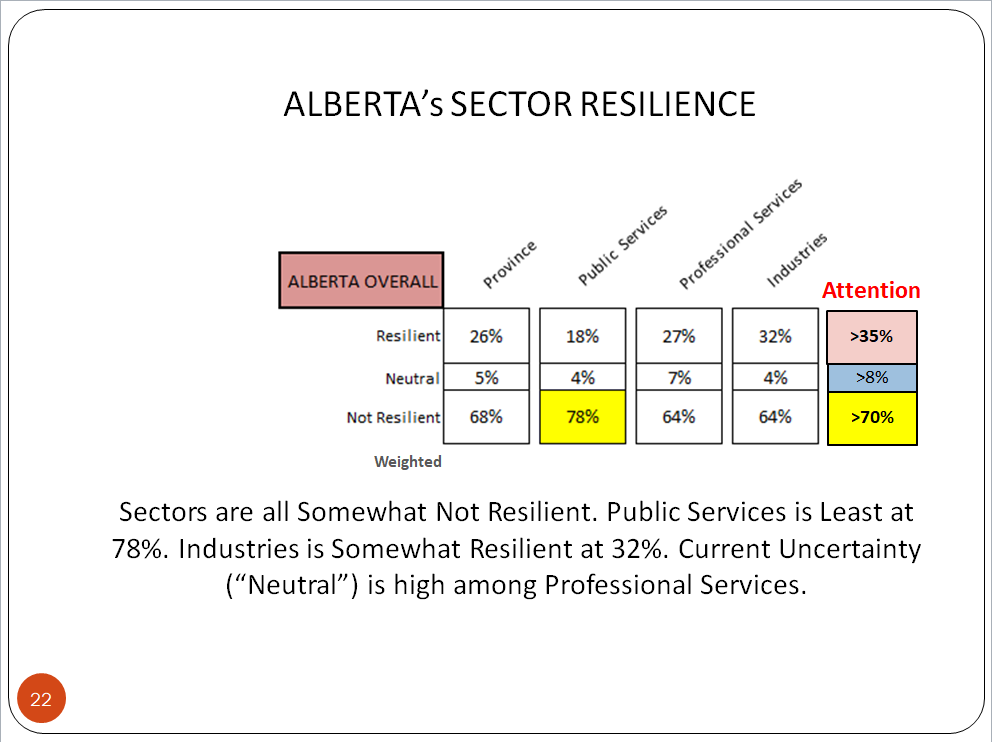
To simplify the comparative analysis we draw your attention with the tan colouring when Resilient (Very and Somewhat) exceeds 35%, in yellow when Not Resilient (Somewhat and Not) is above 70%, and in blue when Uncertainty (Neutral) is above 8%. No sector viewed the province’s economy as resilient (>3.0). Public Services rated the province’s resilience lowest with 78% viewing the Province as Not Resilient – see the yellow highlighting. The Industries Sector viewed the province’s resilience highest at 32% – but still weak. Uncertainty was highest at 7% for Professional Services.
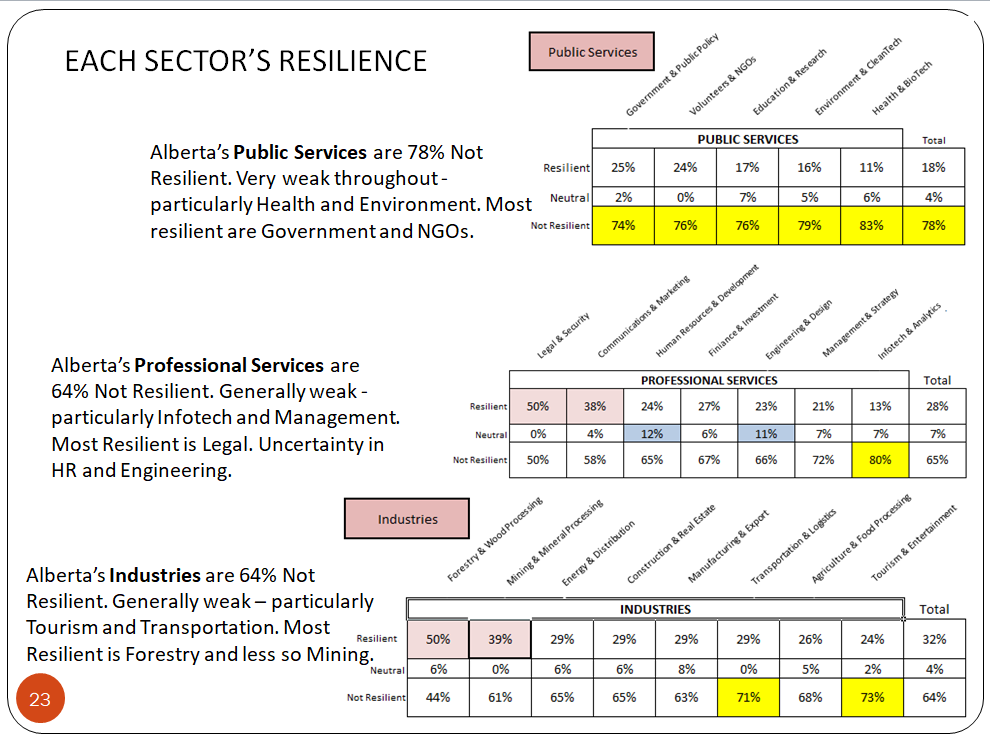
There is considerable detail in the analysis of each sector’s resilience. For Public Services, all sub-sectors view the Province’s economic resilience as weak, with Health weakest at 83% and Environment at 79%. As for Professional Services, again the Province’s economic resilience is viewed as Not Resilient – weak, at 68% and in particular Infotech at 80% and Management at 72%. Some strength in Resilience is evident by Legal Services at 50% with Uncertainty highest for Human Resources and Engineering each at 11%. As for the Industries Sector, there is some strength evident in Forestry (50%) and Mining (39%) with weakness particularly evident in Tourism (73%) and Transportation (71%).
Overall we have seen that the provincial economy is viewed as Not Resilient, that is weak, particularly by the Edmonton Region, the Public Service sector and Health and Environment, the Professional Services Sector and Infotech and Management, and Industries Tourism and Transportation. Some strength is evident in Legal and Communications, Forestry and Mining.
In the next section we will investigate how each sector view’s the Province’s resilience for each Region.
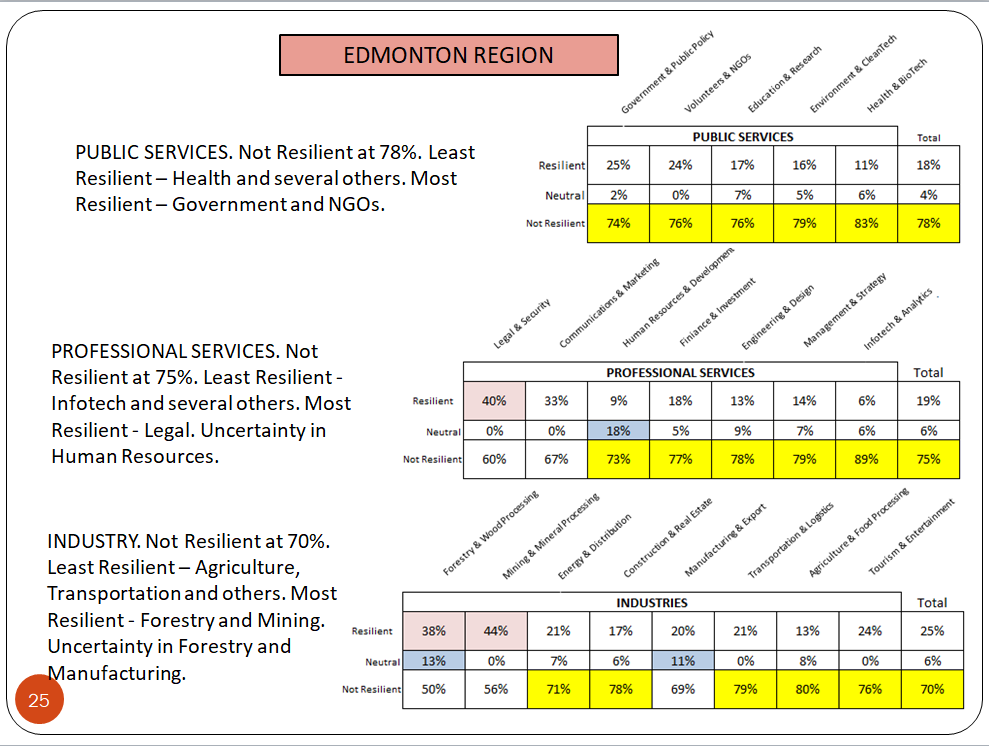
For the Edmonton Region all three Sectors view the province’s economic resilience as weak – see the yellow, with the only strength – see the tan colouring, in Professional Legal Services, and Industries of Forestry and Mining. Uncertainty is apparent in Human Resources, Forestry and Manufacturing.
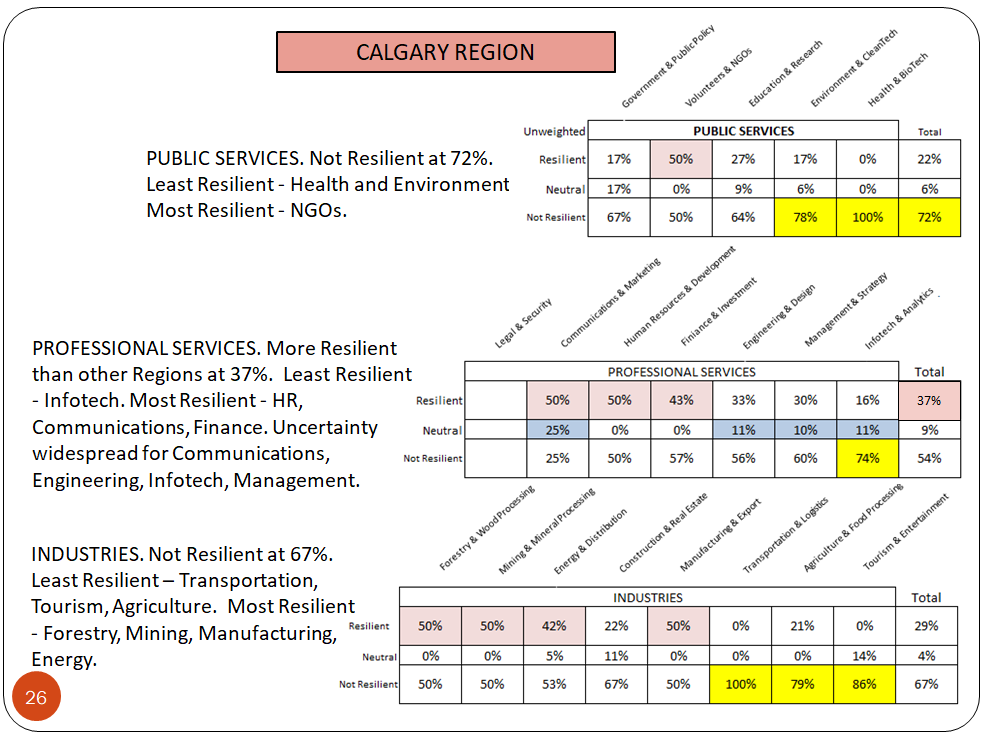
As for the Calgary Region, it views the Province’s resilience as somewhat stronger than Edmonton though Public Services are weak. Strength is apparent in Public Service NGOs, Professional Services of Human Resources, Communications, and Finance with weakness in Infotech. Uncertainty prevails in Communications, Engineering, Infotech and management. Strength is apparent in Industries, specifically Forestry, Mining, Manufacturing and Energy with weakness in Transportation, Tourism, and Agriculture.
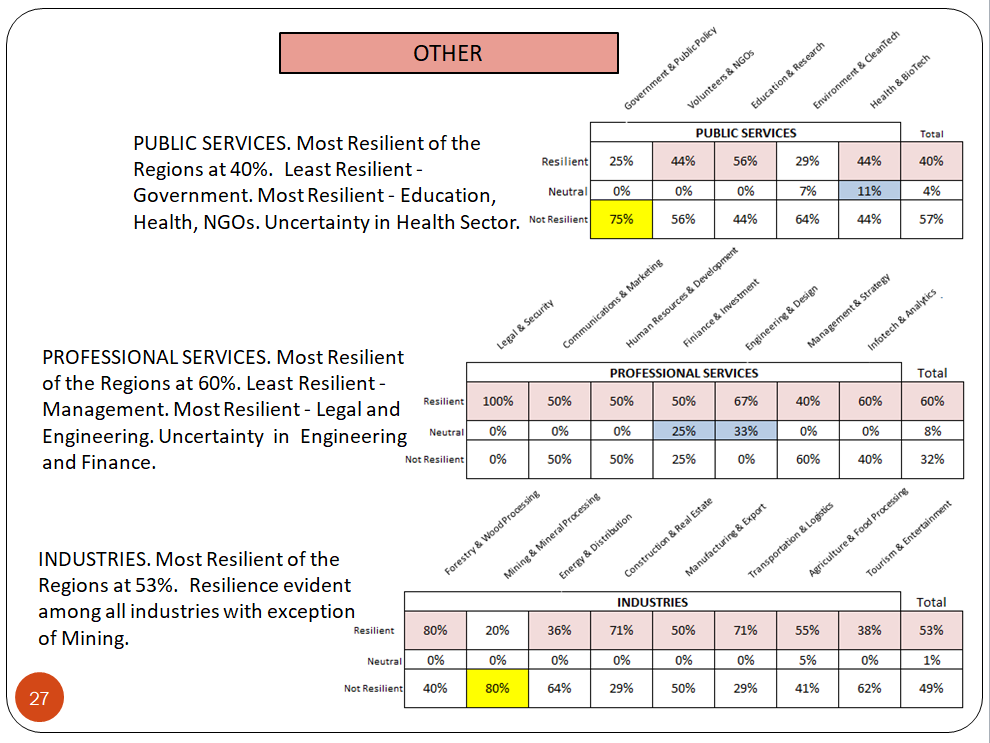
Regions outside Edmonton and Calgary – the Other, had the highest ratings for the Province’s economic resilience overall and for each of the Sectors. Least Resilient was Government in Public Services with strength in all sub-sectors of Professional Services and Industries with the exception of Mining. Uncertainty was highest in Health and Finance and Engineering.
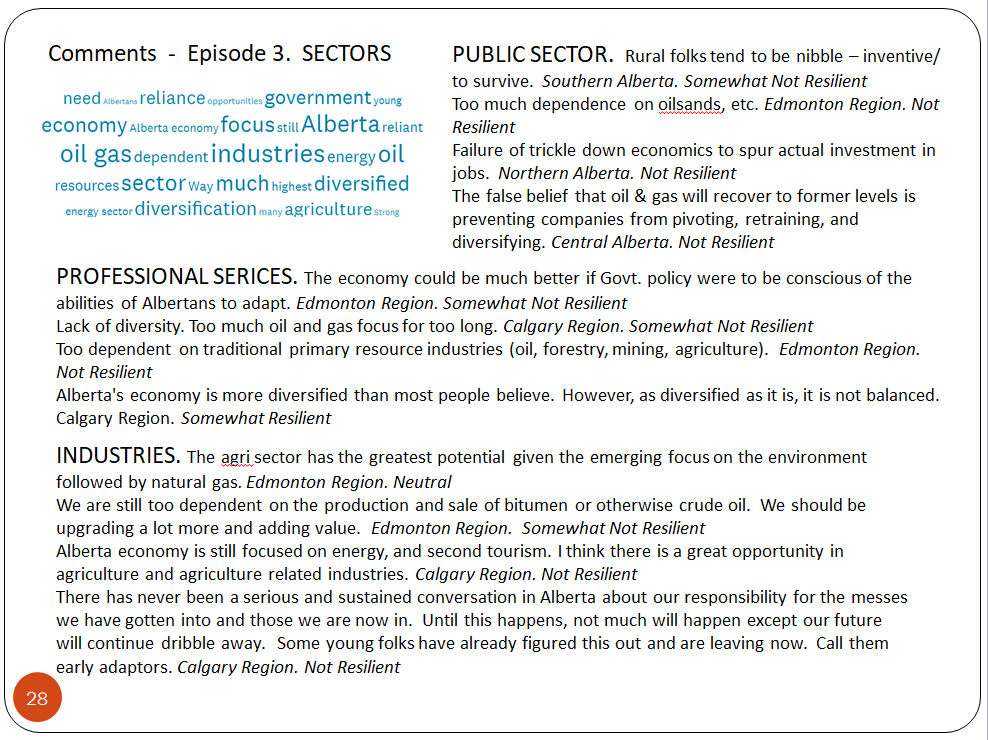
When asked for comments we received many but highlighting again the province’s dependency on oil and gas. Pause to review select comments above.
That brings us to the conclusion of Episode 3. In the next Episode we begin the search for solutions considering your views of the relevance and roles for Government and Alberta’s Innovation Ecosystem. There are several surprises so stay tuned.
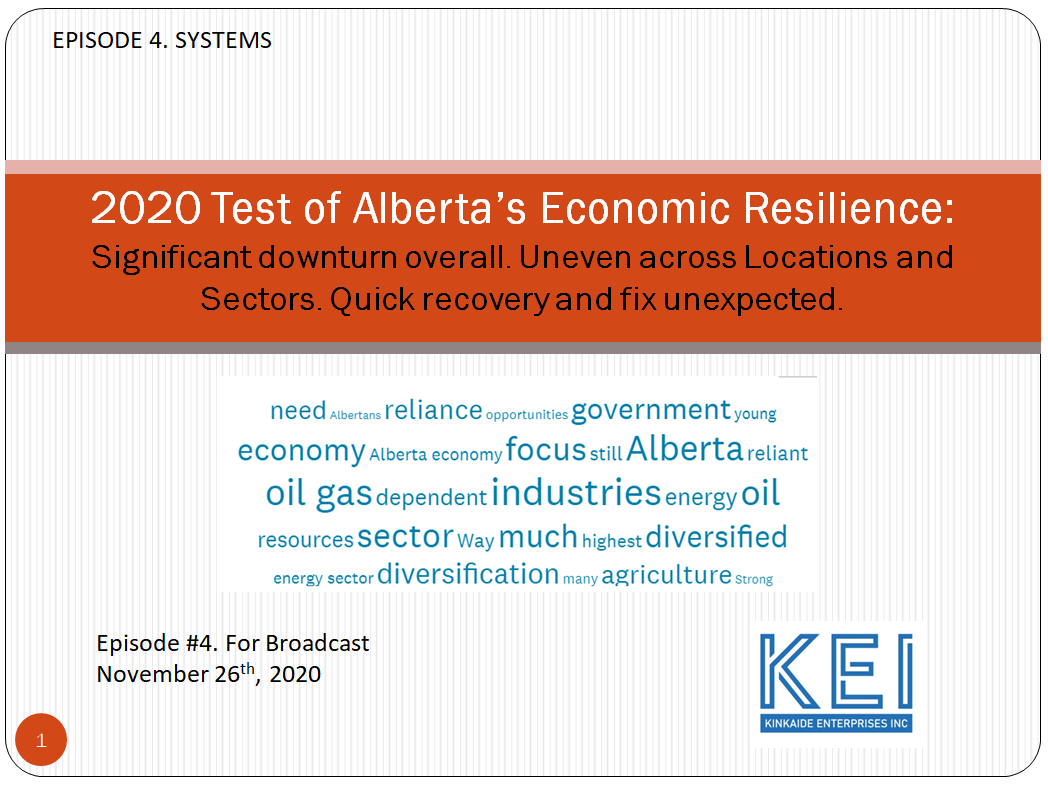
Welcome back to our Program “2020 TEST of Alberta’s Economic Resilience”. We have been discussing your assessment of Alberta’s economic resilience since 2015 and during the recent downturn and pandemic.
I’m your host – Perry Kinkaide, and am narrating the Program
Why the focus on economic resilience? “Resilience” is the ultimate objective of economic diversification – essential for mitigating shocks to the economy and/or recovering quickly. An economy may be diversified, but if it isn’t resilient then why would diversification matter. So our focus is on the objective of economic diversification – ECONOMIC RESILIENCE.
Your view the most sensitive measures of economic resilience continue to be Corporate Investment and Job-related measures.
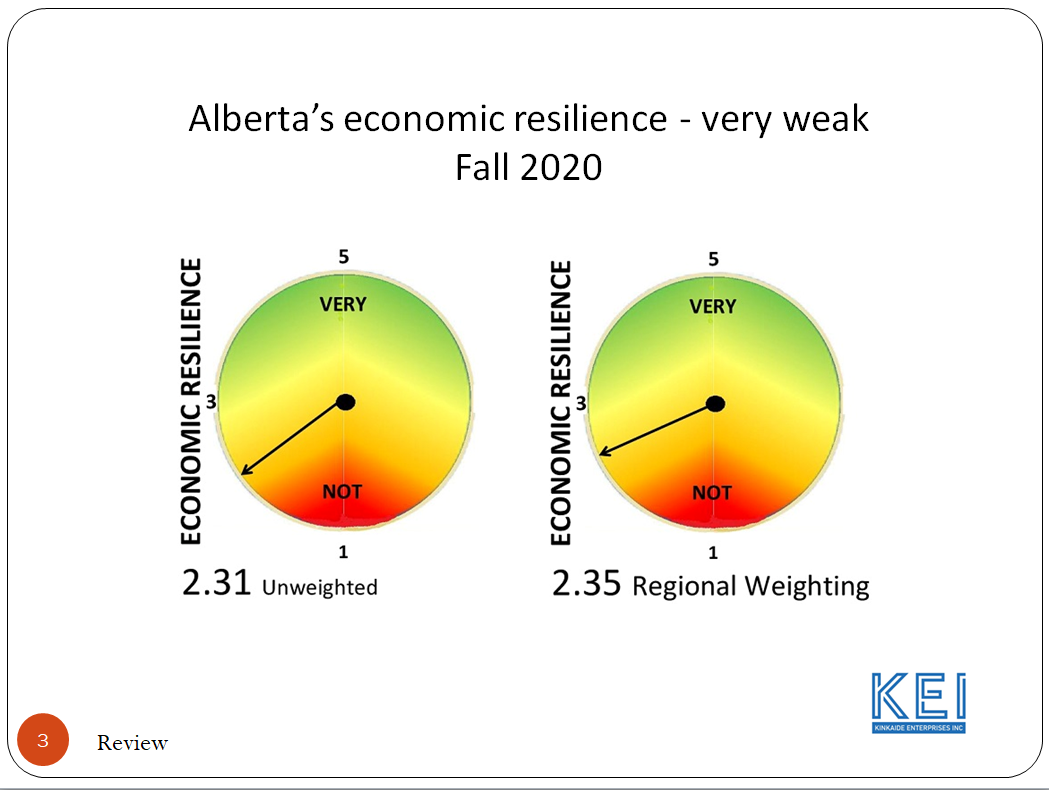
To date we have learned that Alberta’s economic resilience was weak and has become weaker.
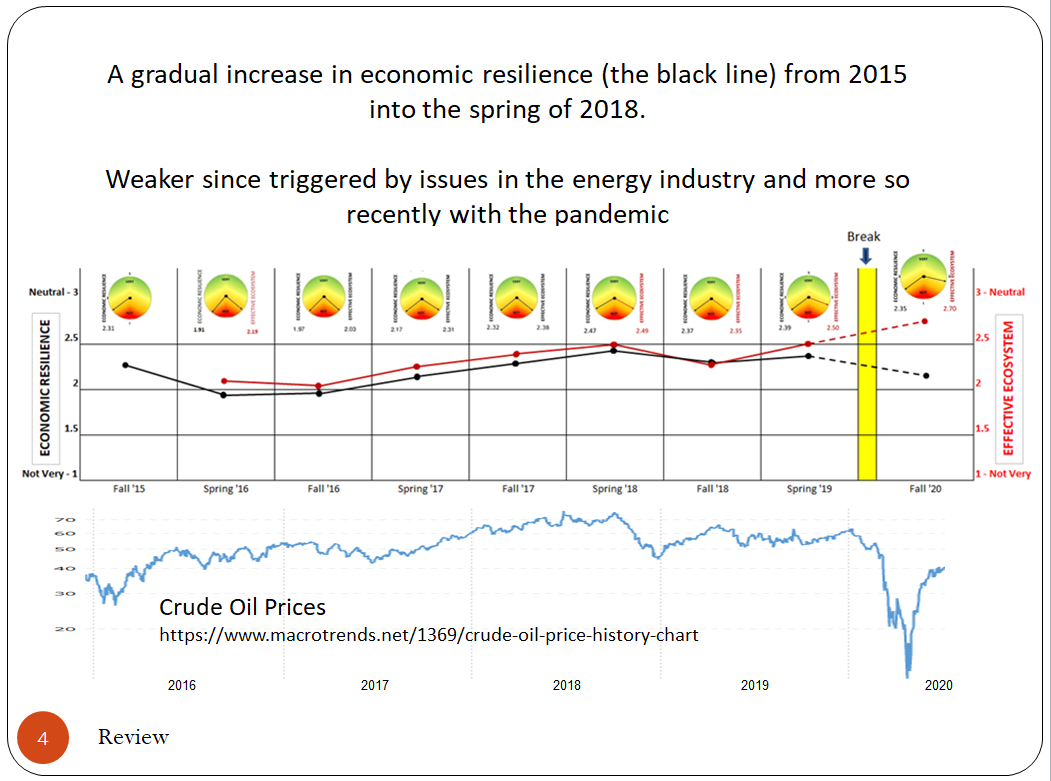
Economic Resilience improved through until 2018 when Alberta’s vulnerability became apparent and turned south when crude oil prices collapsed and continued on into 2020, now reflecting the added impact of Covid and the associated global recession.
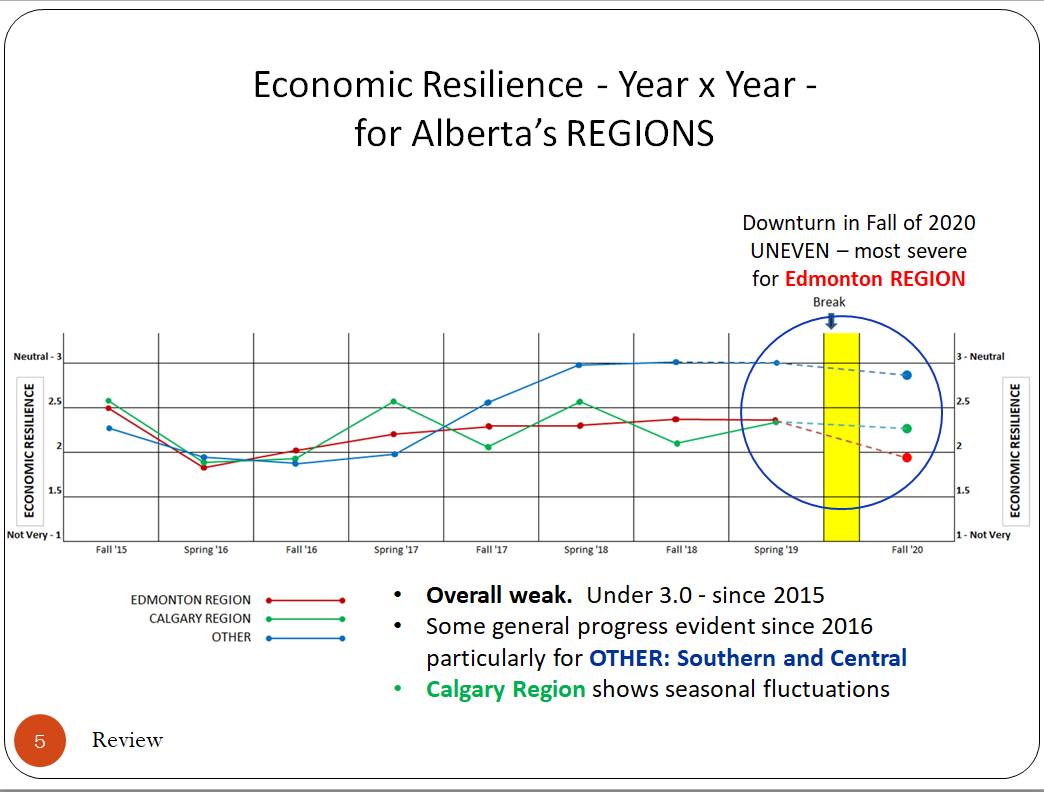
The impact on Alberta has been widespread: across the Province and its Regions, and while widespread, the impact has been uneven. The Edmonton Region has been hit particularly hard, less so in the Southern and Central Regions.
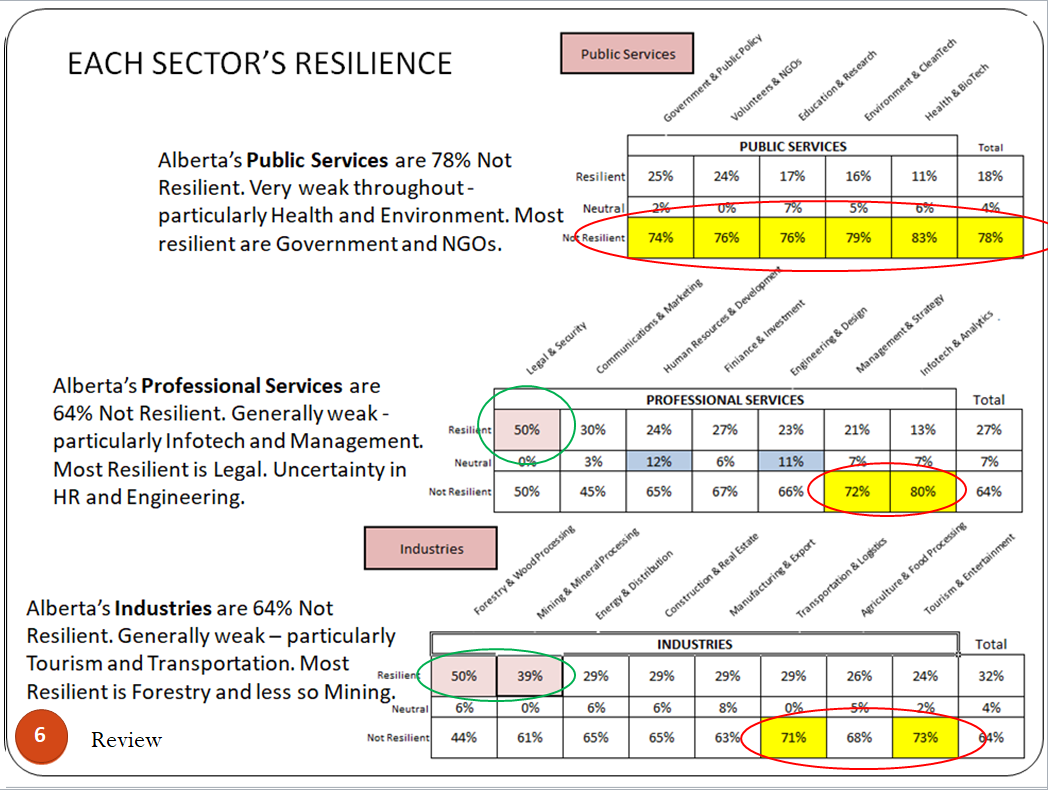
Public Services have proven to be the least resilient and somewhat less so are Professional Services and Industries. As for Professional Services, only Legal Services appear resilient, with Management and Infotech least. Forestry and Mining are most resilient; Tourism and Transportation least.
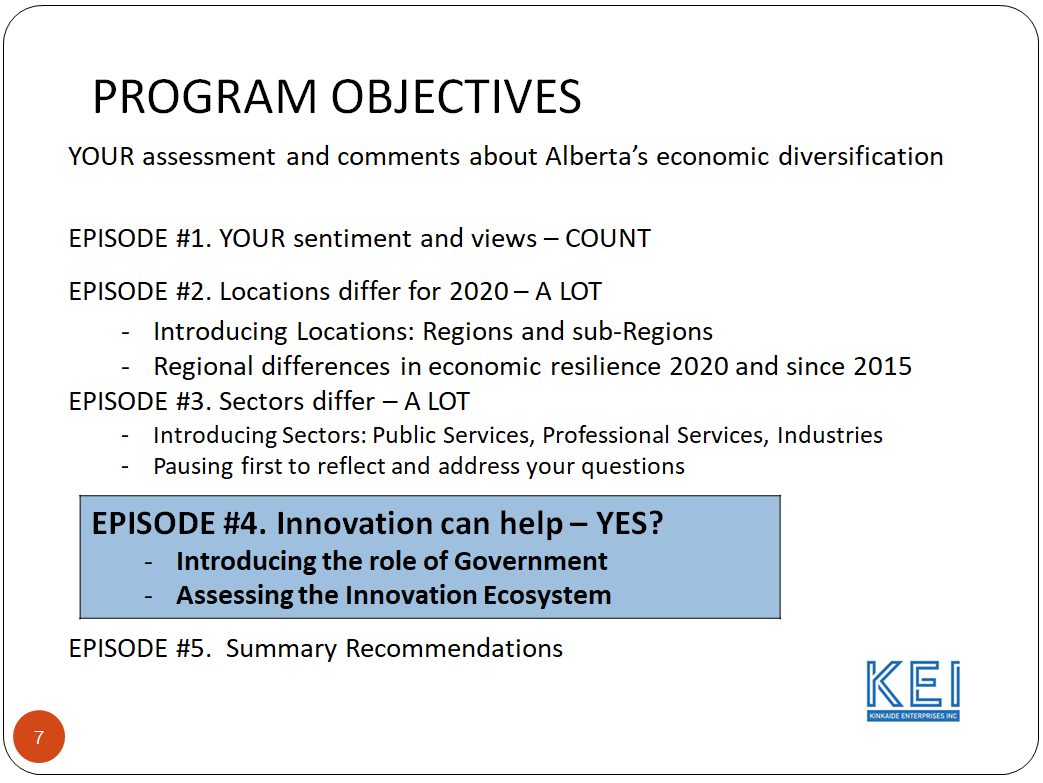
In this Episode #4, we venture into options for improvement, first assessing the roles for government and then the relevance and effectiveness of Alberta’s Innovation Ecosystem.
First, the role of government
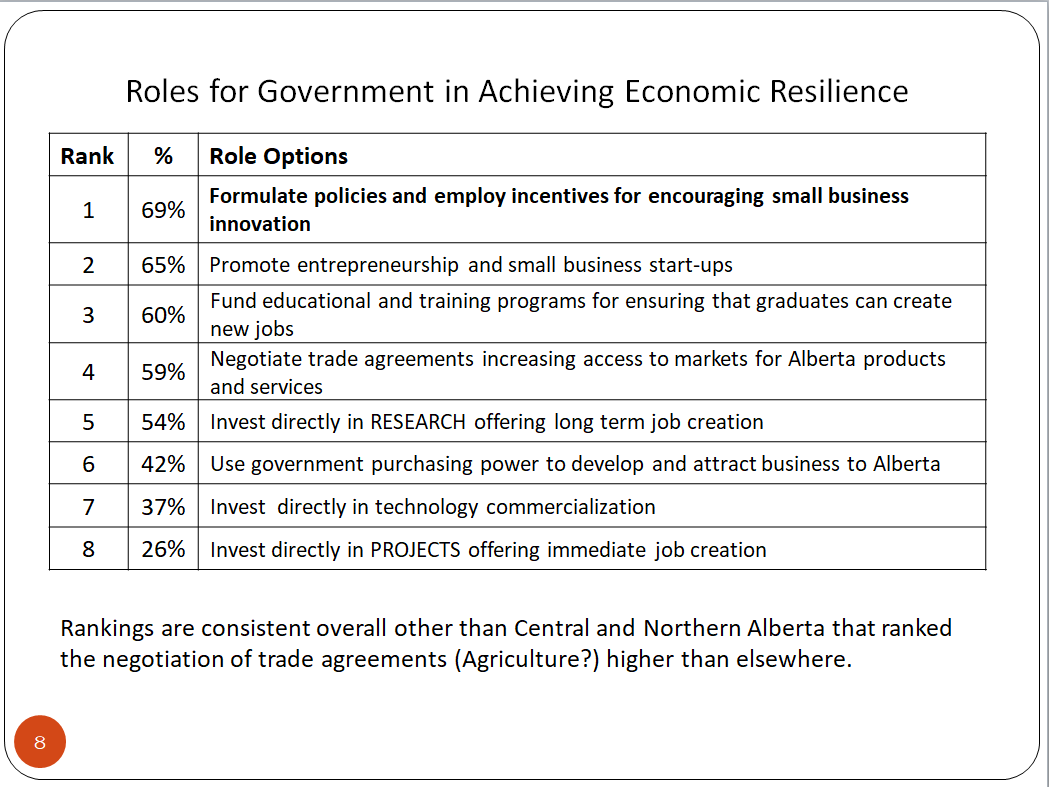
Clearly the role of government is viewed to be first and foremost in policy development and development of small business, funding job creation research and negotiating trade agreements. Also, it’s role as the lone patron of basic research is supported, but less so than for more applied research activity.
Government’s role as the lone patron of research IS supported, but weak compared with more applied research activity.
Next, “Is an Innovation Ecosystem important for the survival, growth, and retention of small business?” The focus on small business is because small business is viewed to be the engine of economic innovation and growth, essential for economic resilience and recovery of the domestic economy.
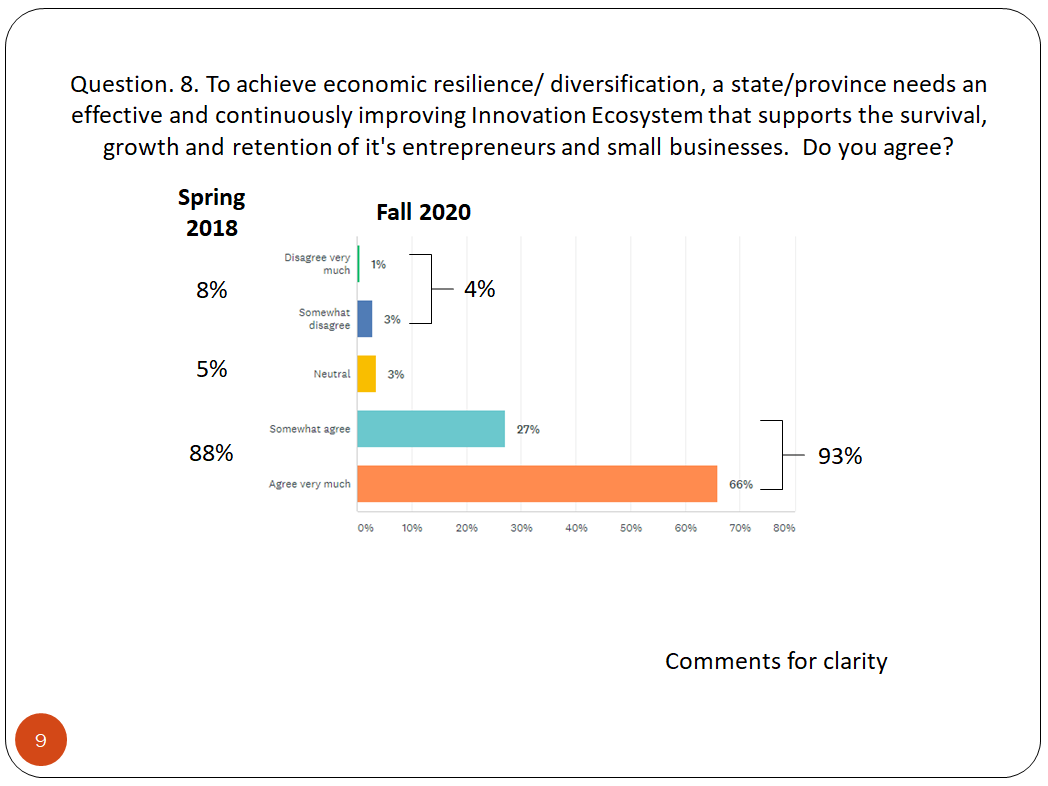
The Innovation Ecosystem is important … and has been receiving overwhelming and consistent recognition as fundamental to the survival, growth, and retention of small business.
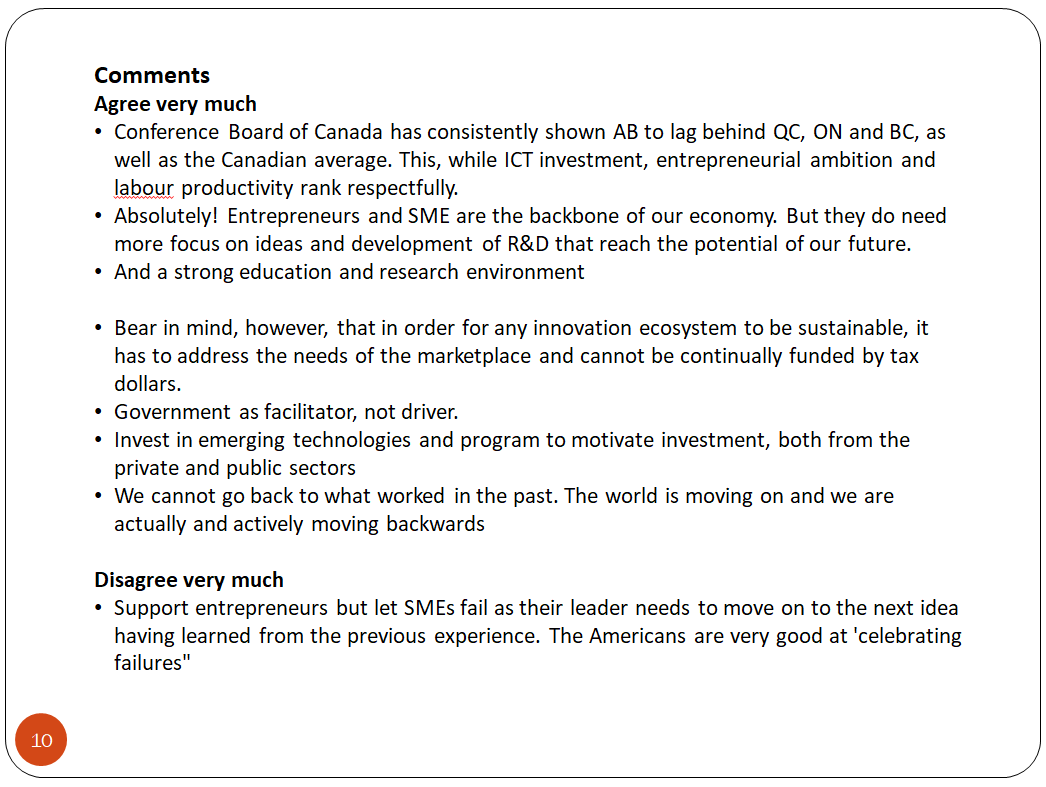
But more importantly is Alberta’s Innovation Ecosystem effective?
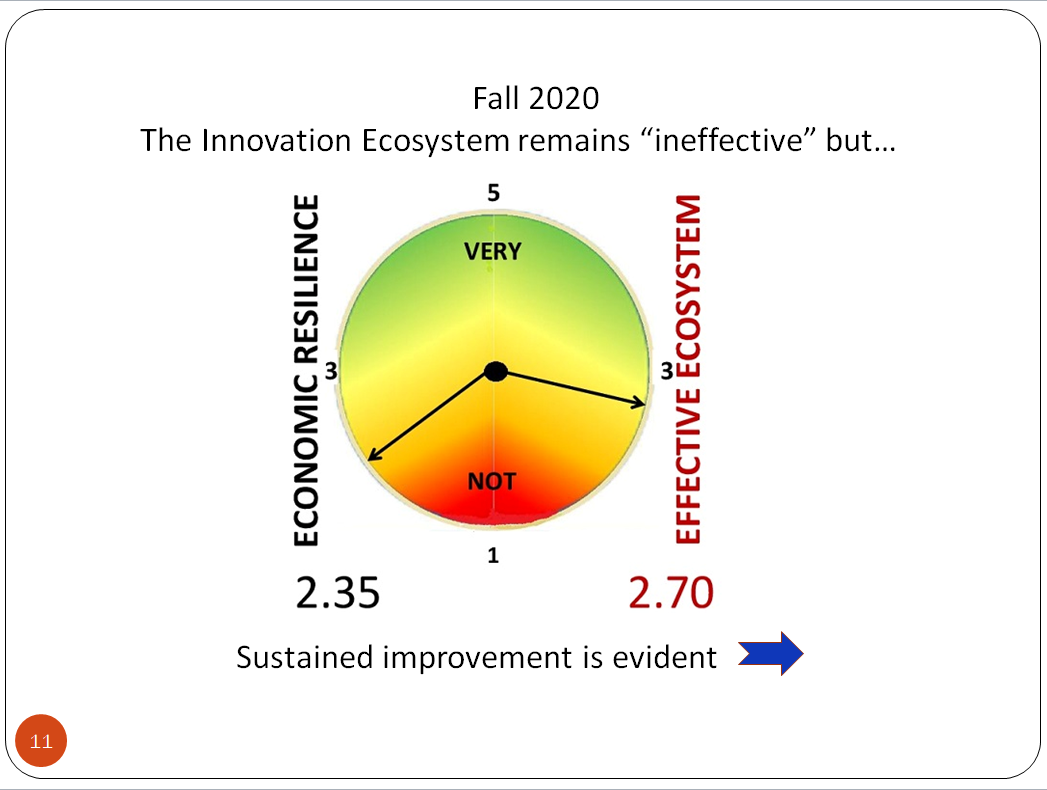
While continuing to be viewed as weak at 2.70 (3.0 is Neutral), it has been improving and …
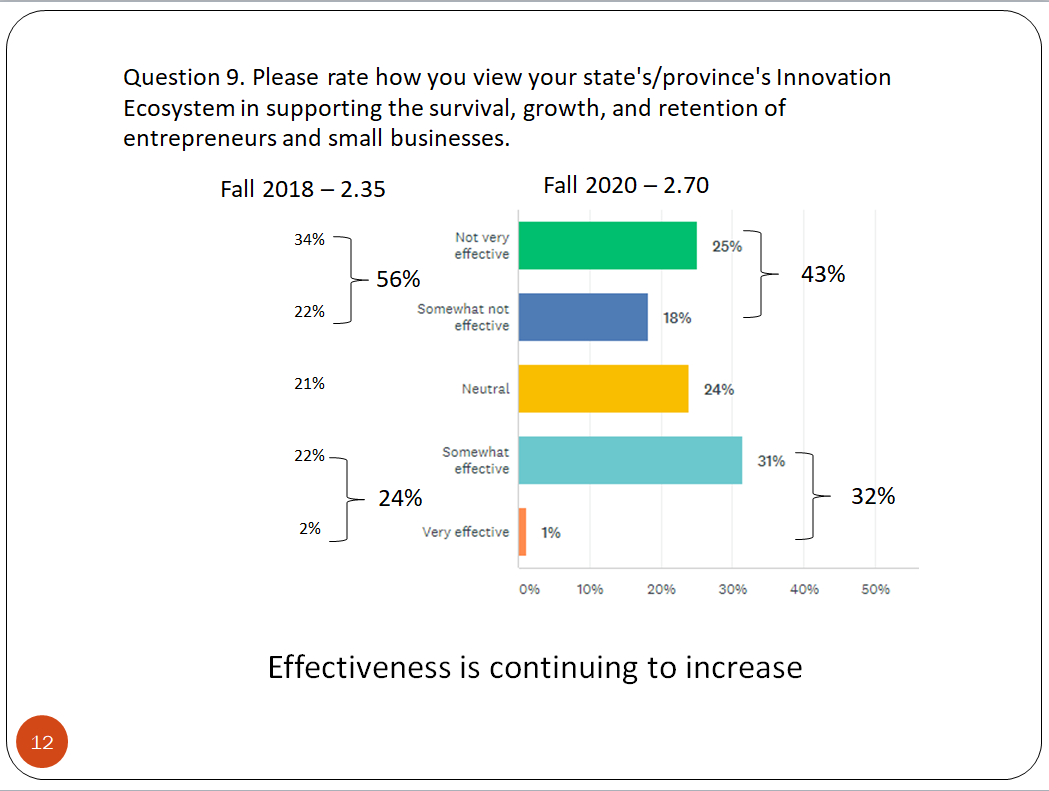
Not only is it improving …
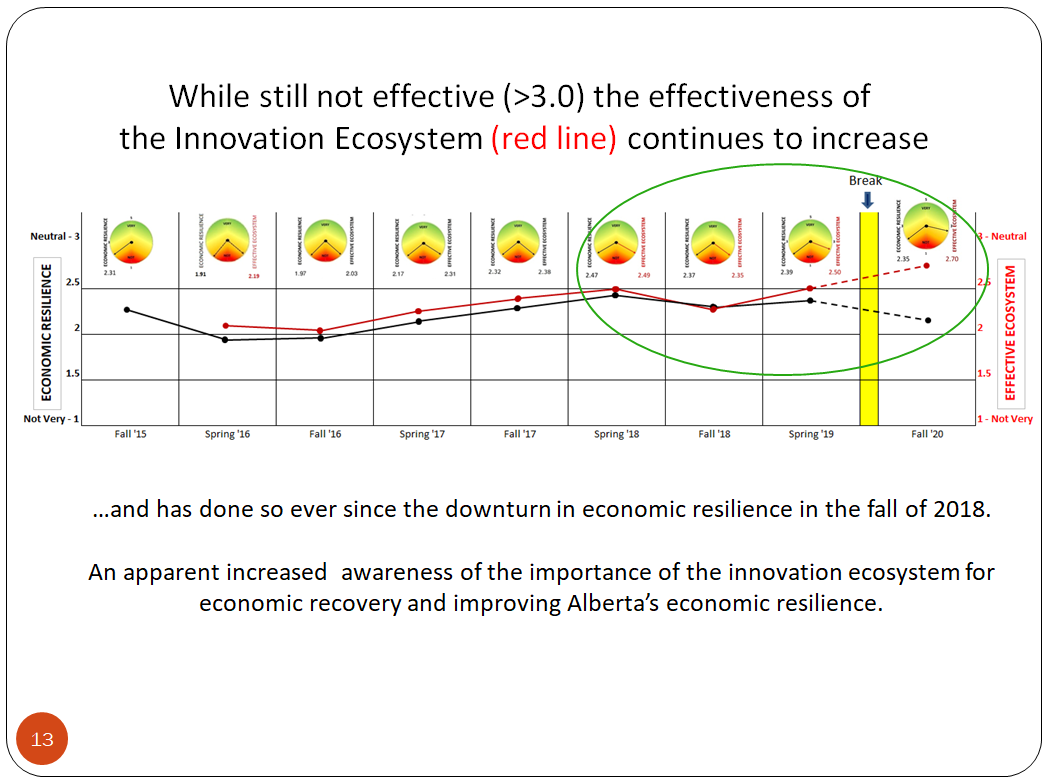
…it has broken out, continuing to reverse it’s link to economic resilience that was evident since 2016. That is, the province’s economic downturn has been accompanied by an improved assessment of the effectiveness of it’s Innovation Ecosystem. This is cause for optimism. That is, the System it’s effectiveness – importance – relevance – has been increasing as the economy deteriorates.
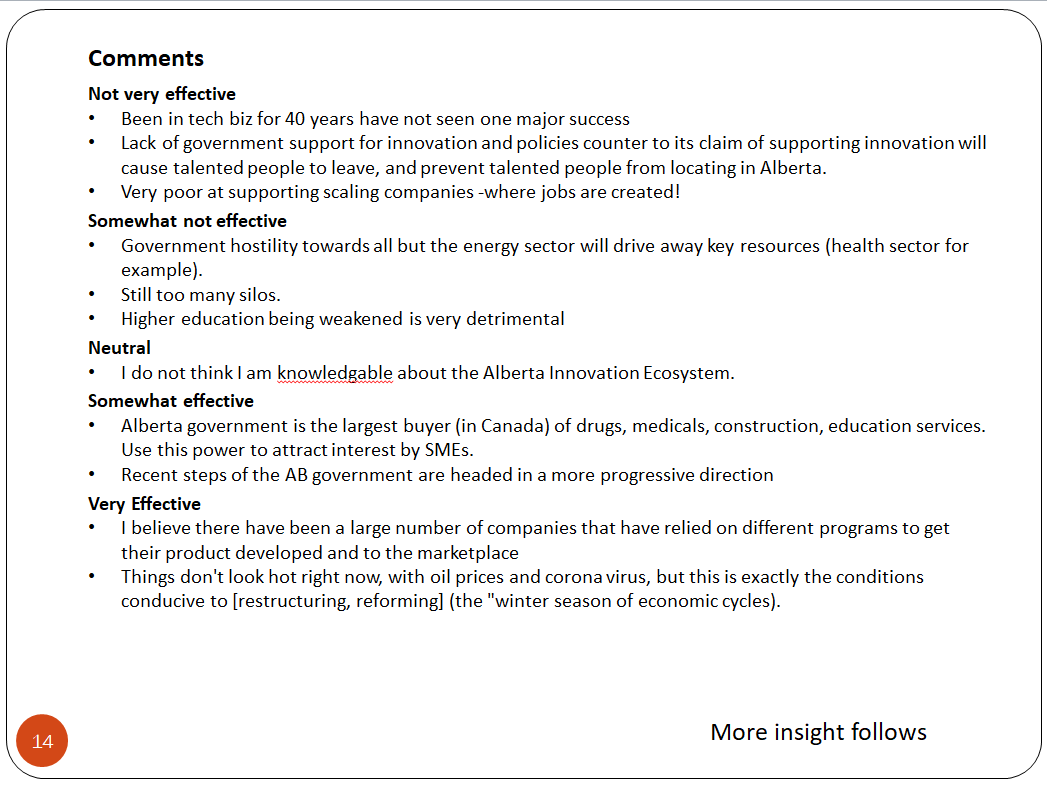
Here are some of your comments on the effectiveness of Alberta’s Innovation Ecosystem.
If change requires a crisis, the improved interest and evaluation of the Innovation Ecosystem may be the silver lining of the simultaneous impact of Covid and other forces on the economy – corporate investment and jobs. A recognition that diversification, that is economic resilience, is essential to mitigate negative economic impacts and expedite recovery. An effective innovation ecosystem is essential.
Now let’s dig deeper into the SYSTEM itself to learn what’s working and what’s not considering four features: Vision & Leadership and the System’s Management Processes, plus the System’s Resources and Infrastructure.
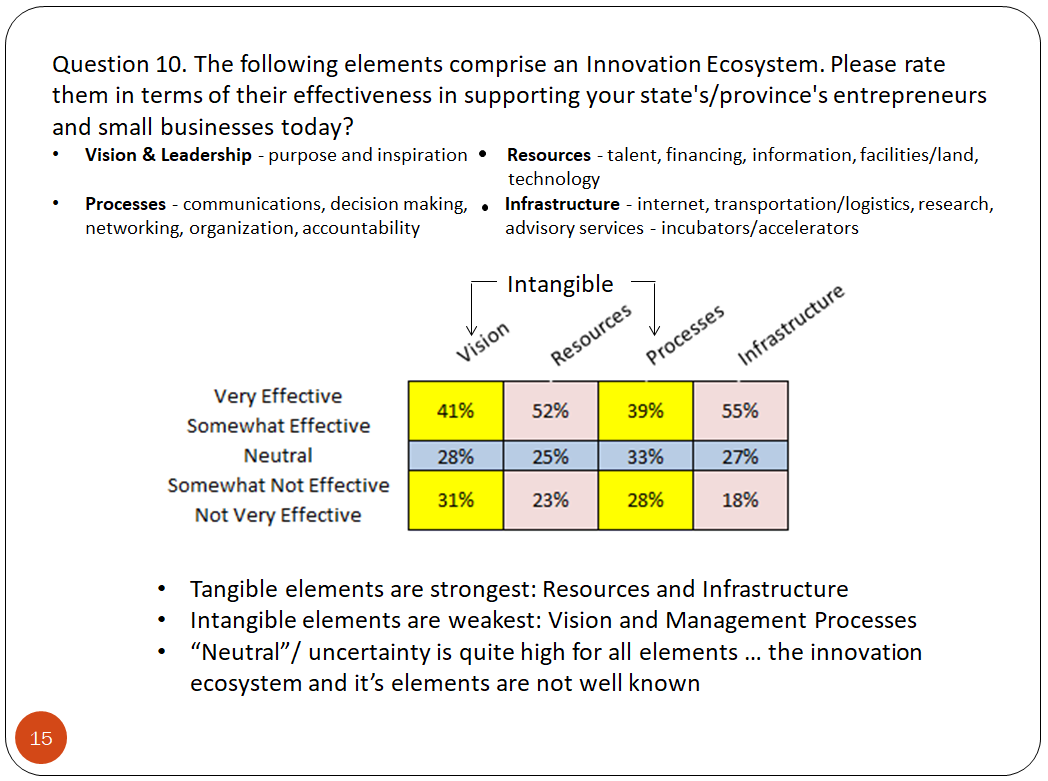
While the differences are small, the indications are clear: Resources and Infrastructure fare better than Vision and Management Processes both of which are intangible and more readily improved than fixing tangible Resource and Infrastructure issues. Note, the high level of Neutral – Uncertainty, reflecting as indicated in Comments that people are somewhat unfamiliar with the ecosystem, the term itself and it’s features.
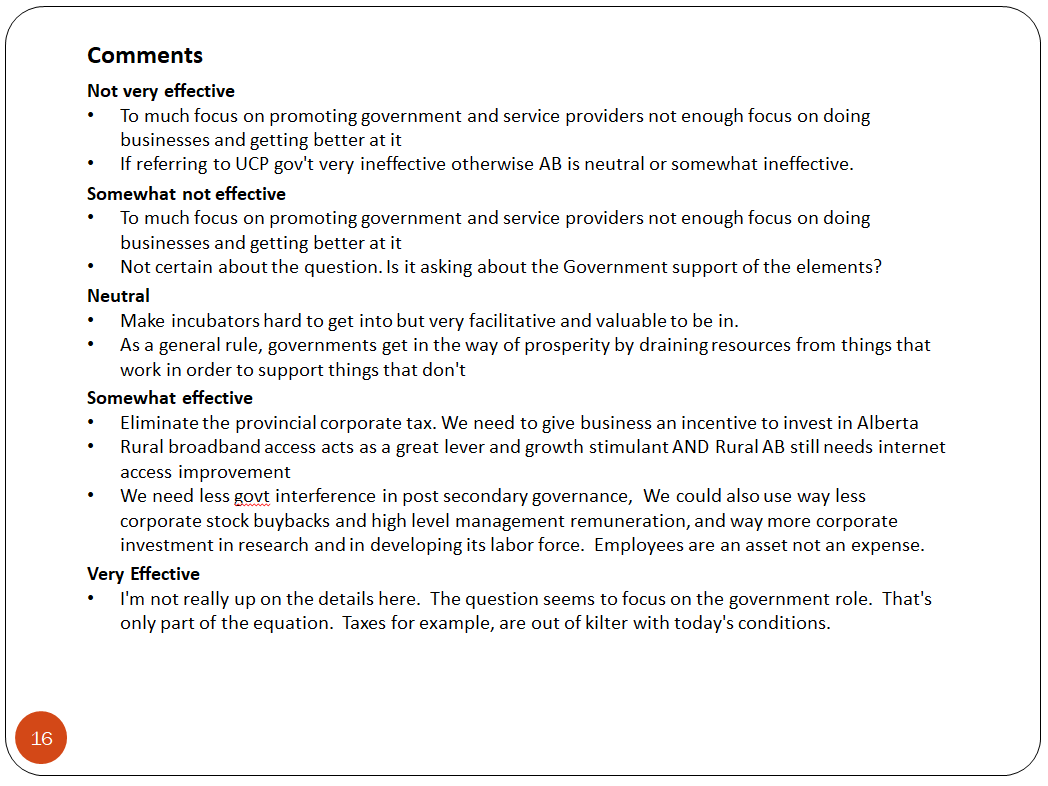
So in summary let’s not waste this once in a lifetime crisis. It is an opportunity for change. The downturn should trigger ACTION. But what and when?
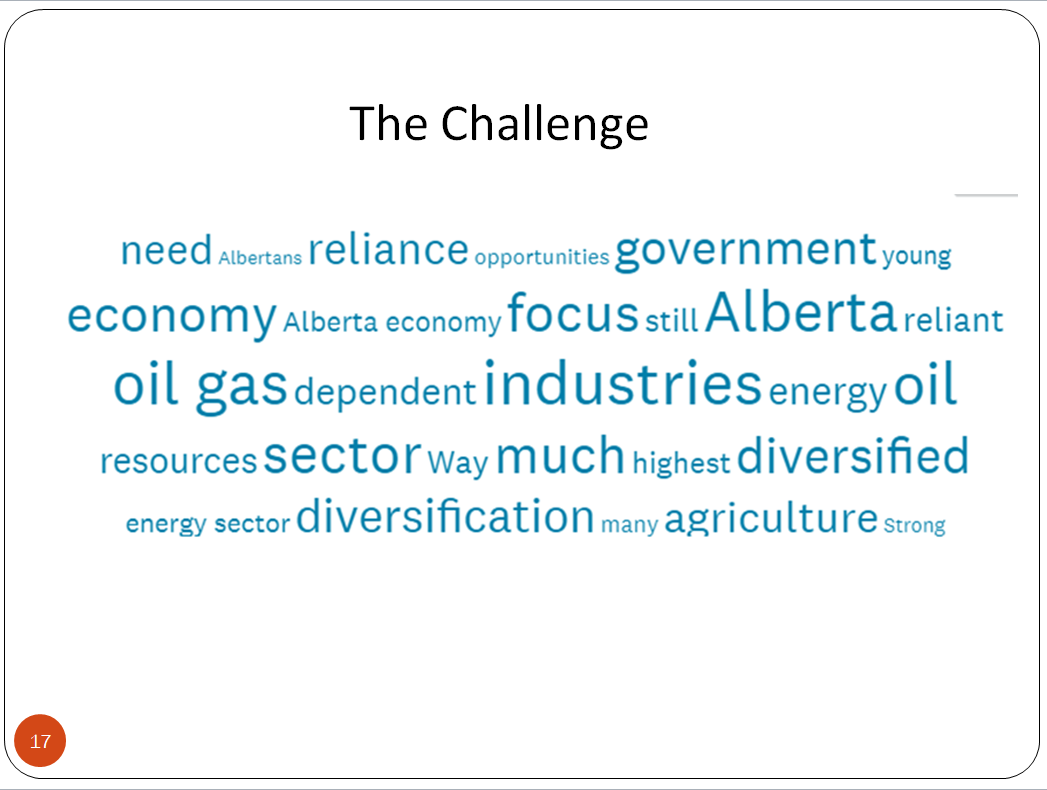
The CHALLENGE will be to consider the long term – the economy, when the immediate is so overwhelming – the people, but that’s the stuff of leaders.
Leadership is the focus of the concluding Episode #5 next week. We will be taking into consideration what we have learned so far and summarizing your views, your recommendations on what needs to be done.
So stay tuned this will be good. Be safe and good night.

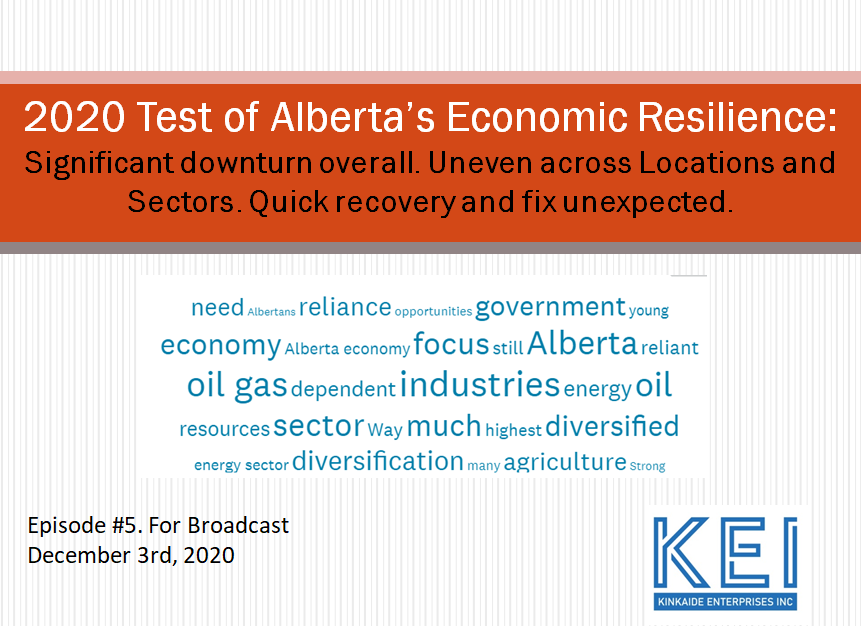
Episode 5. CONCLUSION
Welcome to Episode #5 concluding our Program examining economic resilience in Alberta this past fall and since 2015.
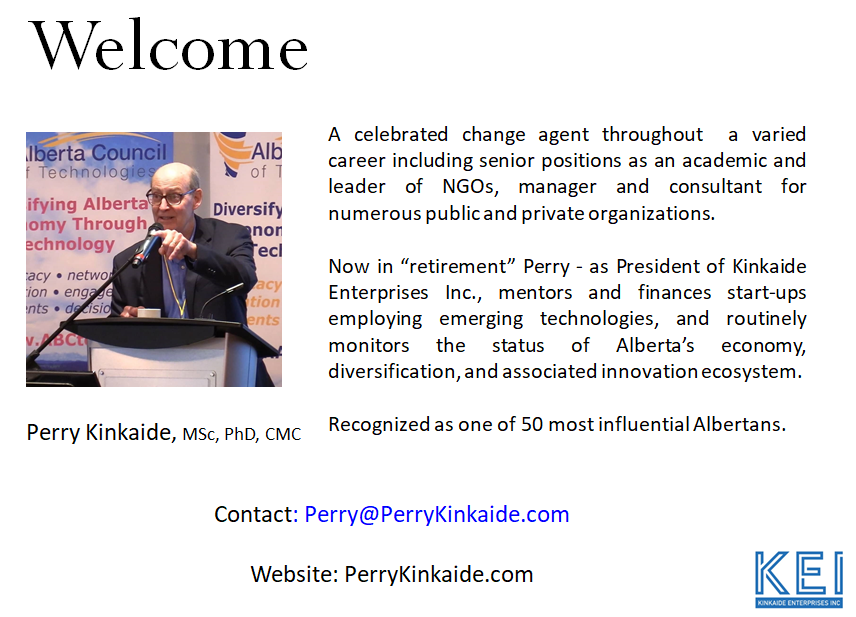
I am Perry Kinkaide and am hosting this episode, trying hard not to lecture or editorialize, BUT failing to keep it short.
First, any discussion of options for resolving Alberta’s Regional and Sectoral weak economic resilience has been complicated by Covid – its socio-economic impact and measures to contain it.
These are confusing times, you might even say troubling…the data, and your sentiment show as much.
In the FOREGROUND there is Covid – messages to mask, to isolate, or not, business closures and encouragement to spend locally. All this against a BACKGROUND of an already troubled economy – declining corporate investment, job losses, and $billions gone in GDP.
What to do? In assembling this Episode I’ve taken into consideration your views with a focus on the economy, the BACKGROUND as contained in the October survey, prior surveys, AND …
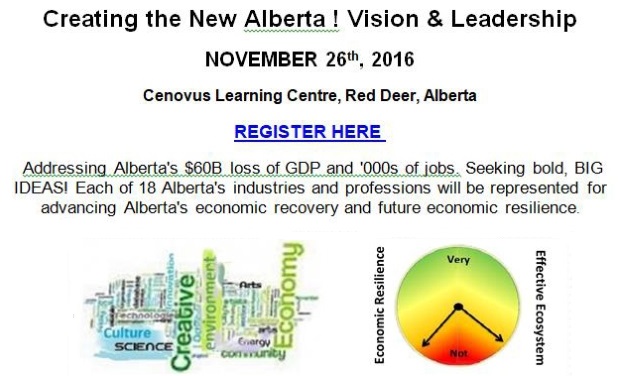
complimentary resolutions contained in the Proceedings of a Provincial Convention in Red Deer in 2016. The Convention concluded a series of conference consultations held earlier in 2015 first in in Edmonton and then in Calgary. The Convention featured presentations of BIG ideas and the very Industries, Public and Professional Service Sectors we’ve been assessing in this consultation. Let me know if you’d like a copy of the Proceedings.
There are three bold thrusts recommended for strengthening Alberta’s economic resilience:
Energy Transition. Expediting transitions in energy to reduce Alberta’s exposure to the industry’s volatility and generate economic alternatives
Economic Resilience. Changing the mix of economies for improving Regional and Sectoral economic resilience with special attention to Public Services
Leadership in Innovation. Developing Alberta’s “Innovation Ecosystem”, supporting Alberta’s entrepreneurs, key to innovation
In addition, we conclude with a brief discussion of the role of government, resistance to change, and Post-Covid economic recovery
First,
ENERGY TRANSITION – Alberta overall and specifically the Calgary Region and the Industry Sector
Calgary is Alberta’s oil Industry capital vulnerable to geo-political events forcing a transition in energy that has affected all other Alberta Industries, Professional and Public Services. Edmonton is Alberta’s Public Service capital also vulnerable but buffered in the short term – as in 2015/2016, by increased government hiring and spending.
The interdependency of the Calgary and Edmonton economies with government as the intermediary is real but changing.
The Calgary and Other Regions and Industry have no choice but to respond to the geo-political forces driving the transitions underway overhauling energy. Daily we hear of collaborative initiatives:
1. New technologies being introduced to reduce carbon emissions making crude oil more acceptable to existing and new markets
2. The resolution of regulatory impediments and long term agreements bridging energy and environmental interests
3. Researching and fine tuning the application of economic incentives and disincentives fir expediting change
4. Securing partners/ investors for processing Alberta carbon in agriculture and forestry, mining and energy including hydrogen and anticipating renewed interest in nuclear – fission and fusion
5. Industry and community leaders active in pooling capital and attracting investors, advocating for innovation and mobilizing entrepreneurs
6. Responding to market interests in climate change through electrification and the adoption of alternative forms of energy
From this point on I’m going to ignore further discussion of Calgary and those directly impacted by the oil industry. The industry remains volatile but the critical ENERGY TRANSITION is underway that should benefit economic resilience throughout Alberta, its Regions and Sectors. It is the Services situation that next warrants special consideration.
SERVICE TRANSITION – Alberta overall, and specifically the Edmonton Region and Public Services
Public Services were identified as the weakest Sector in Alberta compared with Professional Services and Industry, particularly in the Edmonton Region. The Region’s economy is the least diverse and heavily dependent on the Alberta Government as the sole regulator and funder of Public Services.
The Region AND Sector are also the most resistant to change. Why?
1. The Edmonton Region is the locus of Alberta government lobbyists and Provincial NGOs
2. Public Service staffing is comprised of well-educated, vocal, and unionized professionals
3. Any proposed change to Public Services impacts – and therefore involves, all the Regions
4. The public – and the media, view Public Services as a right, justified as a monopoly, and to be protected regardless of costs.
If the Edmonton Region and the Public Sector’s weak economic resilience are to be strengthened, change will require a Vision with sustained and committed, persuasive and influential Leadership at both the Regional and Provincial levels. Both are needed.
This gap was identified in a supplementary Report on impediments to the Region’s economic development. To resolve the overweighting of Public Services in the Region warrants several additional considerations:
1. Regionalization of resources, decentralizing the concentration of staff and services, though this has been tried
2. Initiating a public discussion about the future of Public Services across the board and whether it is time to shift the focus at the top from building capacity to serving people
3. Introducing “Personalization” of services for guiding the transition. The appeal would be particularly relevant for Education and Health given existing technologies in telecommunications
4. Research, recruitment and curriculum should reflect the reorientation of Public Services
5. Introducing options for advancing the adoption of innovations including increased involvement of private and community services and introducing measures for helping educate the users, increase competition by allowing consumer choice, and monitoring user satisfaction.
5. Incentivizing unions and professional associations to engage in transitional training for their members…in fact, this should be mandatory in light of the rate of change driven by emerging technologies.
Community-based NGOs warrant special attention here as an important and often overlooked, undervalued socio-economic asset. There are over 23,000 NGOs in Alberta. They too are a Public Service but are not very resilient: dependent on ALGC/ government grants, experiencing declining memberships, ageing boards, and increasing competition for volunteers and funding, along with not so subtle issues of accountability.
7. Social enterprise should be encouraged, with NGOs incentivized to collaborate, consider mergers, and for being held accountable.
And finally …
8. Identifying leadership and associated resources for championing and guiding the transition of Public Services to more personalized services and service delivery
9. The Leaders should be in the public eye, hosting events such as Conventions for exposing BIG ideas and innovations of broad interest to Sectors with weak economic resilience.
ECONOMIC RESILENCE – Resolving diverse Regional and Sectoral differences
We all need to look ahead. Several Megatrends are anticipated as the sources and forces of significant change. To survive…to grow, all industries and businesses, professions and practices, including those in public service, must be alert, innovative, and nimble.
Let’s consider energy for example, but appreciate technology is changing everything in: transportation and logistics, environment and cleantech, agriculture and agrifoods, education and eLearning, infotech and analytics, engineering and design, construction and materials, financing and fintech, manufacturing and robotics, health and biotech. The list is never ending. These changes are of particular concern to Alberta youth who in our earlier research identified emerging technologies and the future of work as one of their greatest concerns – and whether they were being prepared for Alberta’s future.
Change should be anticipated – no economy is forever. Let’s consider Energy again as it is core to Alberta’s economy and even when transitioned is likely to remain so for some time to come.
Carbon – is the foundation of life. It’s extraction, harvesting, and transport – not so much processing, has been core to Alberta’s economy. And as we discussed earlier, it is in transition.
Silicon, is its competitor, competing and contributing to the diversification of economies everywhere: chips storing and processing data, digitization, the internet of everything, apps aiding decision making across all industries AND professions.
Access or not to data, fast and affordable, is changing everything: the relationship between professionals – the haves and clients – the have nots. It is the basis of what’s called The Digital Divide for those included and excluded from the digital economy. No one should be left behind. This trend must be attended to. As a positive, it is the basis of “personalization”, but also issues of privacy, and it is possibly a new alternative for taxation.
Are the Regions prepared, that is are they resilient? Apparently not though Southern and Central Alberta are on the right track.
The mix of economies differ between Regions. They each warrant their own unique adjustments though all are affected by oil and export markets: Forestry and Mining, and somewhat Agriculture. Tourism in the Rockies and Transportation are likewise heavily reliant on external markets. But Alberta has not – at least yet, embraced Silicon. Note. Artificial technology has now replaced Nanotech as the next big thing in the Edmonton Region. Stay tuned.
The scale of change triggered by emerging technologies warrants a Regional approach to economic development as opposed to business attraction, that is local. They are often confused!
Where warranted strengthening economic resilience on a Regional and/or Industrial scale – may warrant partnerships with government to aid in negotiations for securing long term certainty, that is, trading and regulatory agreements, so very important for attracting capital.
INNOVATION ECOSYSTEM – Alberta, Regions, and all Sectors.
This takes us to the very exciting theme, that of Alberta’s Innovation Ecosystem, that you have acknowledged as core to innovation and fundamental to the early survival, growth, and retention of entrepreneurs and small/medium business in Alberta. By the way, it is imperative that more effort be devoted to explaining just what is meant by an “Innovation Ecosystem”. For the purposes of this consultation, we have meant the array of resources and processes dedicated to the survival, growth, and retention of small and medium enterprises – SMEs.
While you’ve indicated that the “system” remains weak it is increasing in effectiveness with the weaker elements being in Vision & Leadership and Management Processes. That is not to say, that Resources and Infrastructure are acceptable, but that it is the human contributions that need to be prioritized.
Emerging technologies are pervasive touching us all and continue to evolve at an ever increasing rate.
1. Other than the Innovation Ecosystem, new emerging technologies are by definition new and poorly resourced. They have no network for supporting their survival, growth, and retention. This is the mandate of Alberta Innovates to develop.
2. Alberta Innovates should be given a strong mandate to work directly with Alberta’s institutions of Advanced Education and the network of public/private accelerators for advancing innovation and expediting the commercialization of emerging technologies of research institutes, colleges and universities.
3. Accelerators should be held accountable for the development of their tenants, and tenants must be held accountable to graduate/ exit when pre-agreed upon, time-limited, objectives are achieved.
4. Relational skills must be strengthened in SMEs and the Professions as this gap is central to their failure to survive, growth, and to stay. This means revising curriculum and coaching.
5. SMEs should be incentivized and prepared to consider mergers as a growth strategy. In Regions where Infotech is weakest, there are extraordinary opportunities to scale up again through mergers. Note. Infotech continues to be the source of extraordinary innovation, but Alberta-based leadership is lacking overwhelmed by multi-national interests.
6. Incentives should be introduced to encourage the pooling of capital and investment by Albertans in Alberta companies, prime should be companies in prioritized sectors.
7. Public procurement policies and practices must be overhauled including an alignment with objectives to strengthen economic resilience including specifically credit for early stage innovation and partnering.
SPECIAL ISSUES
There are three issues that will have a bearing on executing change: The role of government, resistance to change, and Covid-19 impeding economic recovery. Each of these are worthy of a report, but suffice it to say that the survey was particularly clear on the most appropriate roles for government.
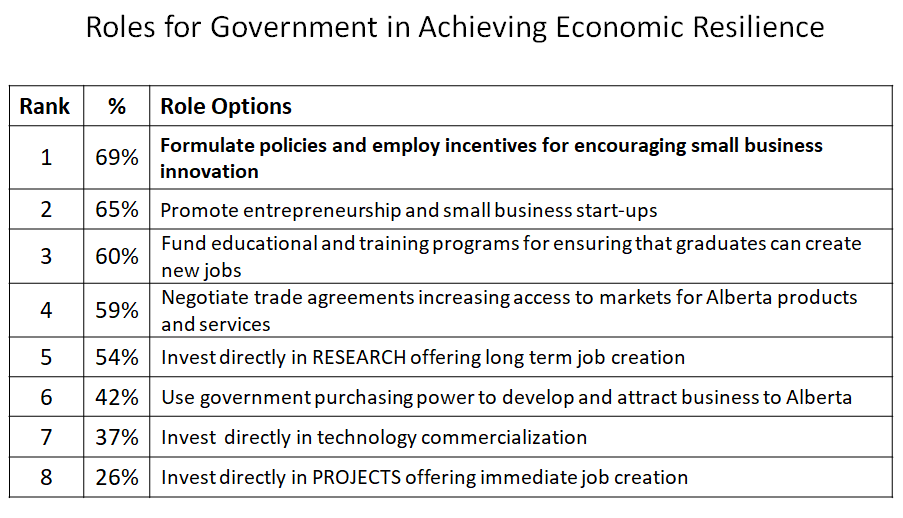
The survey may have overlooked one not mentioned but one that became clear in the commentary and that is SUSTAINED LEADERSHIP WITH A VISION.
Alberta needs to effect significant changes in its economy having lost $billions, thousands of jobs, and now increased government deficits due to Covid. Geo-political events are driving Industry to change, but for others there will be resistance to change, particularly from the Public Sector. That Sector and the associated Professional Services need government’s assistance to help and lead the transition of its sector; it is the regulator and/or the funder. It is it’s role to oversee the transition and reassure the public with clarity on the objectives: to improve service quality by personalizing services and ensure service continuity, while at the same time strengthening the sector overall.
As for Covid and managing the pandemic, who knows? A quick recovery is compromised by weak economic resilience. The Alberta Government released it’s Plan for Economic Recovery in June. The following are supplementary recommendations:
1. Job Creation. Spending to increase Public Sector jobs is clearly not warranted unless affordable, that is – conditional on debt tolerance and/or available resources. Both are spent. This option is further constrained by the high labour costs carried over from the last boom. Expectations should decline as the downturn continues. But as noted the public needs leadership – and to be reminded that it is not acceptable to spend today if it means sacrificing the future.
2. Taxation. Increasing government revenue through taxation may be considered such as introducing a PST as have other jurisdictions. But PST is both unpopular in Alberta and proven to hurt even further the most vulnerable and small business activity. Regardless, should such a tax be introduced it would hopefully be dedicated to debt reduction and then be eliminated. (A first).
3. Austerity. Reducing operating expenditures is justified as Alberta has the highest per capita service expenditures in Canada. These costs should be brought down in line with the rest of the country without sacrificing standards. This is particularly important to stem out-migration.
Surely Covid will play itself out though the damage may take years to heal: unfathomable debt and the federal government’s introduction of a wealth transfer tax gutting another generation of entrepreneurs – a subject we have discussed before, an array of deep social and economic wounds, and a public awakening – new opportunities. Changes as identified in this consultation may be easier to execute following the Covid debacle.
Thank you all very much. Should you want a copy of my speaking notes, please let me know.
In conclusion I would like to thank those who have helped in the production of this series…

* * *