

Newsletter Subscribe
Enter your email address below and subscribe to our newsletter


The index is similar to a weather report and introduced for stimulating and sustaining public and business, industry and government discussion on the state of Alberta's economy. Economic diversity is
ABCtech #47 13OCT15 Introducing An Alberta Economic Resilience Index – Fall 2015
The Alberta Council of Technologies is introducing an index for monitoring the province’s economic diversification. The index is similar to a weather report and introduced for stimulating and sustaining public and business, industry and government discussion on the state of Alberta’s economy. Economic diversity is a measure of the state of an economy. An economy is deemed “resilient” if it has: 1. the capacity to sustain prosperity, 2. avoid or mitigate sources of vulnerability and 3. ensure the jurisdiction’s capacity to recover quickly from an economic shock.
In September we asked our contacts about their views of Alberta’s resilience to economic shocks and to identify the most sensitive measures of resilience. They were also asked what role(s) governments should play for making Alberta more resilient. The survey establishes a benchmark for 2015 employing a scale of from 1 = Not Very Resilient to 5 = Very Resilient. The results – see below, reflect the current sentiment of the observers for the province as a whole, and are also broken down to reflect Regional and Industry differences.
Please contact us should you wish to conduct further analysis of the assessment or wish to share your observations. – Editor
Also, if you are from the Edmonton Region and are interested in it’s economic development – please consider completing the following survey HERE
Economic resilience will be the subject of several related workshops and discussions at our November 30th Conference in Calgary – Creativity & Convergence – “Creating the new Alberta!” FOR MORE As a workup to the Conference we are featuring related editorials on: 1) criteria for assessing climate change policy and 2) the status of funding continuity for Alberta’s SMEs.
2015
Alexander Suen, Vice President
Perry Kinkaide, Past President
Michael Kryton, Communications
Perry Kinkaide, CEO
1-866-241-7535 TF
(780)990-5874
Cloudy throughout Alberta – with resiliency hovering around 2.31
ALBERTA
Alberta’s economy is not resilient (2.31/5.00). The province is too dependent on the oil and gas industry. Diversification is warranted to increase the economy’s resilience to the shock of oil price volatility. Resilience requires innovation and technology, small business growth, and value-added manufacturing and exporting. FOR MORE
REGIONS
None of the Regions isviewed as resilient: Edmonton (2.34/ 5.00), Calgary (2.22/5.00) and Other (2.34/5.00). Calgary appears to be somewhat more vulnerable. FOR MORE
SENTIMENT
The most sensitive measures of economic resilience are: corporate investment activity, jobs – employment and creation and GDP. FOR MORE
OBSERVERS
The 415 respondents possess a broad array of industry interests from across Alberta. FOR MORE
FORECAST
Observers of Alberta’s economy view Alberta, its Regions and Industries as not very resilient due to an over-dependency on oil-prices – Services in particular. Recovery of prosperity depends on the price of oil, determined by geo-political events beyond Alberta’s control. When oil-prices recover, Regions and Industries in Production with savings/reserves will fare better – and recover earlier, than Services.
GOVERNMENT
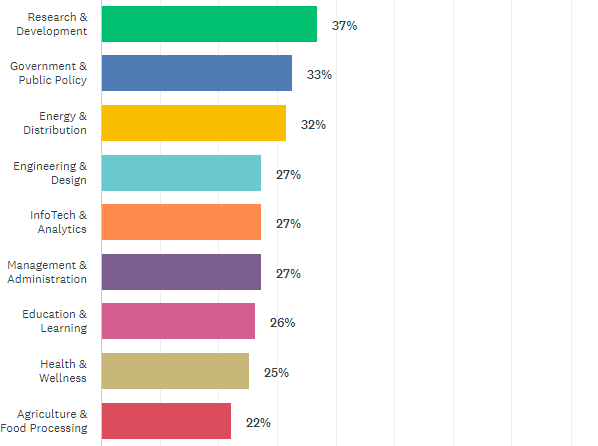
Observers were clear and consistent, government’s roles in making Alberta more resilient should be in: formulating policies and employing incentives to support small business innovation, promoting entrepreneur-ship and business start-ups, funding of research for long term job creation, and negotiating trade agreements for increasing market access for Alberta products and services. FOR MORE
INDUSTRIES
Observers viewing Alberta as least resilient and therefore most vulnerable have an interest in SERVICES: Legal, Entertainment & Hospitality (Tourism), Environment, Finance, InfoTech, and NGOs. More positive are those with an interest in PRODUCTION: Construction, Communications, Manufacturing, Agriculture and Forestry. FOR MORE including an analysis of Regional differences for each industry.
OBSERVER’S INDUSTRIES OF INTEREST and ALBERTA’S RESILIENCY
Agriculture & Food Processing
2.35
Environment & CleanTech
2.14
InfoTech & Analytics
2.18
Communications & Marketing
2.40
Government & Public Policy
2.29
Legal & Security
2.18
Construction & Real Estate
2.44
Health & BioTech
2.28
Management & Strategy
2.28
Education & Research
2.25
Human Res. & Development
2.30
Manufacturing & Export
2.36
Energy & Distribution
2.26
Finance & Investment
2.17
NGO-Non Gov’t Organization
2.20
Engineering & Design
2.27
Forestry & Wood Products
2.34
Transportation & Logistics
2.31
Other
2.27
CAUTION
Transforming a carbon-based, resource economy is a rare and at best, multi-year endeavor. When things are good, they are very good. When they are bad, hope is high and most just scale back and wait as there is little one can do to speed up recovery. Governments typically opt to spend reserves or go into debt for financing short-term infrastructure jobs and social programs. Rarely do they opt to address improving their economic resilience.
Transformations are usually triggered by broadly shared crises such as: a sustained economic decline, a pending calamity such as climate change, or emergence of a disruptive technology such as the internet. Keys to success include: a mature public sector to mitigate intense lobbying from beneficiaries of the status quo, an unwavering long-view warranting collaboration between industry and government, small business innovation and incentives to stay the course, and visionary leadership, monitoring and celebrating progress.