ABCtech #187 01OCT17 Economic Resilience – Fall 2017
Resilience of Alberta’s Economy AND Measuring the Effectiveness of Innovation Ecosystems – Fall ‘17 The Alberta Council of Technologies conducts a spring and fall survey of its followers for assessing
The Alberta Council of Technologies conducts a spring and fall survey of its followers for assessing the “Resilience of Alberta’s Economy” AND evaluating the “Effectiveness of Alberta’s Innovation Ecosystem”. The following Report contains the summary results of the Surveys conducted in March 2017.
Prepared by:
The Alberta Council of Technologies Society
October 2017
Monitoring Alberta’s Economic Diversification – March 2017
Monitoring Alberta’s Economic Diversification – March 2017
Monitoring Alberta’s Economic Diversification – March 2017
Monitoring Alberta’s Economic Diversification – September 2017
The Alberta Council of Technologies is “Creating the new Alberta!’ through our network of contacts sharing an interest in emerging technologies and their commercialization. You can help! The following survey is repeated each September and March for monitoring and benchmarking Alberta’s economic diversification.
Survey results will be available next month – published through QuikTech Notes and posted at www.ABCtech.ca. Questions and comments should be directed to editor@ABCtech.ca
First, about ALBERTA. We view diversification as the primary means of making Alberta’s economy more resilient, that is, less vulnerable and more able to recover from economic shocks.
Q1. On a scale from 1 = Not Very Resilient to 5 = Very Resilient, please rate how you view the diversity of Alberta’s economy
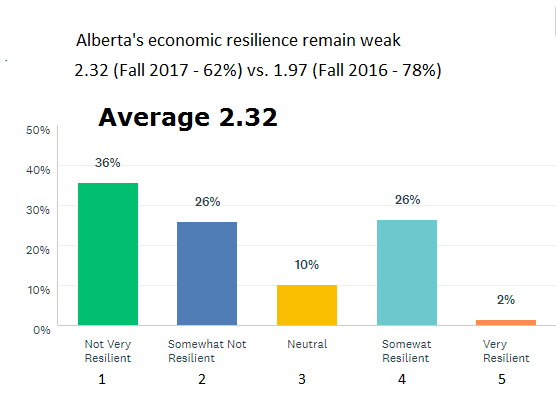
The overall sentiment is that the Alberta economy is not resilient though somewhat improved since 2016
2/3rds (62%) of respondents view the economy as not resilient – down from 78% in the Fall of 2016
1/4th (28%) view the Alberta economy as economically resilient – up considerably from 6% in the Fall of 2016
On a scale from 1 to 5, with 1 being Not Very Resilient, the overall average at 2.32 is well-below Neutral (3.00) though up from 1.97 in the Fall of 2016
While the Province’s sentiment remains negative <3.00, the Regions – with the exception of Calgary, are showing a continued and increasing sentiment of economic resilience particularly for Other Regions where resilience increased from 1.97 to 2.57 since the fall of 2016. The Calgary Region while up considerably in the spring, has fallen back from 2.40 to 2.08.
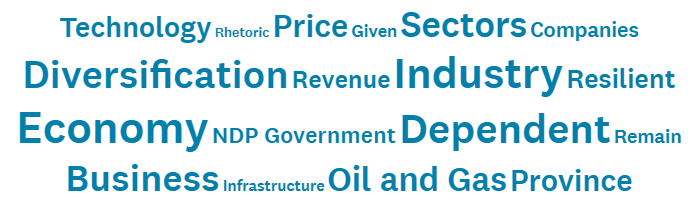
Sample Comments – Alberta’s economy remains overly-dependent on the oil and gas industry
Lip service to diversification – not enough support for emerging technology startups employing people who lost their jobs as a result of the oil and gas fallout. (1–Calgary)
Many small businesses are struggling and closing doors. (1-Edmonton)
The capacity or real commitment to implement strategies for diversification in Alberta has been lacking. (1-Other).
The workforce/population is too big for the economy. One million have come to Alberta since 1998 supported by an inflow of $184 billion of investment. That inflow has been cut. (1–Edmonton)
We are a one trick pony – oil industry. (1-Calgary)
There are still significant assets and businesses that have not pivoted but are instead waiting for o&g to recover. (2-Edmonton)
We got used to the good times and have not had the flexibility or agility to adjust to massive change. (2-Calgary)
Alberta’s Investors and Banks are risk averse – detrimental to the processes of diversification. (3-Edmonton)
Alberta is diversified in the number of industries, but not in the intensity of each industry. (4-Other)
Lots of room to optimize, small debt when compared to other provinces/states, Well-educated workforce. (5-Edmonton)
Next, is to better understand what factors underlie the assessment of economic resilience.
Sep ‘16
63% – 2%
56% – 5%
65% – 14%
62% – 16%
52% – 11%
34% – 3%
33% – 5%
27% – 1%
33% – 7%
Sep ‘17
Q2. What factor(s) are the most sensitive measures(s) of whether Alberta’s economy is or is not resilient?
Other Measures Mentioned
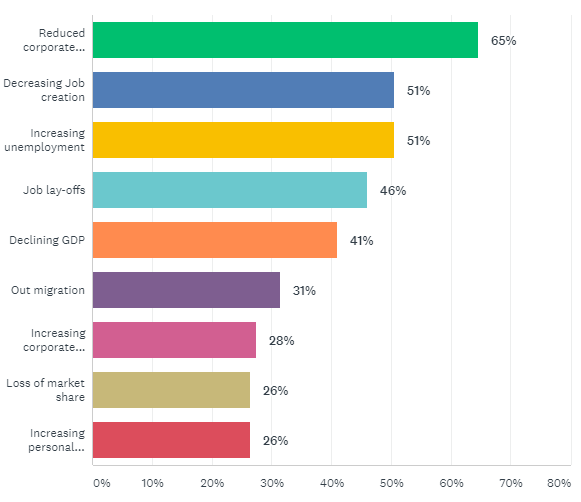
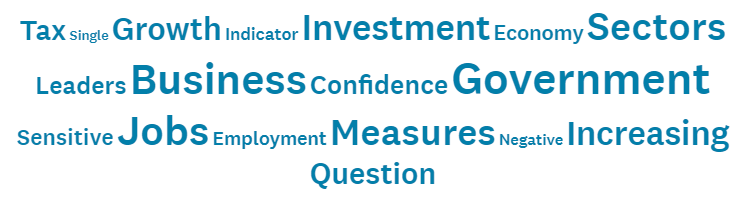
Reduced Corporate Investment and Employment/Job related indicators are most frequently and consistently cited as the most sensitive measures of Alberta’s economic resilience. That all indicators are down since the fall of 2016 may indicate increasing resignation particularly for Job layoffs and Increasing unemployment and Declining GDP.
The most sensitive (top 3) measures of resilience remain: Reduced corporate investment (65%, down 2%), Decreasing job creation (56%, down 5%), and Increasing unemployment (56%, down 14%)
Most sensitive/ variable measures compared with the fall of 2016: Job layoffs (46%, down 16%), Increasing unemployment (51%, down 14%), and Declining GDP (41%, down 11%)
Least sensitive/ variable measures remain: Out migration (31%), Bankruptcies: Corporate (28%) and Personal (26%), and Loss of market share (26%).
In the next section we investigate the economic resilience of Alberta’s various industries.
1 = Not …. 5 = Very
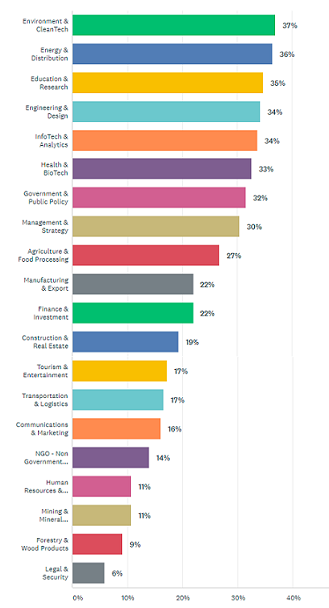
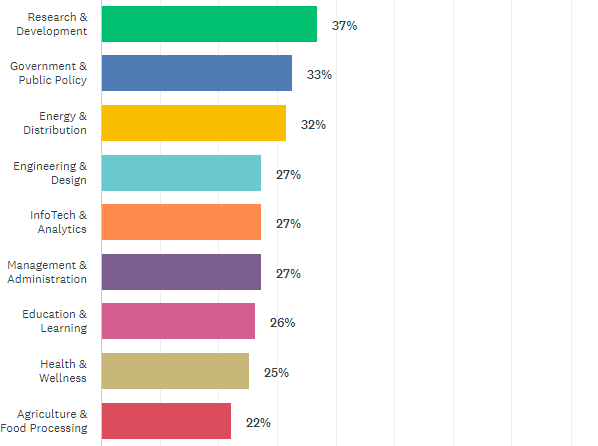
Q3. What 5 industries are of most interest to you?
Economic Resilience
Rank Fall ’17 v Fall ‘16
2.5
2.51
+34%
4
2.47
+24%
7
2.38
+18%
8
2.38
+17%
19
2.12
+ 9%
13
2.16
+ 9%
1
2.68
+41%
10.5
2.41
+10%
12
2.24
+15%
17.5
2.16
+ 9%
15.5
2.17
+15%
12
2.38
+ 5%
5
2.45
+25%
15.5
2.26
– 2%
2.5
2.67
+26%
17.5
2.23
+ 1%
10.5
2.40
+11%
9
2.35
+18%
20
1.94
-13%
6
2.45
+16%
Weak economic resilience (<3.00) is widespread across all Alberta industries with some improvement evident since the fall of 2016
The top 5 Alberta industries rated as the most resilient and the most improved since the fall of 2016 include: Government, Environment, Communications, Energy and Tourism.
The bottom 5 Alberta industries rated as the least resilient and the least improved since the fall of 2016 include: Forestry, InfoTech, Manufacturing, NGOs, and Transportation tied with Finance.
*The analysis is based on an assumption that respondents interested in an industry are aware of that industry’s economic resilience: capacity to invest, create and maintain employment, and avoid layoffs.
4
Q5. What role(s) are most appropriate for government to make Alberta more resilient?
Sep ‘16
63% – 0%
50% + 9%
49% – 6%
48% – 5%
25% + 13%
36% + 2%
31% – 0%
27% + 2%
13% + 8%
4% + 1%
Sep ‘17
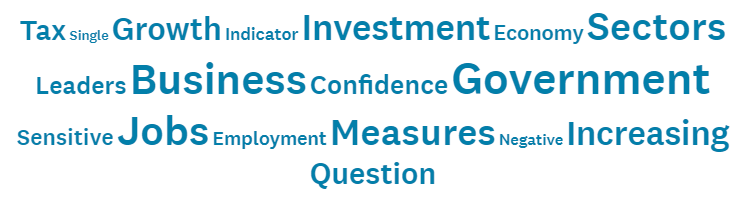
Comments Word Cluster
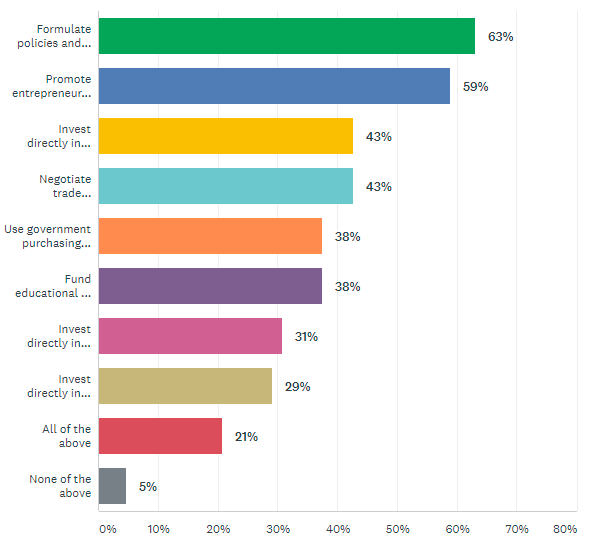
Respondents are consistent and largely in agreement in the appropriate roles for government.
Most agreement as appropriate: Formulate policies and employ incentives for encouraging small business innovation (63%) and Promote entrepreneurship and small business start-ups (59%).
Support equivalent (43%) for Invest directly in RESEARCH offering long term job creation and Negotiate trade agreements increasing access to markets for Alberta products and services.
Support is half as much for: Direct investing in Technology commercialization (31%) and PROJECTS offering immediate job creation (29).
Little deviation in the ranking of roles with the exception that 38% of respondents view Use government purchasing power to develop and attract businesses to Alberta, a 13% increase since the Fall of 2016, equivalent to Fund educational and training programs for ensuring that graduates can create new jobs.
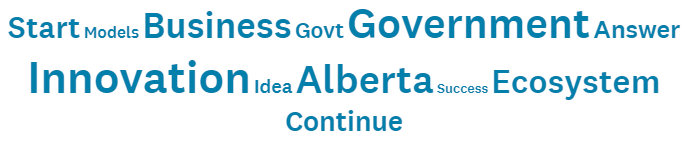
Sample Comments – A mix of recommendations for government policies, incentives and processes for: advancing innovation, entrepreneurship, mentorship, and management comprising Alberta’s innovation ecosystem.
It is the job of gov’t to step in where investors won’t take the risk… not where they will. (1-Calgary)
Lower taxes dramatically.(1-Calgary)
Reduce economic drag of government activity. (1-Calgary)
Invest indirectly in tech commercialization (1-Edmonton)
It is not possible to create jobs for all the new entries into the workforce for the next few years. The young people need to be told to move out of the Province. (1-Edmonton)
Land based regeneration through Public/Private partnership; Off-grid promotion to ensure independence and resilience of communities; balance reliance on external trade and internal resilience; connect health outcomes to industrial causes; promote local; abandon trade agreements (unintended consequences); rethink tourism; focus on pluralism; connect legislation and policy to actual outcomes by improving public feedback; rethink “jobs”; curtail “global market” thinking in favour of community sustainability (decentralization) until balance is achieved; rethink what is a “BIG IDEA”. (1-Edmonton)
Restore programs that help businesses hire recent graduate such as the former AFHMR Internship programs. (1-Edmonton)
I’m in favour of tax credits to encourage diversification and innovation but NOT direct grants. (1-Other)
Instead of all this spending, lower taxes and utility costs and improve transportation infrastructure to lower transport costs. (1-Other)
Formulate policies and employ incentives for encouraging ALL businesses to innovate. (2-Calgary)
Create a space that allows for innovation and diversification outside of O&G, or on the transition from O&G to cleaner hydrocarbons or renewable energy. Alberta is an energy economy – that doesn’t need to change. What must change is our reliance on oil revenues. We should be fostering diversity in our economic profile. (2-Calgary)
Alberta government research institutes still behave in a predatory fashion, and SME innovators are especially vulnerable. (2-Edmonton)
Invest directly in projects to help businesses develop export markets. (2-Edmonton)
There needs to be an innovation through to commercialization and diversification strategy. Integration of multiple currently disparate programs. Increased funding for initiatives that work. Termination quickly of initiatives not producing economic value. An order of magnitude fewer initiatives/programs and significantly more funding for those with proven results. (2-Edmonton)
Establish a competitive/attractive tax structure. (3-Edmonton)
Provide incentive to include retire senior involving in mentorship. (3-Other)
Ensure all elements in the entrepreneurial ecosystem have a good management system in place. (4-Edmonton)
Stop giving large contracts to out of country entities. (4-Edmonton)
Support more than just technology based businesses as innovative business models are just as valuable. (4-Edmonton)
Promote “new economy” ownership structures, like co-ops, and reduce this maximum extraction economic model. (4-Other)
Next we investigate the effectiveness of Alberta’s Innovation Ecosystem, but first –is the system essential for achieving diversifying the economy?
Q6. To achieve economic resilience/ diversification, Alberta needs an effective and continuously improving Innovation Ecosystem that supports the survival, growth and retention of Alberta’s entrepreneurs and SMEs. Do you agree?
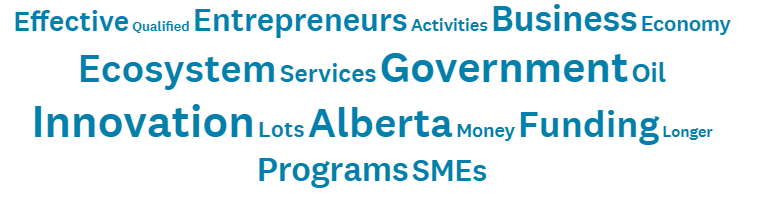
Comments Word Cluster
1 2 3 4 5
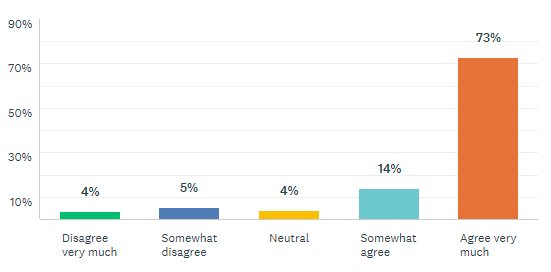
Strong agreement (87%) that Alberta needs an effective and continuously improving Innovation Ecosystem is needed that supports the survival, growth and retention of Alberta’s entrepreneurs and SMEs for achieving economic resilience/ diversification
Sample comments – Regardless of whether respondents agree with the need for an Innovation Ecosystem or not, concerns are raised about accountability, government involvement, expectations and value-for-money.
Ecosystems are great, but spending a lot of money to create them, offering grants that must be spent on other gov affiliated agencies, and having nothing left for the entrepreneur at the end of the day is not money well spent. (2-Edmonton)
The eco-system (gov and agencies) are agenda-driven and not accountable for real value add and jobs, with justification for their expenditures. (2-Calgary)
Innovation is important, but only one dimension for success in large business. Ecosystems and supply chain liaison is far more important to get products to markets. (3-Edmonton)
Agree just not sure Govt does this well. (4-Edmonton)
“Effective/Improving” needs to be accurately measured and monitored. (5-Edmonton)
As long as entrepreneurs and SME’s do NOT become dependent on gov’t programs to run their business. They MUST become self-sustaining in ~5 years. (5-Other)
Defining what an “Innovation Ecosystem” is, is fundamental. The government should support SME’s by providing flexible financing for their innovative work. The government is not innovative and should not be expected to vet or mandate innovation. They should rely on industry experts to identify viable projects that are not currently profitable and should stop funding large business’s R&D projects. (5-Edmonton)
Increase the length of time SME’s have before paying back business loans and with lower interest rates. Give the SME’s enough time to develop markets. (5-Calgary)
We need new technology in Alberta to cope with the changes we face due to a 2 deg low carbon future. (5-Other)
We need to start this culture with kids at a very young age. We can’t expect to see huge success in the short term. It has to be a long-term strategy. (5-Calgary)
Finally we investigate whether respondents view the current Innovation Ecosystem as effective or not.
Q7. Is Alberta’s Innovation Ecosystem effective in supporting the survival, growth, and retention of entrepreneurs and SMEs?
Fall 2016
32% 37% 27% 3% 0%
Word Cluster Comments
1 2 3 4 5
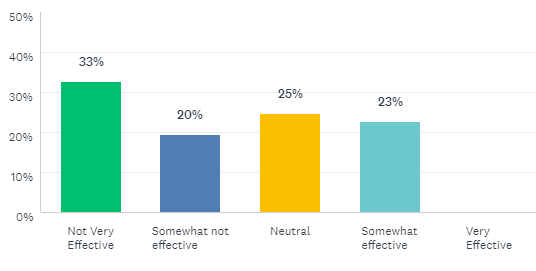
Respondents 2:1 do not view Alberta’s Innovation Ecosystem as Effective
No respondent rated the System as Very Effective
Since the fall of 2016 there has been an increase from 3% to 23% in respondents viewing the system as Somewhat Effective and a comparable decrease in those viewing the System as Somewhat not effective.
Sample Comments – Heavy critiquing of the Innovaition Ecosystem System is atrributed to it’s government affiliation
Entrepreneurs have to deal with the tremendous bureaucracy within AB and Canada. Lots of paper-work that prevents SMEs (with few staff) from taking advantage of the available opportunities. (1-Calgary)
Government does little to nothing to help foster diversity and small business growth. (1-Calgary)
Higher tax for enterprise and individual will push out of the entrepreneurs and SMEs. (1-Edmonton)
The mindset of the NDP Government lacks innovations and creativity-the Digital Transformation. (1-Edmonton)
Appointment of a czar to ensure strategies are implemented. Absolute accountability for measurable achievements are occurring. (1-Other)
Business cannot thrive and grow in an anti-business environment that exists in every level of government in Alberta. (1-Other)
Innovation funding is ok but no support for commercialization that actually creates jobs and provincial wealth. (2-Edmonton)
Current programs are well-intentioned but not well-run. The complex regulatory context at all levels creates too many challenging hurdles. There are some inter-jurisdictional conflicts that make initiating new products and services quite difficult. (3-Calgary)
There is a lot of activity and many successes and failures, which is natural. But a true cluster effect has not yet developed. There is very little government or industry focus on innovation. Primarily the innovation ecosystem is just a large active group of mostly startups. The post-secondaries are good, but don’t support the innovation system enough. IP should be freed up for more commercial benefit. (4-Calgary)
There is a fundamental problem with silo funding, i.e. municipally funded vs provincially funded vs federally funded support organizations not working under a unified vision. (4-Edmonton)
Share your love
KEI Network
KEI Network is a non-partisan platform connecting Alberta's experts, entrepreneurs, and leaders around the ideas shaping the province's future. Built on over 20 years and 15,000+ contacts across academia, government, and industry, it delivers reporting, events, and analysis without the spin.
From policy to emerging tech, KEI Network keeps you informed and connected to the people actually doing the work.





 Regional Breakdown (Resilience: 5 = Very, 1 = Not)