

Newsletter Subscribe
Enter your email address below and subscribe to our newsletter


ABCtech #179 03SEP13 The Intangible Economy by Robert McGarvey Throughout the turbulent 20th century economists knew one thing for certain; the most successful economies were the Developed industrial
ABCtech #179 03SEP13 The Intangible Economy
by Robert McGarvey
Throughout the turbulent 20th century economists knew one thing for certain; the most successful economies were the Developed industrial economies. Economists, accountants, business leaders and economic policy makers all agreed, real value was produced mechanically, largely in factories. The underlying assumption was, things of economic importance were derived from ‘real’ capital (tangible) assets producing measurable material outputs.
Our entire system of production, economic measurement and analysis including GDP and productivity analytics were industrially based. All our capital markets, banks and financial reporting standards were predicated on the industrial model.
And then, in the late 1970s, the world began to change. Microsoft was one of the first companies that broke the mold. Its software products were not tangible, were not produced in a factory and had no limits on how many copies could be produced. Oddly, a quick look at Microsoft’s financial reports (which did not include its software assets) showed no sign of the true potential of the most rapidly growing company of the last century.
Robert McGarvey is former managing director of Merlin Consulting, a London, U.K.-based consulting firm. Robert’s most recent book is Futuromics: A Guide to Thriving in Capitalism’s Third Wave. He has been an Executive Committee Member of the UK-based Economic Research Council (ERC) since 1991 (www.ercouncil.org). Robert currently is building protocols for intangible assets on the Board of TechInvest Alberta
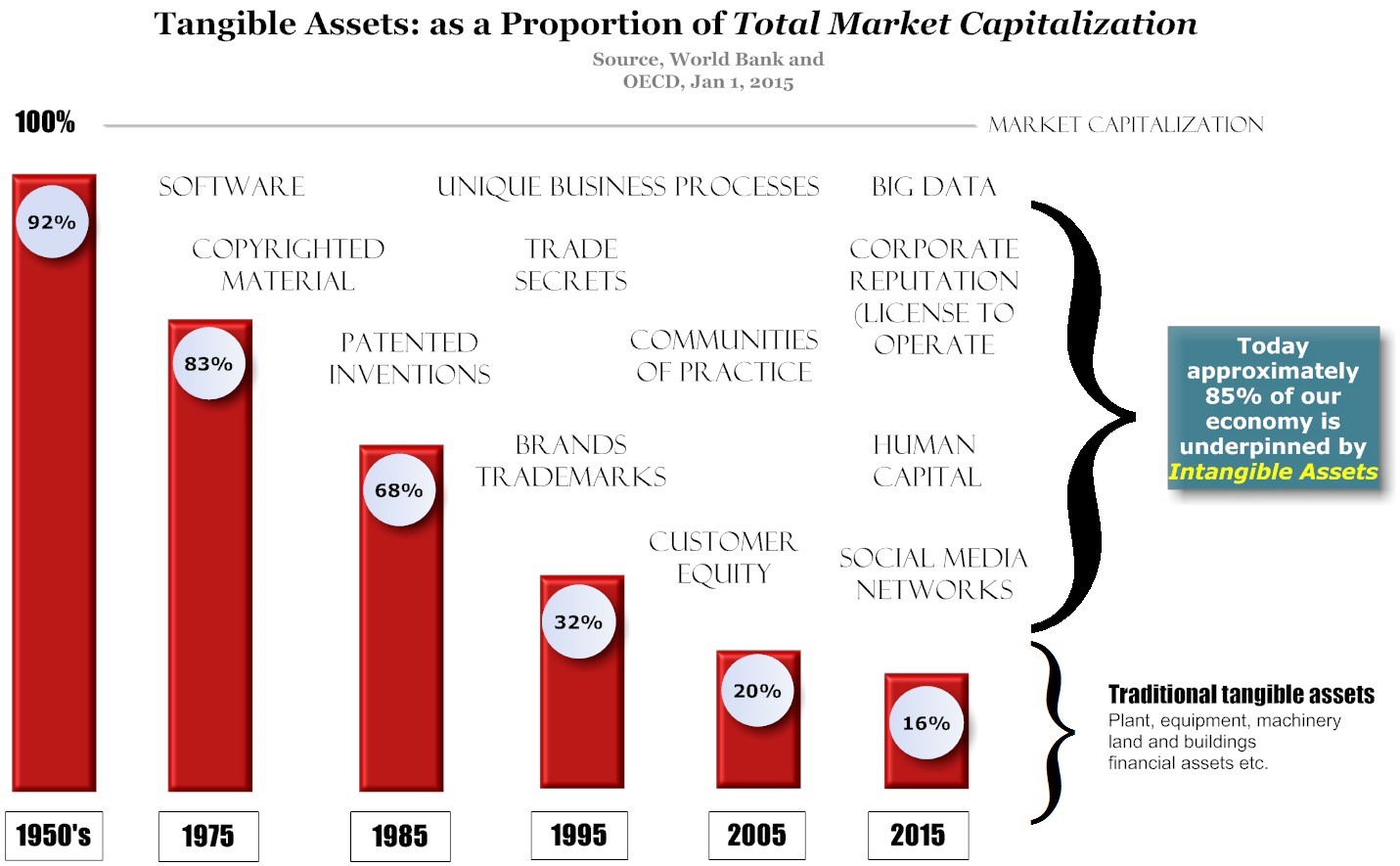
From that point until today, Developed economies have experienced a revolution in their engine of growth as something called ‘intangibles’ emerged to dominate the economy.
What are intangibles?
They’re non-physical value drivers like Microsoft’s software, they’re social media networks, intelligent algorithms or brands and productive ‘communities of practice’ and they’re completely different from physical capital of the industrial era. Intangibles are changing what value is, how it’s created, distributed and, in the process, intangibles are upending almost every so-called law of economics.
According to the OEDC, investment in intangibles is growing rapidly[1]. ” In some cases this investment matches or exceeds investment in traditional capital such as machinery, equipment and buildings. Intensified global competition, ICTs, new business models, and the growing importance of the services sector have all amplified the importance of intangible assets to firms, industries and national economies. ”
According to Wall Street analysts, Intangible sources of value now contribute more than eighty percent of GDP in many developed economies. While this newer intangible economy is growing, industrial-type manufacturing is in decline. Consider that between 1995 and 2002 developed economies in the West lost 22 million industrial jobs. In the last decade, the United States economy alone lost close to 25 per cent (four million) of its domestic manufacturing jobs. Yet, despite the shrinking of their industrial work forces, the output in these countries as a measure of GDP increased by half.
How does this new reality affect Alberta?
The rise of Intangibles impacts Alberta substantially. After fifty years of highly successful oil and gas development and residential property returns, Alberta’s capital markets need ‘tweaking’ in order to capitalize other, potentially high growth sectors of the economy. The question is, what can we do that might help direct capital to other sectors that drive value from intangibles, like technology rich start-up companies?
Capital flows in predictable patterns in an economy. Savings are mobilized for investment through debt and equity markets. Financial institutions, including banks, seek the highest returns with the greatest security. In Alberta’s past, the property and energy industries provided reliable returns and asset security based on their traditional tangible asset strength. The challenges today are to acknowledge intangibles and begin to restructure Alberta’s policy framework, institutional infrastructure and capital markets
TechInvest Alberta, an ABCTech partnership initiative
TechInvest Alberta Ltd. is developing a new investment ecosystem. Recognizing the importance of intangible assets, TechInvest plans to reinvented capital markets in Alberta. In the process TechInvest is developing a new commercialization platform that provides management with the insights, tools, management frameworks and capabilities to formally capitalize intangibles and optimize their organizations’ full asset potential.
Where do we start?
Visibility through measurement is a critical tool in the management of intangible assets. Although there is considerably misrepresentation and institutional resistance to the formal accounting treatment of intangible assets, many of the ‘Easier to Identify’ intangibles such as software, patented technologies, trademarks and brand assets are meeting the FASB (U.S. Financial Accounting Standards Board) and IASB (International Accounting Standards Board) standards and, as such, corporate managers need greater awareness and institutional support to identify and manage these valuable organizational resources to best effect.
The basic principles of intangible asset capitalization have been approved and beta tested in the market place in a variety of case studies in Alberta and elsewhere.
TechInvest is presently working with River City Credit Union (RCCU) and a variety of corporate and institutional organizations to integrate these processes with a new financing model. The object is to build an effective commercialization eco-system for Alberta companies.
Today, in the 21st century there is (again) one certainty – the past is no longer a reliable guide to the future. The rapidly changing economy of today now needs a new suite of institutions to support it and drive future value. TechInvest Alberta is taking the lead in building the new standards and developing new financing options for businesses in Alberta.